
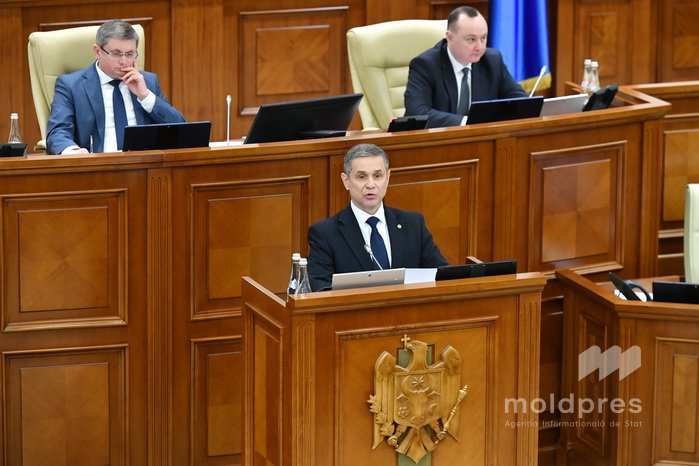
Defense Minister reports to Parliament: Defense investments important for security of Moldova
Defense Minister Anatolie Nosatîi stated today in the plenary of Parliament that the modernization of the National Army is an essential condition for maintaining peace and security in the Republic of Moldova. The statements were made during the debate on a motion submitted against the policies of the Ministry of Defense.

The official emphasized that peace is not guaranteed by default but must be built and defended through a prepared, well-equipped army made up of motivated servicemen. According to the minister, the war near the borders of the Republic of Moldova has demonstrated the need for investments in defense capabilities.

“Today I stand before you to answer a motion of no confidence. But this debate is also an opportunity to discuss a subject that goes beyond any political dispute: the security and defense of the Republic of Moldova. Peace does not appear by chance. Peace is built. Peace is maintained. Peace is defended,” Nosatîi said.

The minister highlighted the lessons of the war in the region and the need for a well-prepared army.

“To defend peace, we need an army that is trained, well equipped and made up of people motivated to serve under the flag of the Republic of Moldova. The war taking place at our border has offered a clear lesson to the whole of Europe. States that invest in defense capabilities protect their freedom, stability and prosperity,” the official noted.

Referring to the situation of the army in 2021, Nosatîi said:

“The army was suffering from chronic underfunding. Military infrastructure was degraded. Most military equipment dated back to the Soviet period. In some military units, soldiers had living conditions that did not meet even basic standards: faulty stoves, non-functional bathrooms, deteriorated buildings. Conscripts faced difficulties related to food, and basic products were missing from warehouses. Apart from camouflage uniforms, soldiers did not have modern individual equipment. The salary of a contract soldier was about 5,000 lei, and that of a sergeant about 6,000 lei—levels that could not ensure a decent living or motivation for a military career.”

The minister then presented the progress achieved:

“In these years we have built together, with the support of Parliament, the specialized Committee, and all MPs who voted for the reforms and the budget, a more modern, better equipped and better prepared army. We have reviewed the food system, updated nutrition standards, and modernized and diversified individual rations. Soldiers have received bulletproof vests, protective helmets, individual medical kits and modern protective equipment. We have introduced new capabilities for the National Army: drone operations and the development of electronic warfare. Military equipment has been modernized: Piranha and Humvee armored vehicles, logistics vehicles and transport equipment.”

The head of defense also stressed investments in military infrastructure:

“In 2020, the budget for capital repairs was about 16 million lei. Today it exceeds 360 million lei annually. This increase has allowed the renovation and construction of military facilities. A symbolic project for this transformation is Military Unit 136 in Băcioi, the first modern complex built from scratch for the National Army. By the end of 2026, the complex will include 46 functional facilities providing modern accommodation, training and logistics conditions.”

In conclusion, the minister underlined the care shown for servicemen:

“Modernizing the army also means caring for people. At the core of any army stands the person wearing the uniform. The salaries of contract soldiers have been increased, free lunch has been introduced, public transport for official duties has become free of charge, and the period of childcare leave is now counted toward the length of service required for a pension. Respect for the soldier means respect for the state.”

The parliamentary opposition submitted on February 19 a simple motion in Parliament against the policies of the Ministry of Defense, invoking serious shortcomings in the management of the institution, including with regard to the security of servicemen and the administration of public assets. The document was signed by 42 MPs.
 Facebook
 Instagram
 X/Twitter
 Telegram
Defense Minister: Institutions analyze every military death case with utmost seriousness, and I have personally committed to closely overseeing intensification of psychological support and monitoring activities
Air defense - strategic priority for Moldova, Defense Minister says
Crisis Cell: Several Moldovan citizens evacuated from Dubai via route organized by Romanian authorities
Authorities in Moldova and Ukraine coordinate actions to manage incident on Dniester River
VIDEO // Authorities intervene on Dniester early morning: filters installed and new water analyses
USMF "Nicolae Testemițanu" to launch bachelor’s program in Medical Cosmetics and Cosmetic Product Technology
GMI warns about fake website offering paid extension of temporary protection for displaced people from Ukraine
VIDEO // Pollution of Dniester under control: water supply restored in more north Moldova settlements; environment minister says there is no risk for Chisinau
VIDEO // Emergency intervention on Dniester: Moldovan environment minister monitors on site installation of barriers against oil slicks
Medical first in Moldova: living donor liver transplant performed using laparoscopic technique
VIDEO // Environment Minister: We installing capture filters to prevent pollution of Dniester
Crisis Cell - 40 citizens returned to country on Dubai–Chișinău flight
Drivers of vehicles registered in other states to be sanctioned for traffic violations on roads in Moldova
Environmental authorities of Moldova monitor oily patches noticed on Dniester River upstream from Naslavcea
VIDEO // Fake documents bearing Moldovan, Romanian, Italian emblems: illegal scheme dismantled by Moldova's Border Police
VIDEO // Three more dams to be installed on Dniester River; Moldovan environment minister says decision-makers take all necessary measures to have safe drinking water
Moldovan parliament speaker says citizens need to know that problem of Dniester River's pollution appears after Russia bombed Hydroelectric Power Plant in Ukraine
Environment minister says water quality improves in north Moldova settlements
VIDEO // Moldovan PM announces installation of additional filters on Dniester River: “Citizens' safety stays our priority''
Moldovans who worked legally in Canada, Moldova to be able to receive pensions from both states
Moldovan PM asks authorities, budgetary institutions to implement strict control of expenditures
 National Bank of Moldova
Moldovan deputy PM has meetings with senior European Union officials in Brussels
Speaker attends reception dedicated to Japan’s National Day
Moldovan government's secretary general country needs stronger mayoralties for communities' development
Moldovan PM meets two entrepreneurs developing successful businesses in Causeni
Moldovan PM visits two major projects completed in Causeni with government's support

VIDEO // Second protective boom set on Dniester; Moldovan environment minister says teams ready to intervene, if oil slicks appear
VIDEO // Construction works at Chisinau, Vulcanesti substations advance: major equipment delivered, set
Moldova to host Black Sea Region Security Conference under aegis of International Crimea Platform
Servicemen intervene in north Moldova district to manage pollution of Dniester River
Romania pledges experience sharing, support for Moldova’s EU accession
Moldovan PM announces requesting of activation of EU Civil Protection Mechanism, in context of situation on Dniester
Romanian Language Day to be marked in Ukraine; Moldovan president says Romanian language unites people on both banks of Prut, all the way to Chernivtsi
Moldovan Interior Ministry, Education Ministry launch joint action plan to prevent drug use, trafficking among pupils, young people
CNMC decided to create joint crisis cell with specialists from national institutions and experts from neighboring countries in context of water pollution in Dniester
VIDEO // Authorities raise alert level after Dniester River water pollution: laboratory tests show exceeding of permitted limits
Parliament backs Moldova’s withdrawal from Treaty protecting fossil fuel investments
Foreign Ministry: 28 Moldovan citizens requested consular assistance in Middle East
VIDEO // Citizens can check in real time gasoline and diesel prices and stocks of fuel stations across country
Moldova aligns with global standards: joining Agroecology Coalition opens path toward modern and resilient agriculture
Ministry of Energy: On 12 March, fuel imports through Giurgiulești Port increased significantly
Speaker attends reception dedicated to Japan’s National Day
Receive the latest news directly to your email

Receive the latest news directly to your email