
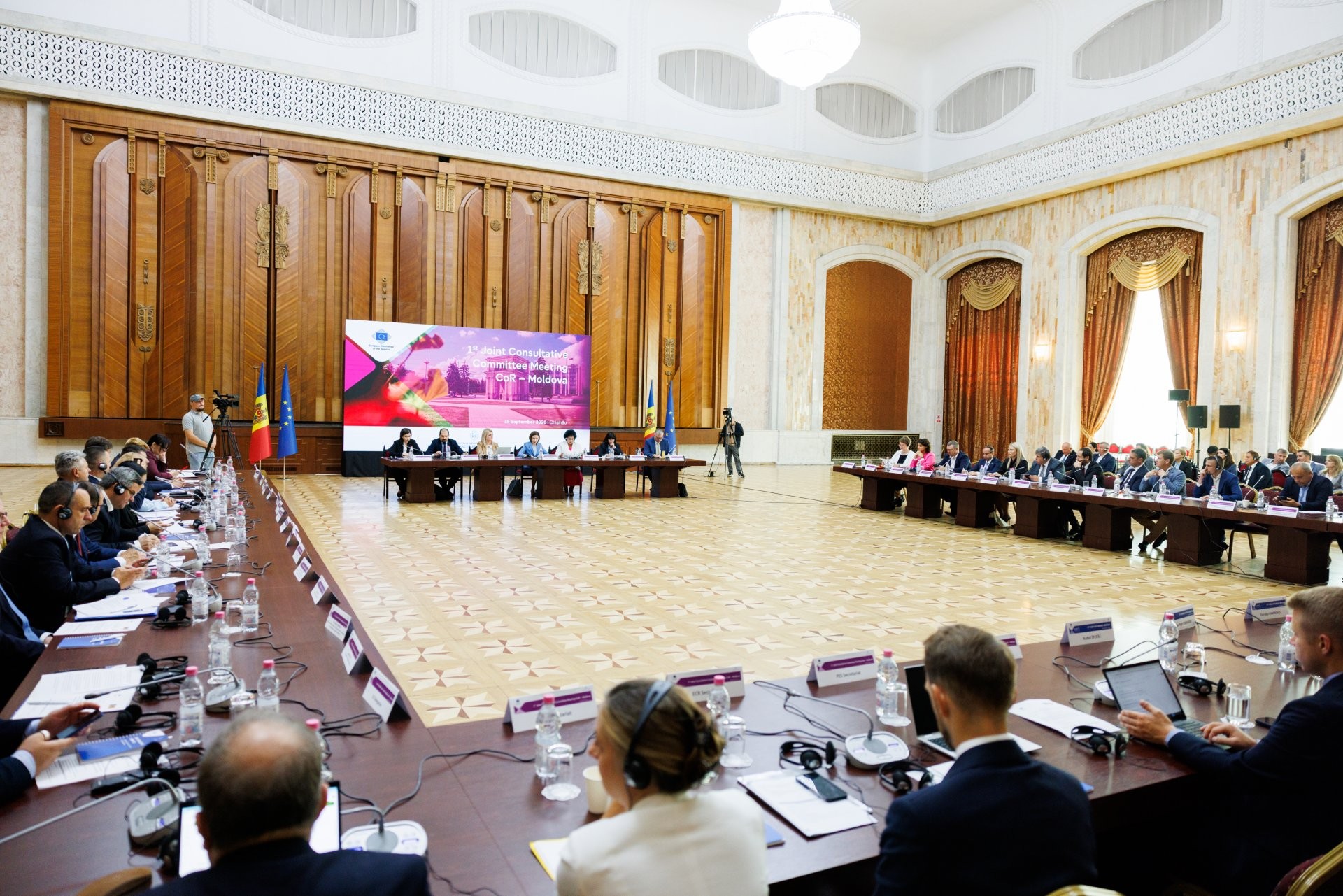
Republic of Moldova and European Committee of Regions strengthen cooperation for stronger communities prepared for EU accession
Local public administration reform, strengthening the capacity of city halls and preparing communities to harness the opportunities offered by accession to the European Union were the focus of the first meeting of the Joint Consultative Committee between the Republic of Moldova and the European Committee of the Regions, held today in Chișinău.

The opening of the meeting was attended by President of the Republic of Moldova Maia Sandu, Deputy Prime Minister for European Integration Cristina Gherasimov, Government Secretary-General Alexei Buzu, as well as representatives of the Government, the European Committee of the Regions, local and regional public authorities and development partners.

Maia Sandu emphasized that strong local authorities with efficient teams, sufficient resources and necessary tools are essential for community development and for transforming the opportunities offered by European integration into concrete improvement for citizens. “We are not carrying out the reform for the sake of reform. We are doing it to achieve results that will give people confidence in both the present and the future of the communities where they live or where we want them to return,” Maia Sandu said.

The head of state praised the efforts of mayors and local representatives involved in the voluntary merger process and reiterated her commitment to supporting the development of localities so that resources can be directed toward their priorities—access to water and sewerage, better roads and higher-quality public services.

Strengthening the capacity of local administrations is also essential for harnessing the opportunities offered by accession to the European Union. Currently, more than 192 projects are being implemented through five European programs, worth nearly €41 million, with 79 local public authorities as direct beneficiaries.

During the session dedicated to the European Union accession process, Deputy Prime Minister for European Integration Cristina Gherasimov highlighted the important role of local authorities in preparing the Republic of Moldova to become an EU member state. “For citizens, European integration will be measured by what changes in their communities: public service quality, better roads and transport, cleaner water, improved waste management, more digital services, new opportunities for businesses and jobs, and ultimately, a better quality of life. Local authorities are not simply beneficiaries of European integration. They are actors in the accession process,” Gherasimov noted.

An important part of the meeting was dedicated to local public administration reform. Alexei Buzu said that 561 city halls or 63% of the total have already adopted final decisions on voluntary amalgamation, while the next stage will focus on strengthening the new administrations, including through integrated and digitalized services, qualified personnel, and a greater capacity to attract investment and European funds.

“The purpose of the reform is for city halls to become stronger, capable of attracting resources, developing new projects, and implementing them. Everything we do starts from the interests of citizens. We must have the courage to engage in difficult discussions, go into communities, and explain this reform to people,” Buzu said.

The Government will continue to support communities in the process of strengthening their administrations through financial incentives and measures to enhance administrative capacity, so that the new city halls can become development centers for their communities.

Participants also discussed the experience of EU member states and other partner countries in public administration reform, as well as solutions that could be applied in the Republic of Moldova to strengthen local democracy and the administrative and financial capacity of local public authorities.

The Joint Consultative Committee between the Republic of Moldova and the European Committee of the Regions creates a permanent framework for dialogue and cooperation between local and regional authorities in the Republic of Moldova and those in the EU. The platform will facilitate the exchange of experience and best practices, contribute to strengthening the capacity of local administrations to implement European policies, and ensure that the Moldovan communities' voice is represented in the European dialogue.
 Facebook
 Instagram
 X/Twitter
 Telegram
Parliament approves draft law on expanding access to cadastral information and regulating land readjustment
Clearer rules on when horticultural plantations begin bearing
Prime Minister discusses fiscal-budgetary priorities and economic reforms with IMF Resident Representative
Prime Minister attends opening of Meeting of Romanian National Theatres
Moldovan PM announces concept for deregulation, simplification of inspections
New ways to advance Moldova-Bulgaria relations on agenda of discussions between Moldovan foreign affairs minister and Bulgarian MPs
Moldovan PM has phone conversation with Dutch counterpart
Moldovan PM visits Superior Council of Magistracy
Speaker: Moldova must become relevant security provider in Europe
Government approves plan on preparing for 2026–2027 heating season
President attends state funeral of King Harald V of Norway
Strengthening transparency in public procurement – new measures approved by Government
Government simplifies authorization of renewable energy projects and sets new rules for biofuel market
Prime Minister discussed next steps in Moldova’s EU accession with European Commissioner
Moldovan Prime Minister holds talks with farmers to simplify activities in sector
Joint Consultative Committee Meeting // Government Secretary-General: Government preparing stronger city halls to access European funds
Joint Consultative Committee Meeting // Deputy Prime Minister: Closer we get to EU, more urgent it is to achieve good results at local level
VIDEO // Consumers to be able to compare natural gas and electricity suppliers’ offers in one place
President at Joint Consultative Committee Meeting: Every locality should be able to contribute to European Moldova we are building together
LIVE // Communities as active part of European integration process
PHOTO // Exhibition dedicated to Michael Davitt and discussion about Dracula, cultural projects discussed at National Library with Ireland’s Ambassador
 National Bank of Moldova
President attends inaugural meeting of Joint Consultative Committee between European Committee of Regions and Moldova
Moldovan Prime Minister holds talks with farmers to simplify activities in sector
Delegation of Parliamentary Friendship Group with Turkmenistan of Parliament of the Republic of Moldova pays working visit to Ashgabat
Moldovan parliament speaker has meeting with Slovenian counterpart
Stronger local administrations for European living standards in communities: European local, regional authorities convene in Moldovan capital

ARMENPRESS: Armenia’s EU membership is “absolutely” possible, Polish official says
Moldova, Ukraine continue negotiations on water discharge from Novodnistrovsk reservoir
PHOTO // Moldovan parliament speaker in Ljubljana says Slovenia’s experience on road to EU valuable lesson for Moldova
Moldovan parliament speaker has meeting with Slovenian counterpart
PHOTO GALLERY // Chisinau hosts annual meeting of Conference of Regional and Local Authorities for Eastern Partnership
Interferon medication, unavailable at Oncology Institute from Chisinau, to be available as of September 15, Health Ministry says
Implementation of Growth Plan advances; Moldovan government prepares new package of projects to attract investments worth 2 billion euros
Prosecutors seek six-year prison sentence for former PM in Chisinau airport's concession case
Grants worth over one million euros to develop Moldova’s innovation ecosystem with EU support
Annual meeting of Conference of Regional and Local Authorities for Eastern Partnership held in Chisinau
Moldova’s airspace violated again: drone enters from direction of Ukraine
Stronger local administrations for European living standards in communities: European local, regional authorities convene in Moldovan capital
Drone briefly entered airspace of Moldova near Palanca
Moldovan parliament speaker in Istanbul discusses Moldova-Turkey relations, elections in Gagauzia
Prime Minister in dialogue with business community: less bureaucracy, clear rules and more investment
National weightlifting team wins 26 medals at World University Championships in Doha
Receive the latest news directly to your email

Receive the latest news directly to your email