
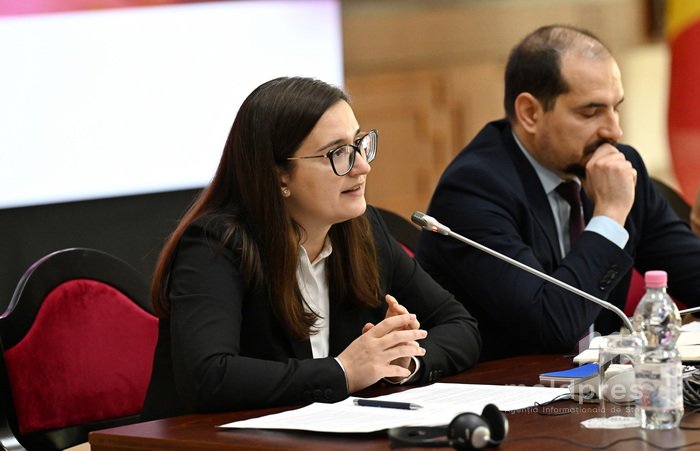
Joint Consultative Committee Meeting // Deputy Prime Minister: Closer we get to EU, more urgent it is to achieve good results at local level
Local authorities’ involvement in the European integration process must become deeper, more systematic, and more implementation-oriented, Deputy Prime Minister for European Integration Cristina Gherasimov said at the launch of the Joint Consultative Committee between the Republic of Moldova and the European Committee of the Regions.


“The closer we get to becoming part of the European Union, the more urgent it is to achieve good results at the local level and improve citizens’ lives. Most of the European acquis is implemented at the local level, and European citizens judge the success of integration by the changes they see in their communities – better public services, roads, water and sewerage systems, business opportunities, and jobs,” Cristina Gherasimov said.


The Deputy Prime Minister noted that local authorities are not only beneficiaries of the European integration process, but also key actors in preparing communities for accession. In this context, the objective is to strengthen administrative and fiscal capacities, accelerate digitalization, and, in particular, prepare local administrations to use European funds efficiently.


“We need to prepare local authorities not only to understand European regulations, but also to understand the changes that EU membership will bring and the opportunities communities will have – from infrastructure and healthcare services to education and economic development. Following the screening process and consultations with local authorities, we identified a series of objectives that need to be achieved in order to strengthen local public administration,” the official said.


Cristina Gherasimov stressed that the new Joint Consultative Committee will bring European experience and expertise closer to the local level and help strengthen ties between authorities in the Republic of Moldova and those in EU member states.


“Mayors and local representatives are closest to citizens; they know best what works and what people expect. They are key actors not only in implementing changes, but also in explaining the European integration process and the concrete results it can bring to every community. European integration is not only about Chișinău and Brussels, but about the involvement of every community. This Joint Consultative Committee is not merely another formal dialogue platform; it will help us become EU members in the future,” Cristina Gherasimov concluded.


President Maia Sandu emphasized that local public administration plays an essential role in community development and in the Republic of Moldova’s European path. In her view, closer ties with the European Union must produce concrete results for citizens, including better public services and improved living conditions.


“Moldova, our regions and our localities have lost a large part of their population because living standards did not meet people’s expectations and were not at the same level as the living standards they found elsewhere. This population decline led to lower revenues for local authorities, creating a major problem that must be stopped. We must halt these trends by creating better living conditions for the population and increasing the resilience of local authorities. To achieve this, we need appropriate public administration structures equipped with adequate budgets. This is the objective of the administrative-territorial reform currently being implemented in the Republic of Moldova,” the President said.


The Joint Consultative Committee between the Republic of Moldova and the European Committee of the Regions (CoR) is holding its first meeting in Chișinău today, marking a new stage in cooperation between local and regional authorities from the Republic of Moldova and those from the European Union. The meeting is attended by representatives of the European Committee of the Regions from Brussels and Strasbourg, mayors and district presidents from the Republic of Moldova, as well as representatives of local authorities from Ukraine.
 Facebook
 Instagram
 X/Twitter
 Telegram
Republic of Moldova and EU open accession negotiations today for Cluster 6
EU grants Moldova additional 120 million euros to strengthen defense
Republic of Moldova opens accession negotiations with EU for External Relations Cluster
Acting Prime Minister welcomes European Parliament report on Moldova
European Parliament report welcomes Moldova’s progress
Speaker after European Parliament vote on Report on the Republic of Moldova: Moldova moves forward. Step by step, ever closer to European Union
European Parliament calls for opening all negotiation clusters with Moldova: report backed by large majority
VIDEO // European Commissioner calls for opening all negotiation chapters on Moldova’s EU accession
Moldova to present position to European Union on External Relations Cluster
Speaker attends conference of speakers of EU candidate countries
VIDEO // Cristina Gherasimov visits Berlin: European integration and cooperation with Germany on agenda
EU–Moldova Summit // European leaders reaffirm Moldova's future in European Union: “Reforms open the door to accession”
European Council President says European Union to support Moldova every step of way towards EU accession
EU–Moldova Summit // Deputy Prime Minister: We are discussing how we can advance more quickly based on our own merits
Natural gas prices on European exchange continue to rise; energy minister says international energy crises directly affect Moldova
EU Ambassador: EU remains firmly committed to supporting justice reform in Moldova
President at Forum on justice reform and fighting corruption: Building rule of law most complicated commitment in EU accession program
Government approves ratification of agreement on construction of bridge over Prut River and first highway section in Moldova
Republic of Moldova to receive €4.3 million grant to strengthen capabilities of National Army
Energy communities – new legal form of organization for everyone who produces, consumes, stores energy together
President at Justice Reform and Combating Corruption Forum: Judicial independence requires integrity and accountability
 National Bank of Moldova
Investments in energy efficiency of public buildings exceeded €348 million in 2019–2025
Agreement between Moldova and Romania to continue construction of Ungheni–Ungheni bridge and modernize road infrastructure
Republic of Moldova to receive €4.3 million grant to strengthen capabilities of National Army
Energy communities – new legal form of organization for everyone who produces, consumes, stores energy together
President at Justice Reform and Combating Corruption Forum: Judicial independence requires integrity and accountability

Republic of Moldova among countries in EU enlargement perspective
Moldova to launch e-Consulate system, to modernize delivery of consular services for Diaspora citizens
Special access measures at Chișinău Airport remain in effect by 17 September
VIDEO // Justice reform and fight against corruption - focus of discussions at international forum in Chișinău
Moldovan Railways state enterprise to be reorganized by late 2026
Investments of 326 million lei to modernize heating systems in Chișinău and 17 million euros for those in Bălți
Modernization works for district heating systems of Chisinau, Balti cities to be declared projects of national public utility
Ministry of Economic Development and Digitalization has new state secretary
Government appoints new directors at SFS, CNAM, APP, AIPA
Government announces new appointments to State Tax Service, APP, CNAM, AIPA
European Parliament approves temporary trade liberalization measures for Armenian products
Open Government Action Plan 2026–2028: Parliament Secretariat and civil society discussed future commitments
Companies from both banks of Dniester explore Romanian market to identify new opportunities for business expansion
ARMENPRESS // EUSR Grono: I do not contest past Armenian presence, rich cultural footprint in Karabakh
Moldovan parliament speaker meets Slovenian president, other high-ranking officials in Ljubljana
Moldovan deputy PM for reintegration pays working visit to Stefan Voda district
Receive the latest news directly to your email

Receive the latest news directly to your email