
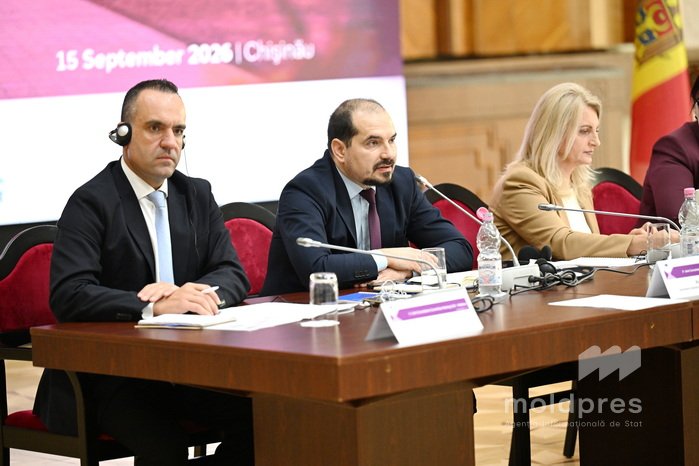
Joint Consultative Committee Meeting // Government Secretary-General: Government preparing stronger city halls to access European funds
Local public administration reform is necessary because of population decline, limited financial resources and the excessive fragmentation of the administrative system, Government Secretary-General Alexei Buzu told the Joint Consultative Committee Meeting between the European Committee of the Regions and the Republic of Moldova. The official presented the reasons for the reform, the steps taken so far and the measures the Government intends to implement.

Alexei Buzu said that the reform is complicated, and stressed that the reasons for launching it must be explained.


“Any reform of this kind is contested, but we must understand why we are carrying out this reform. I want to say that censuses were held in the Republic of Moldova in 2014 and 2024. The country’s average population declined by approximately 14% between 2014 and 2024. In city halls with fewer than 3,000 inhabitants, the population declined by 32%, by 32.7%, so practically 33%. One-third of the population has disappeared from these localities,” Buzu said.


According to the Government Secretary-General, the demographic problem is accompanied by the limited financial capacity of local public authorities. He noted that nationwide, the own revenues of first-level local public administrations account for approximately 11%.


“If we exclude the effects of inflation in recent years, in real terms, own revenues in Moldova’s city halls are declining. Every year, there are fewer own revenues. In the European context, own revenues per capita in the Republic of Moldova amount to approximately 23 euros. In Kosovo, they amount to 61 euros per capita. In Bosnia, 100 euros per capita. In Albania, 140 euros per capita,” the official said.


Buzu also highlighted disparities in access to basic services, noting that small localities account for a large share of households without access to water and sewerage.


“In the Republic of Moldova, eight out of ten families without water and sewerage live in municipalities with fewer than 3,000 inhabitants. This is not a mere coincidence; it is a structural factor,” Alexei Buzu said.


At the same time, he rejected the idea that the problems faced by local administrations are caused by the work of local representatives.


“This is not the fault of local representatives, of the absolutely phenomenal mayors whom I have known for years and whom I have come to know even better over the past year. We have strong mayors in the Republic of Moldova, but we also have weak city halls. Why? Because we have a capacity problem, a resource problem, because we have an extremely fragmented system,” Buzu said.


According to the official, the reform primarily aims to strengthen first-level local public administration so that city halls have sufficient teams and resources to manage services and projects.


“We need to solve this capacity problem and resource problems. First of all, we want to strengthen the first administrative level, to have stronger city halls with more resources, to bring teams together, to ensure we no longer have teams of four or five people, but larger teams in which we can have specialization in areas such as public procurement, projects, service management and so on. But this means bringing together,” he explained.


For the second level of local public administration, the Government proposes a role focused on support and cooperation between city halls, without overlapping their responsibilities.


“For the second level, we propose narrowing mandate so that it does not provide any services or interfere with the work of city halls, but is structured as a support mechanism. When city halls need to cooperate better or develop joint projects, this could be the value of the second level,” Buzu said.


He announced that the Government had finalized the division of responsibilities between the levels of local public administration, and that the documents would soon be presented and submitted for consultation.


“We have finalized this division of responsibilities within the Government. We will present them shortly and will certainly debate and consult on them,” he said.


Regarding voluntary amalgamation, Buzu said that the process had been initiated by the Government and that a large number of city halls had decided to participate.


“We are very pleased that 85% of city halls have initiated this process, while 63% of all city halls in the country have adopted final decisions. This accounts for approximately 65% of city halls with fewer than 3,000 inhabitants,” he said.


The Government is currently working on the statutory amalgamation stage, involving more than 250 city halls. Buzu said that the process is accompanied by consultations with local representatives and citizens.


“I want to say that we go to every city hall and every locality and hold discussions. To date, we have held more than 2,000 discussions with our local colleagues and more than 1,000 public consultations with citizens,” he said.


According to Buzu, the Government intends to prepare the legislative package on the reform this autumn, including the new administrative-territorial map.


“We will prepare the legislative package this autumn. This legislative package will include the new administrative map, level one and level two. We will finalize the statutory amalgamation process by late September, so the draft law should also be ready around that time. We will debate this legislative package on the Government platform; it will be voted on by the Government, then sent to Parliament, where it will also be debated,” he said.


Buzu said that the objective is for the reform to be approved this autumn, approximately one year before the 2027 local elections.


“It must be approved this autumn, approximately one year before next year’s local elections,” the official said.


At the same time, the Government is working with localities that have undergone voluntary amalgamation and plans three types of incentives for those communities.


“The preparation incentive is being provided this year, and more than half of the city halls are already benefiting from it. We are processing the applications for the remaining city halls,” Buzu said.


According to him, the second incentive will be prepared by the end of the year and will represent on average approximately 55–60% of the 2026 budget of amalgamated city halls. It is expected to be granted starting in 2027, while from 2028 the respective communities are expected to benefit from the third incentive for three years.


“We will work until the end of the year and finalize these projects. Incentive 2 is equivalent to approximately 55–60%—and I am referring to certain averages—of the 2026 budget for amalgamated city halls. We will work on the projects with the intention that in 2027 those city halls will benefit from incentive number two, while starting in 2028, they will benefit from incentive number three for three consecutive years,” Buzu explained.


Another objective of the reform is the digitalization of local public administration. He said that digitalization remains insufficient in many city halls and that some successful practices are still exceptions rather than the norm.


“One problem faced by local public authorities is that their work is not digitalized. There are some exceptions where digitalization has indeed penetrated more deeply into the work of city halls. For example, I spoke with our colleagues from Leova and learned that they have a good experience. The one-stop shop is not a common practice; once again, it is more of an exception than a normal practice,” Buzu said.


The Government also intends to invest in the professional training of employees in the new administrations and in their capacity to attract funding.


“We will work on these aspects, we will work on restructuring the new teams, and we will invest heavily in certification programmes in public procurement and project development. So, we will have certification in this area. We will also work on developing project portfolios. We are preparing and doing our homework,” he said.


Buzu said that the new system is scheduled to enter into force with the 2027 local elections, and one of the main challenges is to ensure that the transition does not cause major disruptions to the work of the administrations.


“It will enter into force with the 2027 local elections. That will be the main challenge. First of all, we must ensure that there are no massive disruptions and that the shock cost of the reorganization is absorbed quickly, allowing the new, stronger and more capable municipalities to focus on developing and implementing projects. In short, that is the purpose of the reform,” Buzu stressed.


The official stressed the need for direct communication with citizens throughout the process of reforming local public administration.


“All activities, as I have already said, start from the interests of citizens, and yesterday I mentioned the lesson that local representatives offer to all of us. We should follow their courage and their sense of responsibility, avoid difficult discussions and not shy away from citizens. We should go and explain things to them. When we discuss this reform, we should indeed call things by their name and not tell only half-truths; we should tell the whole truth,” the Government Secretary-General concluded.
 Facebook
 Instagram
 X/Twitter
 Telegram
Republic of Moldova opens accession negotiations with EU for External Relations Cluster
Acting Prime Minister welcomes European Parliament report on Moldova
European Parliament report welcomes Moldova’s progress
Speaker after European Parliament vote on Report on the Republic of Moldova: Moldova moves forward. Step by step, ever closer to European Union
European Parliament calls for opening all negotiation clusters with Moldova: report backed by large majority
VIDEO // European Commissioner calls for opening all negotiation chapters on Moldova’s EU accession
Moldova to present position to European Union on External Relations Cluster
Speaker attends conference of speakers of EU candidate countries
VIDEO // Cristina Gherasimov visits Berlin: European integration and cooperation with Germany on agenda
EU–Moldova Summit // European leaders reaffirm Moldova's future in European Union: “Reforms open the door to accession”
European Council President says European Union to support Moldova every step of way towards EU accession
EU–Moldova Summit // Deputy Prime Minister: We are discussing how we can advance more quickly based on our own merits
Moldovan, Polish officials discussed next steps for Moldova on path to EU accession
VIDEO // Justice, anti-corruption and strong institutions priorities in negotiations with EU
Moldovan Prime Minister holds talks with farmers to simplify activities in sector
Joint Consultative Committee Meeting // Government Secretary-General: Government preparing stronger city halls to access European funds
Joint Consultative Committee Meeting // Deputy Prime Minister: Closer we get to EU, more urgent it is to achieve good results at local level
VIDEO // Consumers to be able to compare natural gas and electricity suppliers’ offers in one place
President at Joint Consultative Committee Meeting: Every locality should be able to contribute to European Moldova we are building together
LIVE // Communities as active part of European integration process
PHOTO // Exhibition dedicated to Michael Davitt and discussion about Dracula, cultural projects discussed at National Library with Ireland’s Ambassador
 National Bank of Moldova
President attends inaugural meeting of Joint Consultative Committee between European Committee of Regions and Moldova
Moldovan Prime Minister holds talks with farmers to simplify activities in sector
Delegation of Parliamentary Friendship Group with Turkmenistan of Parliament of the Republic of Moldova pays working visit to Ashgabat
Republic of Moldova and European Committee of Regions strengthen cooperation for stronger communities prepared for EU accession
Moldovan parliament speaker has meeting with Slovenian counterpart

ARMENPRESS: Armenia’s EU membership is “absolutely” possible, Polish official says
Moldova, Ukraine continue negotiations on water discharge from Novodnistrovsk reservoir
PHOTO // Moldovan parliament speaker in Ljubljana says Slovenia’s experience on road to EU valuable lesson for Moldova
Moldovan parliament speaker has meeting with Slovenian counterpart
PHOTO GALLERY // Chisinau hosts annual meeting of Conference of Regional and Local Authorities for Eastern Partnership
Interferon medication, unavailable at Oncology Institute from Chisinau, to be available as of September 15, Health Ministry says
Implementation of Growth Plan advances; Moldovan government prepares new package of projects to attract investments worth 2 billion euros
Prosecutors seek six-year prison sentence for former PM in Chisinau airport's concession case
Grants worth over one million euros to develop Moldova’s innovation ecosystem with EU support
Annual meeting of Conference of Regional and Local Authorities for Eastern Partnership held in Chisinau
Moldova’s airspace violated again: drone enters from direction of Ukraine
Stronger local administrations for European living standards in communities: European local, regional authorities convene in Moldovan capital
Drone briefly entered airspace of Moldova near Palanca
Moldovan parliament speaker in Istanbul discusses Moldova-Turkey relations, elections in Gagauzia
Prime Minister in dialogue with business community: less bureaucracy, clear rules and more investment
National weightlifting team wins 26 medals at World University Championships in Doha
Receive the latest news directly to your email

Receive the latest news directly to your email