
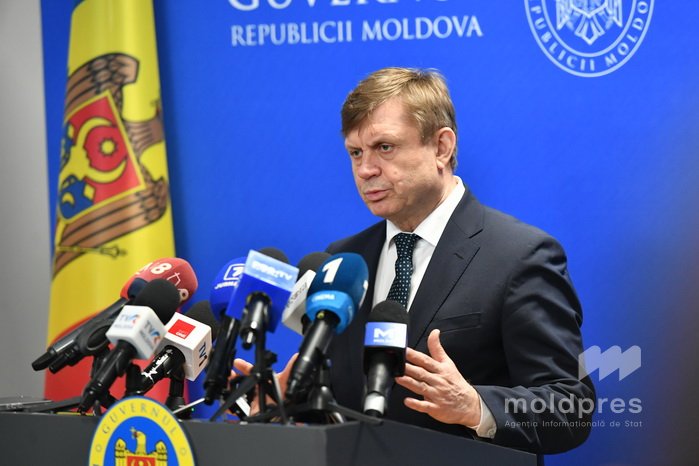
Moldovan deputy PM for reintegration says gradual elimination of tax exemptions provided to economic agents of Transnistrian region to allow unifying fiscal space
The gradual elimination of tax exemptions provided to economic agents of the Transnistrian region will allow the unification of the fiscal space throughout the entire territory of the country. Deputy Prime Minister for Reintegration Valeriu Chiveri today made statements to this effect, after Tiraspol had asked Chișinău to abandon the new tax provisions.

The official stressed that the legislative amendments had gone through all legal procedures, with transparency ensured.

“Parliamentary hearings were held, to which economic agents from the left bank of Dniester were also invited. These changes are about people, first and foremost, and not about taxes and funds, and they will allow us to unify the fiscal space across the entire territory of the country,” noted Valeriu Chiveri.

Through the approved amendments, the authorities aim to eliminate existing differences and ensure equal conditions for all economic agents of Moldova. The first measures will be applied this year, when certain tax exemptions for non-essential products, such as alcohol, will be removed. Subsequently, the import and sale of these products in the Transnistrian region will be subject to value added tax  (VAT) and excise duties, just like in the rest of the country.

The draft also provides for the removal of certain tax facilities for the delivery of balancing electricity and natural gas, as well as the harmonization of import-export rules for economic agents from the left bank of Dniester. Full implementation of the reform is planned by 2030. According to estimates, these measures could bring additional revenues to the state budget.

In the context of the reform, the authorities will also create a Convergence Fund, aimed at reducing economic disparities between the two banks of Dniester. The resources will be used for infrastructure projects, support for the business environment and social programmes.

The authorities intend for these measures to contribute to the country’s economic reintegration and to bring the Transnistrian region closer to European standards.
 Facebook
 Instagram
 X/Twitter
 Telegram
VIDEO // Ukrainian president says Ukraine, Moldova moving together towards EU, strengthening their security cooperation
Moldova ready to help rebuild Ukraine; Moldovan president Kyiv says Ukraine's recovery shared responsibility of Europe
Moldovan parliament speaker conveys message on 40 years since Chernobyl catastrophe
Moldovan president pays visit to Kyiv, Chernobyl
DOC // EU sanctions extended until 2027: Moldova updates list of targeted individuals
DOC // State of emergency in energy sector ends in Moldova
New local elections in south Moldova settlement: residents to elect mayor on November 1, 2026
PHOTO // Deputy Prime Minister at Delphi Economic Forum: Moldova wants to become full-fledged EU member state
Speaker about possible denunciation of Treaty of Friendship and Cooperation with Russia: We should act with caution
Mark Tkaciuk left parliamentary faction of Alternative Bloc
Speaker after Plahotniuc’s conviction: Logically, there must follow other episodes involving other people as well
Speaker about possible resignations at Interior Ministry
Prime Minister in Parliament: State of emergency in energy sector achieved goal. Government will continue risk management through mechanisms of state of alert
Parliament simplifies mechanism for voluntary amalgamation of localities
Moldovan foreign affairs minister says accusations by Russian ambassador attempts to destabilize situation, part of hybrid warfare mechanism
PHOTO // Drone-like object discovered on field in central Moldova district: identified parts pose no danger
Moldovan deputy PM for reintegration says gradual elimination of tax exemptions provided to economic agents of Transnistrian region to allow unifying fiscal space
ARCHIVES' Chronicle // Sergei Lunchevici’s virtuosity brought back to public eye: rare 1966 recording published by National Archives Agency of Moldova
Mechanism for establishing state of emergency to be amended in Moldova according to European model
PHOTO // Railway of Moldova enterprise restores direct connection to Giurgiulesti International Port
Farmers of Moldova to receive partial compensation of diesel excise duty for March 1 – May 31, 2026: government allocates 110 million lei
 National Bank of Moldova
Farmers of Moldova to receive partial compensation of diesel excise duty for March 1 – May 31, 2026: government allocates 110 million lei
Moldovan government approves establishment of Ungheni–Ungheni border crossing point
Road accidents to be recorded, analyzed in modernized system in Moldova
Moldovan government approves new rules for growing, processing, marketing industrial hemp
Moldovan head of state wishes singer Satoshi success before participation in Eurovision Song Contest 2026

Moldovan government approves new rules for growing, processing, marketing industrial hemp
Moldova to introduce new models of passports, travel documents
Moldova launches negotiations for international road transport agreement with People’s Republic of China
Moldova modernizes Register of road accidents, aligns it with EU standards
Moldovan Interior Ministry has new secretary general
DOC // Moldovan government allocates 110 million lei to fully compensate diesel excise duty for farmers; regulation sets ceiling of 200,000 lei per beneficiary
Moldovan head of state wishes singer Satoshi success before participation in Eurovision Song Contest 2026
Moldovan president wishes success to singer Satoshi before Eurovision performance
PHOTO // Two new tourist trails launched in south Moldova
Moldovan head of state says only real chance for Gagauz language to endure profound change of paradigm, mentality
Moldovan president’s message at international conference dedicated to Gagauz language
PHOTO // Denim Day international campaign campaign; Moldovan Labour Ministry's employees stand in solidarity with violence victims
Strengthening public trust, democratic resilience discussed at international conference in Moldovan capital
Holiday vouchers now available for employees of private sector in Moldova
Moldovan deputy PM for reintegration has discussions on national reintegration policies within special parliamentary commission
State to be able to intervene more quickly in energy alert situations; draft law to this effect registered in Moldova's parliament
Receive the latest news directly to your email

Receive the latest news directly to your email