
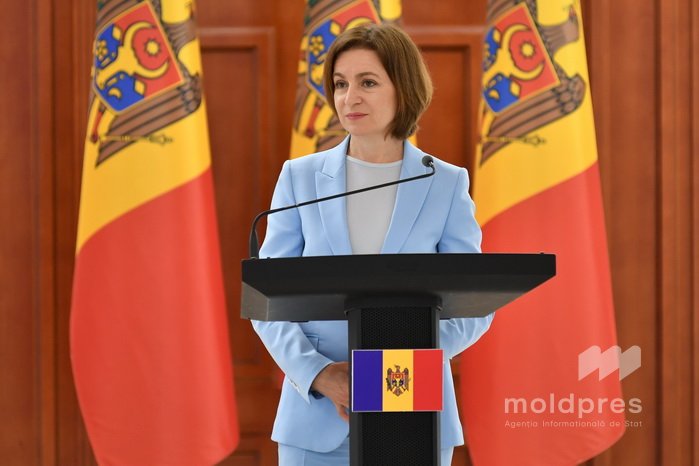
President about Russia’s “second target”: Kremlin wants to control Moldova in order to use it against Ukraine
The Russian Federation has not given up its objective of imposing control over the Republic of Moldova, and Moscow’s interest in our country is determined primarily by its geographic position and the war in Ukraine.  President Maia Sandu made the statement at a talk show, after the publication of a New York Times article about Russia’s plans to destabilize the Republic of Moldova. The head of state pointed out that control from Moscow would mean international isolation for our country.

"When you control power, it means you have subordinated the Republic of Moldova to the Kremlin’s interests, and then the Kremlin decides, not Moldovans or the people elected by the citizens of the Republic of Moldova. We know from history what Moscow does with one country or another, and we see what is happening in other states and, obviously, if this were to happen, it would isolate us internationally. On the one hand, Russia has demonstrated its inability to help its partners; we can see that it can no longer even support the regime in Tiraspol, which it has backed for three decades. At the same time, if you are Russia’s partner in everything, in its aggression against the peaceful world, then you cannot expect help from other states, from the free world. We are talking about peace and war, about countries that want peace—and there are more of them—and about countries that are aggressors; in this case we are talking about the Russian Federation," the president warned.

"Russia would like to strike Ukraine also from our side, from our border, and at the same time we would become a bridgehead toward the European Union. This is what I was talking about," the head of state stressed.

Maia Sandu underlined that the warnings regarding Moscow’s intentions are not new, as the authorities in Chișinău have repeatedly spoken about Russia’s attempts to destabilize the Republic of Moldova and to influence internal political processes. The president noted that in recent years the Republic of Moldova has managed to significantly reduce its dependencies on the Russian Federation, including in trade, remittances, and, most importantly, in the energy sector.

According to Maia Sandu, Moscow has previously used energy dependence as a tool of political pressure on Chișinău.

"In recent years we have managed to reduce, to eliminate, our dependence in the energy sector; this was the most serious dependency, because every time the Kremlin did not like what was happening in Chișinău, it turned off the natural gas tap and the country was left in the dark. Consequently, the country had to comply with the demands coming from Moscow. Together with the citizens, during this difficult period marked by many crises and price increases, we have managed to diversify the Republic of Moldova’s energy supply, and today Russia can no longer blackmail us," the head of state said.

Given that it no longer has the same economic and energy levers, the Russian Federation is turning to more sophisticated methods, Maia Sandu believes. Among these, the head of state listed information manipulation, propaganda, and attempts to influence electoral processes.

"What does Russia do when it no longer has the levers it had in the past? It resorts to more sophisticated actions, first and foremost through information manipulation. Even if we have broken away economically from Russia, we are still in Russia’s information space; Russia’s information space is still present. Our citizens speak Russian and therefore watch entertainment shows and so‑called news programs that are not news, but forms of propaganda, as well as various forms of interference in elections. It is clear that the Russian Federation wants to control the power in Chișinău not because we are a big country or because we have metals or land, but because we are geographically positioned in a way that is convenient for Russia to complicate the situation in Ukraine and to harm European states," the president said.

Maia Sandu assured that, for now, there is no danger of Russian troops approaching the border of the Republic of Moldova, as Russian forces are not making significant advances at the front. In the absence of major gains on the battlefield, Russia continues to attack Ukraine with ballistic missiles, Shahed drones and other weapons, striking the civilian population as well.

"We see that Russia is not advancing on the front. For years now the Russian army has been more or less in the same positions, with minor changes, but in the meantime, because it cannot advance on the front, the Kremlin is mercilessly striking with ballistic missiles, with Shaheds, with all kinds of other bombs and deadly weapons, hitting civilians who are sleeping in their homes and going about their work, and through this trying to bring Ukraine to its knees. So, there is currently no danger that Russia will reach Odesa, because the Russian army is far from Odesa, and it is clear that they have not given up and, no matter how difficult the situation is, including economically—because it is clear that due to the war Russia has spent enormous resources—they still do not abandon this aggressive plan to subdue Ukraine and then move further," the president explained.

Maia Sandu’s statements come in the context of a recent investigation published by The New York Times, according to which Russia has prepared for the Republic of Moldova an operation to seize political control, following Ukraine. According to the American newspaper, the plan is part of the Kremlin’s strategy to weaken the European Union and NATO from within.
 Facebook
 Instagram
 X/Twitter
 Telegram
President about Crocmaz explosion: Russia - one waging war of aggression in Ukraine and bears full responsibility for danger brought to our people’s homes
Ukraine and Moldova mark 35 years of independence
Joseph Burkhalter confirmed by U.S. Senate as next ambassador to Moldova
PHOTO // Moldova and Ukraine strengthen customs cooperation for border security and European integration
VIDEO // Over 450 town halls decided to merge voluntarily and will receive investment funds
Deputy Prime Minister at Diaspora Forum: Each of you is an ambassador of our country and contributes to promoting image of Moldova
Prime Minister’s message to diaspora citizens: I encourage you to contribute to development of Moldova
Speaker at Diaspora Forum: Moldova shows through its citizens at home and abroad that it deserves to become part of great European family
Diaspora Forum held in Chișinău
People’s Assembly of Gagauzia must have full mandate
Disciplinary sanctions after Taliban delegation’s visit to the Republic of Moldova
Republic of Moldova making progress in European integration process
DOC // Law ratifying Convention establishing International Claims Commission for Ukraine published in Official Journal
Moldova and Estonia reaffirm commitment to strengthening cooperation
VIDEO // Defence Minister about crash of aircraft in Talmaza: Russia's hostile activities against Ukraine also endanger Moldova
Chronicle of INDEPENDENCE // We stood in front of Soviet tanks – memories of day that proved generation’s courage
PHOTO // Initial police findings: aircraft crashed in Talmaza shows characteristics similar to drone-missile
VIDEO // UPDATE // Explosion near Talmaza
President about cooperation with US: We have very good relations, important projects, including in energy sector
Moldova to be ready to join EU by 2030
VIDEO // Around 500 town halls adopted voluntary amalgamation decisions
 National Bank of Moldova
Moldova and UN to continue cooperation for sustainable development and support of reforms
Mayors from Central Region of country participated in consultations on investments for amalgamated localities
Moldovan Prime Minister and Luxembourg counterpart discussed European path of country, expansion of bilateral cooperation
Information session for businesses on both banks of Dniester on application of VAT and excise duties to goods imported into Moldova
Prime Minister attended Sports Festival held in Nisporeni

President about measures to stop Russian drones and aggression: Support Ukraine
Mayors from Central Region of country participated in consultations on investments for amalgamated localities
VIDEO // Deputy Prime Minister: Moldova turning page on CIS and moving decisively toward peaceful, promising and prosperous future within great European family
Moldovan Prime Minister and Luxembourg counterpart discussed European path of country, expansion of bilateral cooperation
Electricity and gas meters could be checked less often
European gas prices reach highest level in last three weeks
Government discusses solutions to problems in grain sector with farmers
Moldova has sufficient fuel stocks and diesel shortage temporary, Ministry of Energy says
Position of Bashkan of Gagauzia declared vacant
Former President of Gagauzia People’s Assembly sentenced to eight years in prison by South Court of Appeal judges
Inflow to Novodnistrovsk reservoir dropped to alarming level
President urges children to share stories about books read this summer; most avid readers invited to Presidency
Moldovan electoral body announces start of electoral period for new local elections and referendum of 1 November
Information session for businesses on both banks of Dniester on application of VAT and excise duties to goods imported into Moldova
VIDEO // Foreign Minister about cooperation with Romania: Strategic relationship between two states based on shared language, history and traditions is major asset for our country
MOLDOVA#35 – What We Have Built // Deputy Prime Minister: We Have Followed Complex Economic Path. Next Step Is Full Integration into European Economy
Receive the latest news directly to your email

Receive the latest news directly to your email