
Chronicle of INDEPENDENCE // We stood in front of Soviet tanks – memories of day that proved generation’s courage
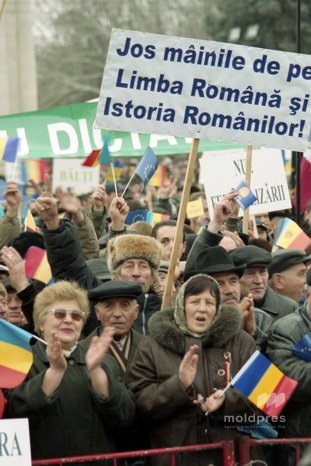
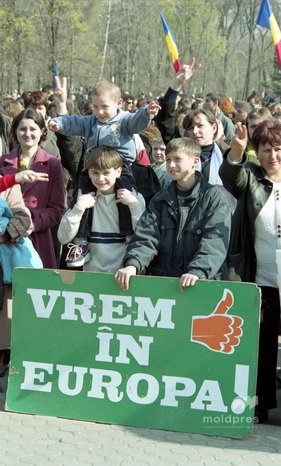
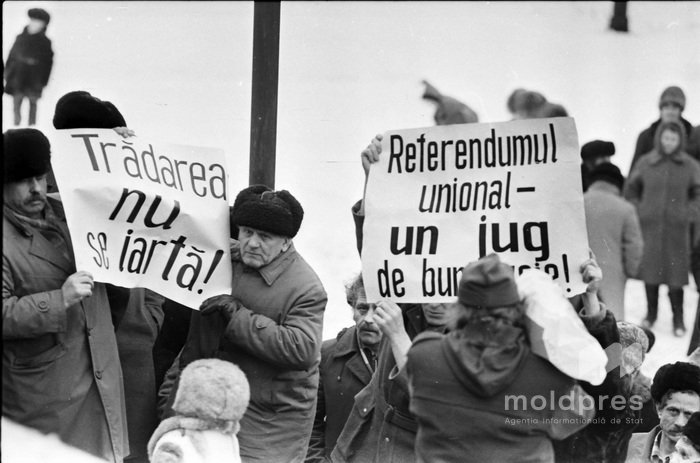
Independence of the Republic of Moldova was not achieved in a single day. It was the result of a process that had begun years earlier, led by a generation that had the courage to demand freedom, defend its identity, and claim the right to decide its own destiny. “Chronicle of Independence” reconstructs this period through the testimonies of those who lived through those times and the explanations of historians. These are stories about people, courage, hope, and a society that found the strength to demand change.

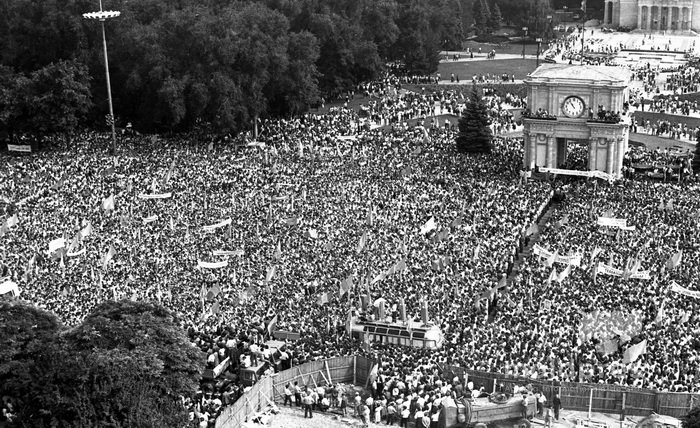
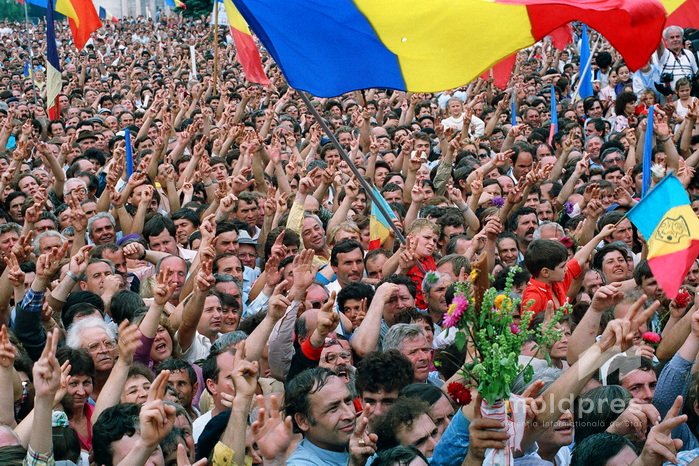
November 7, 1989 was the day when thousands of people took to Chișinău’s main artery to stop the advance of Soviet tanks. People formed a human chain in front of the armored vehicles, in an act of courage and determination that would become one of the symbolic images of the struggle for freedom and national revival. Among the young people in the crowd was Octavian Țîcu, then a student at the Faculty of History of Moldova State University.

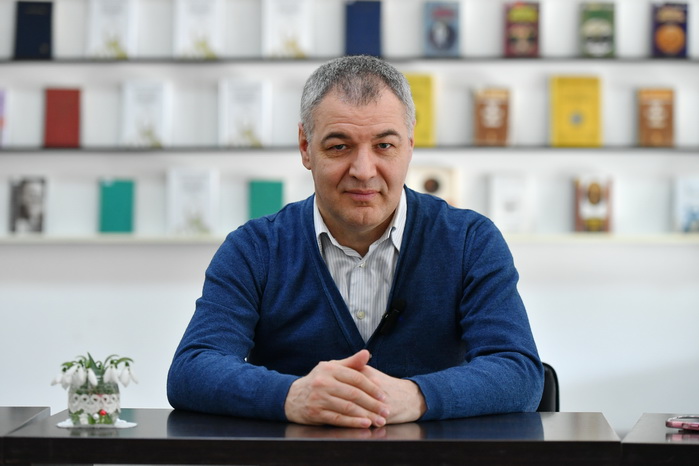
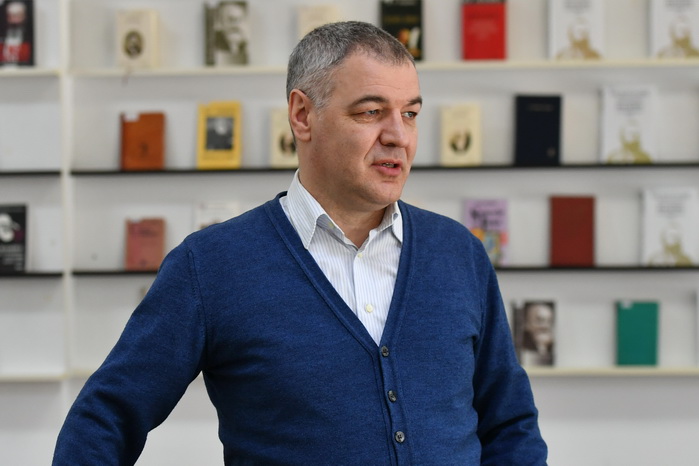
More than three decades later, Octavian Țîcu recalls those events, speaks about the people who stood on the front line of the national revival, and about the road traveled by the Republic of Moldova from the first demands for freedom.

Road to Independence: 1989–1991

Octavian Țîcu: I remember especially the events of November 7, 1989. I think it was one of the days of great courage for our people. I was in my first year of university, and we took to the streets in large numbers. That day, the Soviet parade dedicated to the October Revolution was to take place. The Popular Front had demanded that the parade not be held, but the Soviet authorities ignored the request. Then the Popular Front massively mobilized the population. People came from all corners of the country, and they stood in front of the tanks. The entry of the tanks into the area of the University of Medicine, towards Ștefan cel Mare Boulevard, was blocked. There were clashes, followed by the repression of the demonstrations and the assault on the Ministry of Internal Affairs. Many people were beaten and arrested. The militia even went through student dormitories in search of participants. For me, the courage of our citizens, especially of the young people who literally stood in front of the tanks, remains an unforgettable moment.

From 1989 to 1991 I took part in many such demonstrations, because I was a student at the Faculty of History. The Historians’ Association was extremely active. The very dean of the faculty, Alexandru Moșanu, would later become the first president of the Parliament of the Republic of Moldova. It was a spectacular, romantic, and particularly interesting period. These are unforgettable moments in our history. The people’s desire to express themselves and defend their demands was very clear to see.

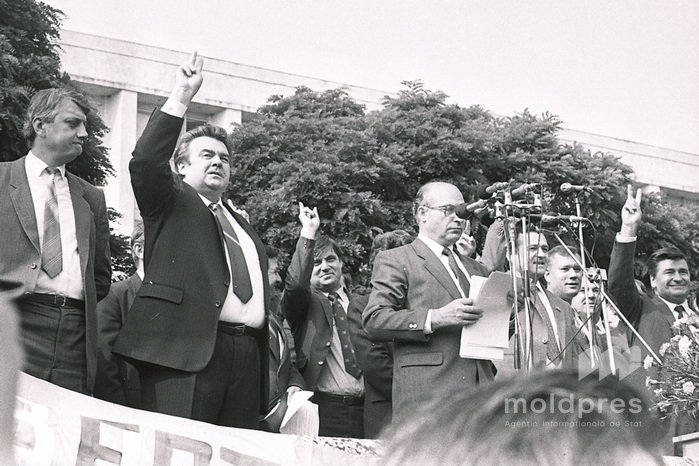
When we analyze the proclamation of sovereignty and independence, we must keep in mind all the steps taken by the leaders of the emancipation movement. First, the Popular Front was created in 1989. This was followed by the organization of the Great National Assembly on August 27, 1989, the return to the Latin alphabet, and the recognition of the Romanian language as the state language in the Moldavian Soviet Socialist Republic. Then came the adoption of the tricolor and the elections for the first Parliament, held in 1990 for the Supreme Soviet of the Moldavian SSR. This parliament politically brought together the national forces.

All these actions enjoyed broad popular support. If we look only at the three Great National Assemblies in 1989, 1990, and 1991, more than half a million people took part in them in total. It was the pressure from the streets that brought about the major changes that preceded the proclamation of independence. The proclamation of independence and the adoption of the Declaration of Independence on August 27, 1991 were, therefore, the culmination of several years of effort. An important step was the adoption of the Declaration of Sovereignty on June 23, 1990. This was followed by negotiations with the imperial center and the political consolidation of the national revival movement.

At the head of this movement were personalities such as Alexandru Moșanu, Mircea Snegur, Ion Hadârcă, Ion Ungureanu, Nicolae Dabija, Valeriu Matei, Ion Vatamanu, and Grigore Vieru. It was a generation that knew how to organize the national revival movement in such a way that, in the confrontation with the imperial center, it obtained more freedoms and rights. These efforts ultimately materialized in the adoption of the Declaration of Independence on August 27, 1991.

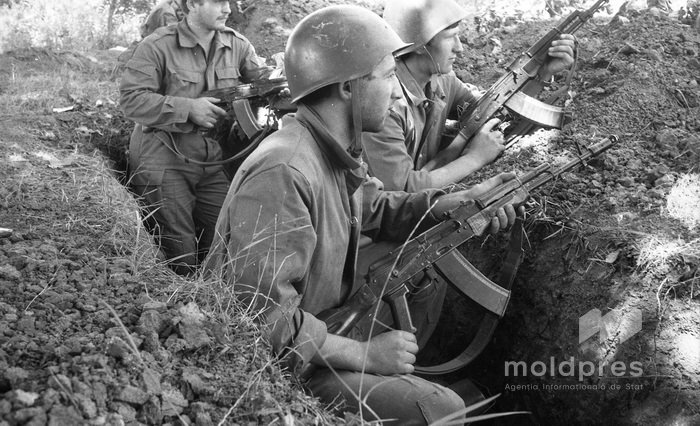
Why Did the Transnistrian War Break Out?

Why did the Transnistrian war break out when the Russian Federation had already recognized the independence of the Republic of Moldova? Historian Octavian Țîcu explains the origins of the conflict through the lens of the continuity of Moscow’s policy of influence over the country and its support for separatist structures in Gagauzia and the Transnistrian region.

Octavian Țîcu: We must look at history through the lens of continuity. The Russian Empire, then the Soviet Union, and later the Russian Federation have all demonstrated continuity in their imperial ambitions and their desire to keep the Republic of Moldova within their own sphere of influence. The Transnistrian war was one episode in a longer conflict between Romania, Russia, and the Soviet Union. The conflict actually began with the creation of Gagauz and Transnistrian separatism in 1989–1990, when the Republic of Moldova was trying to detach itself from the imperial center.

The imperial center supported the idea of separatist entities so that, instead of a single independence, several centers of power would emerge. Separatist structures were created in Gagauzia and the Transnistrian region. Strengthening these entities through military, political, and economic support was aimed at keeping the Republic of Moldova within the Soviet Union. After the proclamation of independence, the Russian Federation used separatism to regain control and influence over the Republic of Moldova. The presence of Russian troops on the territory of the Republic of Moldova was formalized in the form of peacekeeping forces. In 1994, a Constitution was adopted that at that time enshrined “the Moldovan language” as the state language and the neutrality of the Republic of Moldova.

35 Years of Independence Like a “Roller Coaster”

Referring to the European path of the Republic of Moldova, historian Octavian Țîcu explains why the approach to the European Union has been a long and difficult process, marked by historical legacy, a divided society, and repeated shifts in the political and geopolitical vector.

Octavian Țîcu: First of all, we must take into account the historical legacy. Following successive changes of power between Romania and Russia and, later, between Romania and the Soviet Union, two political, identity, and historical blocs have formed: some citizens who look East, and others who look West.

The evolution of the Republic of Moldova over 35 years of independence has been like a “roller coaster.”

Of the 12 parliaments we have had, four were controlled or partially controlled by Russia. Frequent changes in the political and geopolitical vector have not encouraged continuity in reforms.

Citizens must understand that they are Europeans and that the Republic of Moldova is part of the European space. The Romanian language is one of the old European languages. We are a European people and must return there without continuing to swing between East and West.

But we must also understand that the current government has received the people’s trust in two electoral cycles and, in the context of the current political spectrum, is the best available alternative. When we criticize the current government, we must ask ourselves what we would put in its place and what alternative we have.

We need unity in our society. The Republic of Moldova is under threat from Russia. There is a war at our border, and Russia acts in various ways to destabilize, antagonize, and divide society. Therefore, when we think about the European project, we must realize that it is, at this moment, the only civilizational, historical, economic, political, security, and welfare alternative we have.

Paradoxically, the war in Ukraine has strengthened the state of the Republic of Moldova and its citizens. The war has shown us the danger of a failure of democracy and, for this reason, we have consolidated as a society. The Republic of Moldova appears today much more vigorous than it was in 1991, in 2009, or even in 2020. State institutions function, and there is a certain unity at the level of actions.

Therefore, I am more optimistic on the eve of the 35th anniversary of independence than I was, for example, in 1991, 1992, 2009, or 2020.

Octavian Țîcu is a historian and former professional boxer, a graduate of Alexandru Ioan Cuza University in Iași, Romania. In 2010, he was a member of the Commission for the Study and Evaluation of the Totalitarian Communist Regime in the Republic of Moldova. Later, in 2013, he served as Minister of Youth and Sports. An important moment in his sporting career was his participation in the 1996 Summer Olympic Games held in Atlanta, USA.
 Facebook
 Instagram
 X/Twitter
 Telegram
Parallel financial investigations to be conducted under common national mechanism
PHOTO // Chisinau-Straseni-Calarasi water main close to completion: over 47 kilometers of pipeline installed
DOC // Published in Official Journal. Operation of eCall system to be regulated by law
Additional 6 million lei to be provided to fund shelters for Ukrainian refugees
Defense Minister: Aircraft that caused explosion in Crocmaz is Russian propulsion drone
Approved by Government. Moldova to step up exchange of police data with European states
Dniester river water level drops
Moldovan, Romanian officials approach bilateral cooperation
DOC // Ion Ojog promoted to military rank of brigadier general
PHOTO // Training for Independence Day parade
DOC // Published in Official Journal: allowances of up to 300,000 lei for teachers deciding to work at other schools following reorganization
Aircraft unlawfully flew over airspace of Moldova
Over 15,000 people employed through ANOFM
VIDEO // Over 2,000 service members to march on Independence Day
Parliament strengthens dialogue with civil society: Over 20 draft laws subjected to public consultations
VIDEO // Defence Minister about crash of aircraft in Talmaza: Russia's hostile activities against Ukraine also endanger Moldova
Chronicle of INDEPENDENCE // We stood in front of Soviet tanks – memories of day that proved generation’s courage
PHOTO // Initial police findings: aircraft crashed in Talmaza shows characteristics similar to drone-missile
VIDEO // UPDATE // Explosion near Talmaza
President about cooperation with US: We have very good relations, important projects, including in energy sector
Moldova to be ready to join EU by 2030
 National Bank of Moldova
Government State Secretary for Reintegration meets Ambassador of Czech Republic to Moldova
Moldova and UN to continue cooperation for sustainable development and support of reforms
Mayors from Central Region of country participated in consultations on investments for amalgamated localities
Moldovan Prime Minister and Luxembourg counterpart discussed European path of country, expansion of bilateral cooperation
Information session for businesses on both banks of Dniester on application of VAT and excise duties to goods imported into Moldova

President about Russia’s “second target”: Kremlin wants to control Moldova in order to use it against Ukraine
Moldova and UN to continue cooperation for sustainable development and support of reforms
Foreign Ministry condemns violation of airspace of the Republic of Moldova: Such incidents unacceptable
President about measures to stop Russian drones and aggression: Support Ukraine
Mayors from Central Region of country participated in consultations on investments for amalgamated localities
VIDEO // Deputy Prime Minister: Moldova turning page on CIS and moving decisively toward peaceful, promising and prosperous future within great European family
Moldovan Prime Minister and Luxembourg counterpart discussed European path of country, expansion of bilateral cooperation
Electricity and gas meters could be checked less often
European gas prices reach highest level in last three weeks
Government discusses solutions to problems in grain sector with farmers
Moldova has sufficient fuel stocks and diesel shortage temporary, Ministry of Energy says
Position of Bashkan of Gagauzia declared vacant
Former President of Gagauzia People’s Assembly sentenced to eight years in prison by South Court of Appeal judges
Inflow to Novodnistrovsk reservoir dropped to alarming level
President urges children to share stories about books read this summer; most avid readers invited to Presidency
Moldovan electoral body announces start of electoral period for new local elections and referendum of 1 November
Receive the latest news directly to your email

Receive the latest news directly to your email