
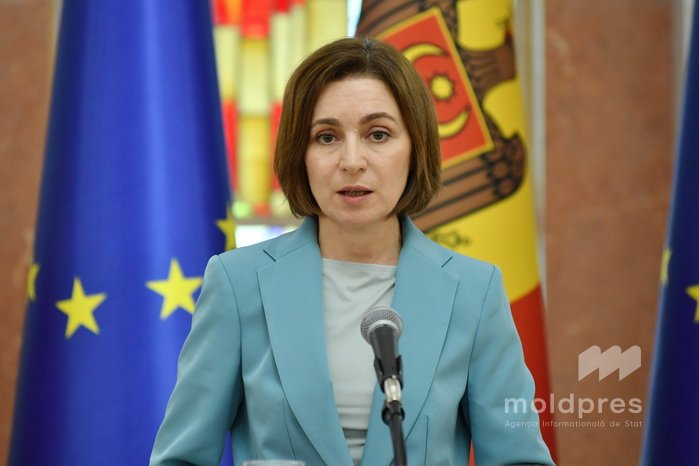
VIDEO // President: Russia wants to control Moldova by autumn
Russia wants to control Moldova by autumn and is preparing an unprecedented interference in September elections. The risks to public order and security are high, and all institutions, as well as society must be aware of the danger and protect ourselves. President Maia Sandu made the statement following the meeting of the Supreme Security Council.

According to the official, Kremlin is investing in multiple political vehicles through intermediaries to enter the next Parliament with the aim of taking control in Moldova. The head of state presented 10 main tools of interference in the political and electoral processes of our country, which are allegedly coordinated and financed by Ilan Shor.


"The greatest danger of the Russian Federation's interference in our internal affairs and these elections is that it poses a direct threat to our state security, the country's sovereignty, and the European future of Moldova. We will face extreme interference, well-orchestrated, with immense financial resources and involved criminal groups. Our institutions must work much more closely in the coming period for data exchange, identification, and stopping attempts to circumvent the law, creating institutional mechanisms to inform in the context of increasing informational manipulation. It is necessary to act united and professionally to protect the national interest," stated Maia Sandu.


Among the threats listed by the head of state are: electoral corruption and illicit external funding, where approximately 100 million euros are planned to be financed through cryptocurrencies; foreign informational manipulation campaigns; the organization of paid protests; cyberattacks on digital infrastructure ensuring the elections and other critical infrastructure targets; the use of the church for the benefit of a foreign state; utilizing so-called opinion leaders and online influencers as intermediaries to convey messages against the European path of the country; involvement of organized crime in destabilizing actions; sabotaging the electoral process in the diaspora; hybrid influences concerning the electorate in UTAG and Transnistrian region; mobilization and radicalization online by promoting extremism and hatred in society.

The head of state emphasized that these actions should not frighten us but mobilize us.


"The purpose of these actions is to increase social tensions, weaken people's trust in the state and its institutions, and even to generate violence. It's important to remain vigilant. Our institutions know what to do. And citizens have a great responsibility. The future of Moldova depends on each of us, on the information we consume, on the actions we take, on what we believe, and how we make decisions. We want free and fair elections, elections where Moldovans decide, not Moscow's money, not propaganda, and not fear induced by organized violence. We all, those who love Moldova, want a European future in peace and prosperity, here, at home," remarked Maia Sandu.


The President of Moldova called today the meeting of the Supreme Security Council. During this meeting, actions to combat informational manipulation and foreign interference in the electoral process were discussed.
 Facebook
 Instagram
 X/Twitter
 Telegram
VIDEO // Russia tried to destabilize our country and spent hundreds of millions of dollars for this purpose. Moldova resisted, Prime Minister says
More than 50 UN member states called on Russia for complete, immediate and unconditional ceasefire in Ukraine
VIDEO // Prime Minister - interview with CNN: We welcome United States involved in energy support projects for Moldova
Moldovan parliament speaker says Russia triggers tensions, seeks to sow fear by unauthorized overflights of airspace
Republic of Moldova reaffirms commitment to refugee protection at UN meeting dedicated to 1951 Convention
Republic of Moldova and UNESCO to strengthen cooperation in education, culture and combating information manipulation
Foreign Ministry deems violation of airspace by Russian drones inadmissible
Speaker condemns drone incidents recorded this morning
President condemns violation of Moldova’s airspace by Russian drones: Russia’s war puts all of Europe at risk
Deputy Prime Minister at Crimea Platform Summit: Russia’s aggression affects security and stability of all Europe
Corneliu Dudnic, Alexandr Stoianoglo file documents to run for office of Gagauzia's bashkan
Moldova, Mongolia abolish visa requirements for holders of diplomatic, service passports
DOC // Decision on declaring state of emergency in energy and hydrological sectors published in Official Journal
StratCom analyzes main vulnerabilities of regional information environment ahead of elections in Gagauzia
Deputy Prime Minister to visit Canada: talks on strengthening bilateral relations and developing economic partnerships
Prime Minister’s speech at UN: We have realistic path to build country our children will not have to leave in search of new opportunities
Prime Minister: Our ambition is clear: to firmly anchor Moldova in European family
PM: We want peaceful reintegration of country
 National Bank of Moldova
Nearly 500 children took up President’s reading challenge
Prime Minister meets with UN Secretary-General
Prime Minister at UN: Moldova may never become great power, but it can certainly become great country
Speech by Prime Minister at 81st Session of United Nations General Assembly
Prime Minister discusses European integration and strengthening economic cooperation with Croatian and Slovenian counterparts in New York

Speech by Prime Minister at 81st Session of United Nations General Assembly
PHOTO // U.S. Ambassador-designate to Moldova arrives in Chisinau
Prime Minister discusses European integration and strengthening economic cooperation with Croatian and Slovenian counterparts in New York
Moldovan Prime Minister holds talks with Croatian and Slovenian counterparts
“A Night Written in Red” - documentary performance about courage, resistance and freedom staged in Parliament square
VIDEO // Prime Minister for Fox News Podcasts: Moldova can be export and trade hub for entire region
Strengthening Moldova’s cooperation with UNDP, UNOPS discussed in New York
PHOTO // PM in New York tells Diaspora government willing to turn experience of Moldovans from United States into projects for country
Moldovan foreign affairs minister at UN says Moldova strengthening capacity to respond to health threats
Moldova under emergency state in energy, hydrological sectors as of September 26; what measures take effect
Moldova's National Crisis Management Commission approves new measures to ensure energy security, protect water resources
PHOTO // PM promotes Moldova's investment opportunities in New York
Balti Clinical Hospital to receive ultrasound machine through grant provided by government of Japan
Moldovan PM, U.S. investors, companies discuss potential projects in Moldova
Japan supports modernization of Balti Clinical Hospital with grant worth over 95,000 dollars
Moldovan parliament speaker urges students not to be afraid to express their ideas, wishes
Receive the latest news directly to your email

Receive the latest news directly to your email