
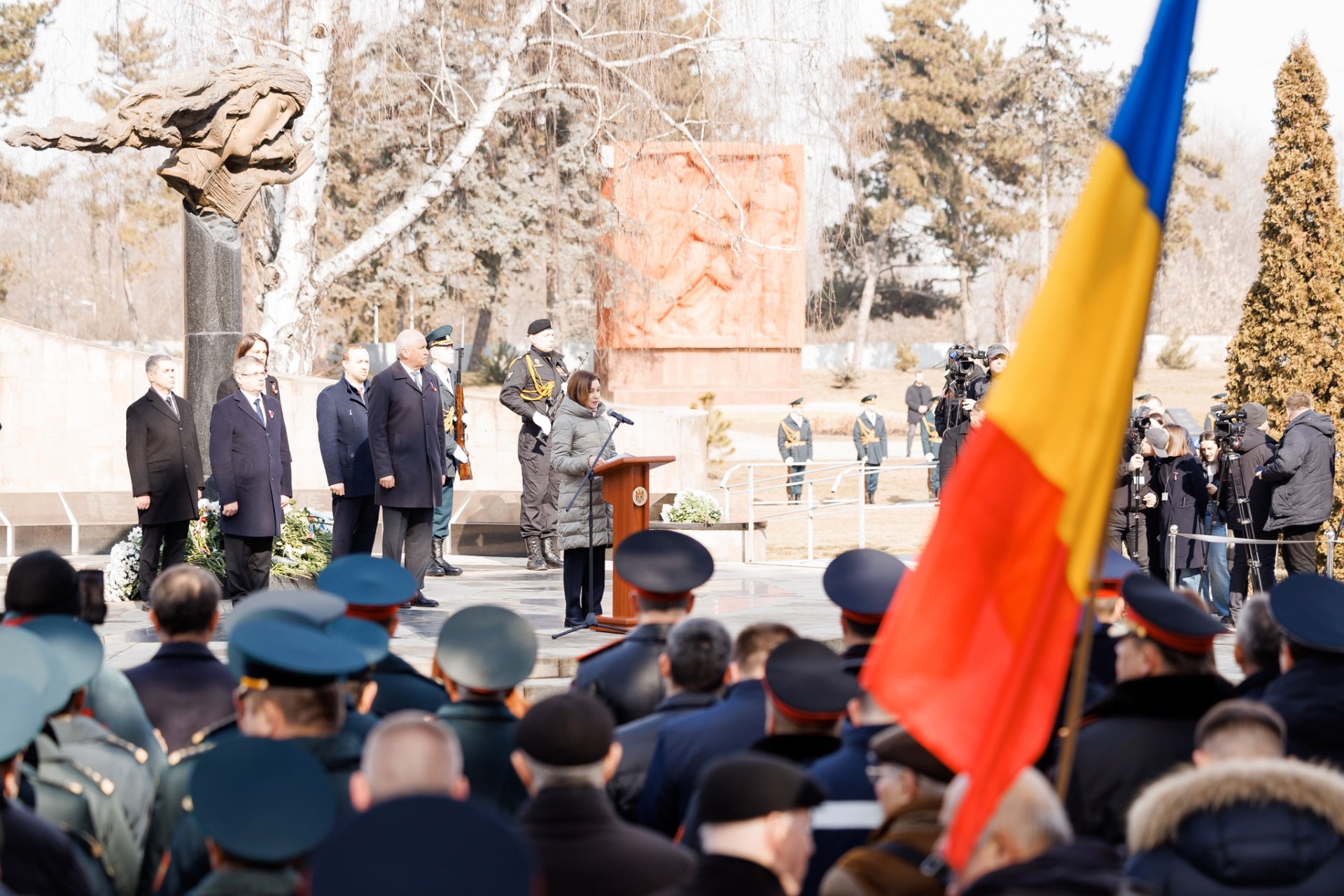
President: Aggression against our country has not disappeared even today – only methods have changed. We are living through genuine cognitive war that targets our memory and identity and seeks to confuse victim with aggressor
President of the Republic of Moldova Maia Sandu warned that the aggression against our country has not disappeared even today. “If in 1992 the aggression came with tanks, today it comes through propaganda, manipulation and disinformation. We are living through a genuine cognitive war that targets our memory and identity and seeks to confuse the victim with the aggressor,” the head of state declared today at the rally commemorating the fallen heroes of the War for the Independence of the Republic of Moldova.

The President again called for the withdrawal of Russian troops from the left bank of the Dniester. In her speech delivered at Eternity Memorial Complex, Maia Sandu recalled that the Republic of Moldova did not start wars and did not covet foreign territories, but only defended its ancestral land.

“We bow today with respect and gratitude before those who, in 1992, defended the sovereignty and independence of the Republic of Moldova. It is a day of pain, but also of dignity. It is the day when we remember not only the deeds of the heroes, but above all their sacrifice – because freedom came at a heavy price. For this freedom, hundreds of people lost their lives. Tens of thousands of others put their health, their future and the peace of their loved ones in danger. Behind every name engraved on a cross there is a life cut short too soon. Behind every veteran there is a story of courage and dedication to the land inherited from our forebears. The commemoration of the heroes of the Dniester War reminds us that freedom is not a given. It must be protected over time. In the past, our freedom was strangled: our language and traditions were marginalized, and our destiny was decided elsewhere. Moldovans wanted to decide their own future, to live in a state in which their voice matters. Those who defended the country on the front line know best how precious freedom is. That is why, dear veterans, you have been and remain on the front line of defending democracy. We owe you respect and gratitude,” the head of state said.

The President noted that even today, more than three decades after those events, our peace and freedom are once again under threat.

“They are being defended, including on our behalf, by Ukrainians. In war, the aggressor must be named: in 1992, the aggressor was Russia. Today, in Ukraine, the aggressor is also Russia. To claim that both sides are to blame would be a falsification of the truth. Moral neutrality in the face of aggression is not only cowardice, but also a lie. Solidarity between peoples that have experienced aggression is a duty. The Republic of Moldova has not coveted foreign territories and has not started wars. It has only defended its ancestral land, and the aggression against our country has not disappeared even today – only the methods have changed. If in 1992 the aggression came with tanks, today it comes through propaganda, manipulation and disinformation. We are living through a genuine cognitive war that targets our memory and identity and seeks to confuse the victim with the aggressor,” Sandu specified.

She reiterated that the defense of memory must be part of national defense.

“Remembrance and Gratitude Day is not only about the past, it is also about the future. It is about the values that define us: freedom, democracy, peace and our natural place in the family of European states that cherish human dignity and the common good. Knowledge of history and of the sacrifices of our forebears is the condition for a strong state. Without memory, there is no identity; without identity, there is no resilience; without resilience, there is no security. The Republic of Moldova does not want war, but peace. True peace cannot be built on lies and cannot be imposed by foreign troops on our territory. We firmly demand the withdrawal of Russian troops from the territory of the Republic of Moldova,” the head of state declared.

Maia Sandu said that the events of 1992 demonstrated the citizens’ desire to live in freedom.

“We showed that when freedom is threatened, Moldovans know how to stand up. It is our sacred duty to continue what the heroes of those days began: to consolidate democracy, to strengthen state institutions, to ensure the security of citizens and to build a European, strong and prosperous Moldova. In the name of those who fell and fought, we pledge to keep the flame of freedom alive in each of us,” Maia Sandu concluded.

The conflict on the Dniester officially began on 2 March 1992, but the first tensions had already appeared in 1990. Over two years, the situation in the region gradually deteriorated. In Dubăsari, a duality of power was established between the separatist authorities and the constitutional ones.

The first victims were recorded in November 1990 on the bridge in Dubăsari, where violent clashes took place between law enforcement officers and supporters of the separatists. In 1991, other armed incidents led to the deaths of several police officers.

After obtaining UN membership status on 2 March 1992, the authorities in Chișinău authorized a military intervention to restore constitutional order. The armed conflict lasted about four months, with the most intense fighting taking place in Cocieri, Coșnița and Tighina.

On 21 July 1992, the Republic of Moldova and the Russian Federation signed the Convention on the Principles of the Peaceful Settlement of the Conflict, putting an end to military hostilities.

More than 30,000 citizens took part in the Dniester War, including soldiers, police officers, volunteers and civilians. Approximately 400 people lost their lives and around 1,200 were wounded. The conflict also left missing persons, including from among the civilian population.
 Facebook
 Instagram
 X/Twitter
 Telegram
Women researchers of Moldova awarded on International Day of Women and Girls in Science
More courts of Moldova to have new buildings; Palace of Justice planned to be built in Cahul
Former mayor of central Moldova village sentenced to seven years in prison for fatal accident, leaving scene
Thirteen judges from anti-corruption panels continue external evaluation procedure
PHOTO // Moldovan firefighters receive new equipment under Denmark-funded project
Corner of China in heart of capital: Spring Festival brings Chinese traditions closer
Eight people detained following searches in case concerning dispossession of Durlești local public administration
CNA officers raided Durlești town hall
Bomb threat at Eugen Doga Chisinau International Airport; passengers evacuated
Around 1,350 drug-related cases initiated in Moldova in 2025; interior minister announces new mechanisms to combat trafficking in banned substances
PHOTO GALLERY // Performance in dual education awarded prizes in Chisinau
Case prosecutor presents secret witness’s testimony in Billion Theft file in Moldova; Vladimir Plahotniuc does not attend hearing
Number of young people admitted to dual education increases in Moldova in recent years
Reorganized schools, support classes and allowances for young teachers
PHOTO // Decade of Memory and Gratitude launched in Chisinau; Moldovan president says state without memory vulnerable state
EU Entry/Exit System extended to more border crossing points of Moldova as of March 2
Moldovan PM conveys message on 34 years since outbreak of Transnistria War
Perspectives concerning Moldova's territorial reintegration; expert says reunification can happen through society’s collective refusal to play Russia’s game
 National Bank of Moldova
Moldovan PM says peace fragile, all share responsibility to protect it
President - 34 years after war on Dniester: In the name of those who fell and fought, we commit to keeping the flame of freedom alive. Every day
President’s message at event on Remembrance and Gratitude Day
PHOTO // Speaker paid working visit to Criuleni district
Moldovan president attends opening of Martisor International Music Festival

President’s message at event on Remembrance and Gratitude Day
15 citizens of the Republic of Moldova in Middle East requested consular assistance from diplomatic missions
President: Aggression against our country has not disappeared even today – only methods have changed. We are living through genuine cognitive war that targets our memory and identity and seeks to confuse victim with aggressor
PHOTO GALLERY // War on Dniester through lens of MOLDPRES: documentary photographs from front line
Foreign Ministry: No Moldovan citizens among victims in Middle East conflict zones
Local referendum to recall mayor of Sadîc scheduled for May
LIVE // Rally commemorating heroes fallen in war for independence of Moldova
Medical leave certificates become exclusively digital in Moldova starting March 1
MIA system becomes available for transfers between companies
PHOTO // Speaker paid working visit to Criuleni district
British MPs in Chișinău: security and cooperation on discussion agenda
Thirty four years since Transnistria War // Memorial, Gratitude Day marked in Moldova
PHOTO GALLERY // Opening of Martisor 2026 International Music festival
Moldovan president attends opening of Martisor International Music Festival
Eugen Doga Chisinau Airport in waltz harmonies: tribute to great composer
BTA: Martenitsa: Bulgarians Celebrate Spring with Centuries-Old Tradition
Receive the latest news directly to your email

Receive the latest news directly to your email