
Over one thousand more families in Moldova to receive vouchers for energy-efficient home appliances
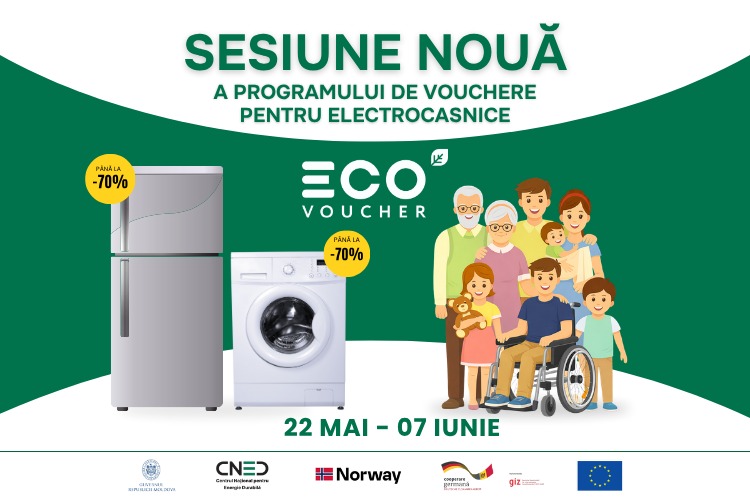
About 1,160 families in the Republic of Moldova will receive vouchers to purchase energy-efficient household appliances under a new round of the EcoVoucher Program, financed by the European Union. The session will take place on 22 May - 7 June 2026.

According to the National Center for Sustainable Energy (CNED), the program provides direct support to households to reduce energy consumption and modernize home appliances. Beneficiaries will receive vouchers worth 6,000 lei to buy refrigerators and washing machines that meet energy efficiency standards and European Conformity (CE) requirements.

Beneficiaries of this session are families with minor children, elderly people over the age of 63, and persons with severe disabilities. To access the program, they must be registered in the Energy Vulnerability Information System. Eligible persons will be informed by SMS or email and will be able to access the vouchers on the platform compensatii.gov.md.

The vouchers can be used during the active session and will cover up to 70% of the cost of the appliances, without exceeding the value of the voucher. To use the voucher, beneficiaries will have to hand in an old appliance of the same type. According to the authorities, since the launch of the program, 41,645 families in the Republic of Moldova have received vouchers to purchase large household appliances. Beneficiaries have reported savings on energy bills and improved comfort in their homes.

In the 2026 edition, the EcoVoucher Program is financed by the European Union with an estimated budget of one million euros, through the project "Energy Efficiency and Renewable Energy in the Republic of Moldova" (E4M), implemented by GIZ. The program was developed by the Government of the Republic of Moldova with the support of the European Union and is implemented by the National Center for Sustainable Energy within the E4M project. The project is funded by the Government of Germany and co-financed by the European Union, Norway, and Denmark.
 Facebook
 Instagram
 X/Twitter
 Telegram
Moldova, Ukraine strengthen energy cooperation, set priorities for preparing for next cold season
Republic of Moldova - EU investment conference scheduled for 4 June to be opened by President, European Commissioner and Prime Minister
Goods exports up by 10 percent in first three months of 2026: EU stays main market for Moldovan products
National Bank of Moldova: annual inflation rate to follow upward trend in 2026, afterwards to decline
Energy minister Athens says Moldova undergoing major transformation of its energy system
Moldova and Ukraine initialed new sanitary-veterinary certificates for poultry meat and feed
Moldova continues to increase renewable energy generation capacity, with solar power leading way
Moldovan economic development minister says inflation driven by external developments, especially conflict in Middle East
Energization of Vulcanesti–Chisinau power line might take place in next June
New investment projects in Moldova
Government allocates 50 million lei to compensate losses suffered by farmers affected by drought and heat in 2025
Spring Wine Vernissage
US to provide Moldova with 8 million dollars to strengthen cybersecurity
Women entrepreneurs from communities located in Moldova’s protected areas trained to develop sustainable businesses
President shared Moldova’s experience in countering hybrid warfare at GLOBSEC Forum
Republic of Moldova could be included in list of tourist destinations for Chinese citizens
Over one thousand more families in Moldova to receive vouchers for energy-efficient home appliances
Finnish Embassy warns Moldovan citizens about job-related scams
PHOTO // Agri-food potential of Moldova presented at business forum held in Rome
Minister explains upcoming education reform: It will bring very clear salary increases
President participated in GLOBSEC Forum in Prague
 National Bank of Moldova
President participated in GLOBSEC Forum in Prague
Moldovan PM attends event dedicated to International Day of Ukrainian Shirt “Vyshyvanka”
Participation of Deputy Prime Minister for Reintegration in OSCE Permanent Council Meeting
Prime Minister at anniversary of National Confederation of Employers
Moldova, IMF reach agreement on new three-year cooperation programme

Moldovan PM attends event dedicated to International Day of Ukrainian Shirt “Vyshyvanka”
China open to increasing imports of wines, agri-food products from Moldova; discussions held by Moldovan foreign affairs minister in Beijing
VIDEO // Access to Culture returns: funding for development of cultural life in Moldova
Moldovan foreign affairs minister has meeting with Chinese counterpart; facilitating access of domestic products to Chinese market on agenda
EU accession negotiations could be opened in next June; parliament speaker says Moldova, Ukraine deserve this step
Moldovan parliament speaker, after Putin’s decree, says Russia wants to make up for losses on front
VIDEO // Opposition walks out session hall at today's parliament meeting; Moldovan parliament speaker says not to tolerate insults, degrading behavior
Moldovan parliament speaker rejects accusations by Tiraspol separatist regime on alleged interference with “so-called presidential elections”
Moldovan parliament speaker says agreement with IMF important indicator for international partners
Meteorologists issue Yellow Code warning for atmospheric instability in Moldova
Participation of Deputy Prime Minister for Reintegration in OSCE Permanent Council Meeting
Prime Minister at anniversary of National Confederation of Employers
New rules for corruption and organized crime investigations
DOC // Activity of zoos to be regulated by new law
DOC // Particip.gov.md platform to be modernized to ensure easier access to information on draft decisions proposed by authorities
BITEI Festival 2026 opens in Chisinau; event's programme
Receive the latest news directly to your email

Receive the latest news directly to your email