
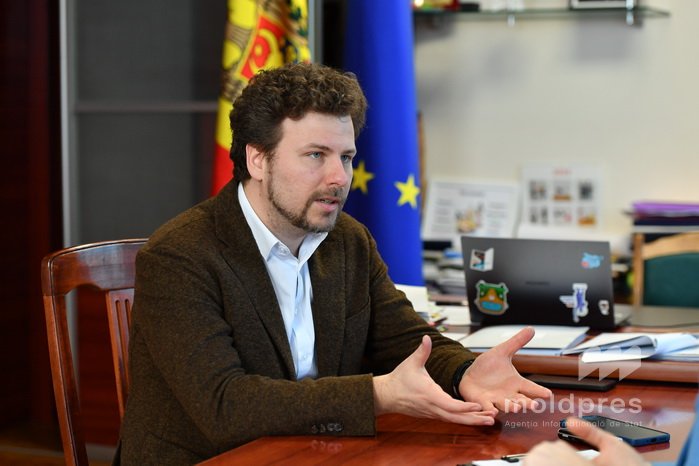
Minister explains upcoming education reform: It will bring very clear salary increases
The broad reform prepared by the Ministry of Education and Research promises to change the way the education system in the Republic of Moldova is administered. Minister Dan Perciun states that the new changes will bring more competitive salaries, greater efficiency in school management, and a reduction of political influence over the education system. According to Perciun, the Ministry will be able to effectively resolve problems reported by parents.

The minister explained that district education divisions will be transformed into territorial agencies under the direct authority of the Ministry of Education. At the same time, gymnasiums and high schools will come under the coordination of these structures, while sports schools, art schools, and kindergartens will remain under the management of local authorities.

According to the minister, one of the most important aims of the reform is to strengthen the administrative capacities of the education divisions, which are currently affected by staff shortages and low salaries.

“We have districts where the occupancy rate of positions is 25%, in others 50%. Salaries are low, they’re unattractive, and directors or teachers are not always willing to take positions in the education divisions. The people who are there today often do a titanic job, but they are few and the work is not attractive. We want to increase these capacities through this reform, which will bring them very clear salary increases,” the minister of Education said on Jurnal TV.

Dan Perciun says that the salary increases could exceed 15%, in the context of a broader wage reform planned for September.

“We still have to see exactly, because we also have a wage reform that will take place in parallel starting in September, and it might even be higher than the simple change of subordination. Higher than plus 15%, I think somewhere around that level,” the official specified.

Another major objective of the reform is the depoliticization of the education system. The minister maintains that, at present, many important decisions regarding schools are politically influenced at the local level.

“Today, as they are subordinated to district councils, there are at least three major areas where the political factor influences decisions, and these decisions are not always made rationally based on what is important for the education system,” Perciun declared.

The minister gave as an example the reorganization of the school network, where differences between districts are very large.

“We have district councils that understand the importance of having larger, better-equipped schools with more children, and they make such decisions. We have districts where every third school has fewer than 50 students. Children’s chances of receiving quality education differ depending on how the local political factor relates to this issue,” the minister explained.

Perciun also criticized the way investments in schools are allocated, saying that in many cases clear and transparent criteria are lacking.

“Only five out of 35 districts have even a basic regulation that states how they decide whose roof to repair or where to carry out thermal insulation. In the other cases, there are local-level understandings without clear procedures. Sometimes we end up in a situation where we build a swimming pool in a school and do not complete it, while in other institutions the sanitary blocks are in poor condition,” he said.

The minister also spoke about the problem of acting (interim) principals, which he says is a consequence of political influence in the system. According to him, the new reform is also expected to change the way competitions for management positions are organized.

“Today, the employers are the district councils. We have districts where 20% of principals are acting (interim), and no competitions are being held because it is sometimes more convenient to have an interim than a person fully appointed to the position,” Dan Perciun stated.

The minister maintains that, once institutions come under the authority of the territorial agencies and the Ministry of Education, decisions on the appointment of principals will be taken by structures within the education system and not based on local political interests.

“Our hope and goal is for decisions regarding principals to be made by people from the education field, putting education at the top of the agenda, and for them to be less influenced by political considerations at the local level,” the official emphasized.

Perciun says that the reform will allow the Ministry of Education to intervene more quickly in problems reported by parents, including cases of bullying or informal payments in schools.

“All parents frustrated by informal payments or bullying write to the ministry, but realistically, we are not the employers of the principals and we do not have real levers of intervention. Once we have a more centralized system, we will be able to intervene more specifically and take full responsibility for what is happening,” the minister underlined.

The reform is to be officially presented next week, and the implementation of the new administrative structure is planned by 2027. According to Dan Perciun, there will be at most 10 territorial education agencies in the Republic of Moldova, following the model already applied in the social protection system.
 Facebook
 Instagram
 X/Twitter
 Telegram
PHOTO // Moldova's Emergency Inspectorate reports 65 interventions after June 6 torrential rains
VIDEO // Car swept away by floodwaters, four people evacuated in central Moldova districts; authorities intervene in more localities
PHOTO // European Commissioner for Enlargement, Moldovan environment minister participate in visit on Dniester bank
Homes flooded, roads blocked after heavy rainfall in Moldova; authorities urge caution
PHOTO // European Commissioner for Enlargement returns to Marta and Maria Monastery of Moldova
PHOTO // European Commissioner for Enlargement meets mayors of Moldova: EU to help modernize another 20 schools
Over 1,000 Diaspora Moldovans register for Online Career Fair
PHOTO // European Commissioner for Enlargement urges young people to defend democracy, combat disinformation
Moldovan president conveys message on World Environment Day
Environment Minister announces when fish safety to be checked
Moldova prepares new edition of Red Book
Moldova prepares case against Russia over Dniester pollution
International post-disaster needs assessment mechanism launched in Chișinău following Dniester river pollution crisis
Right to fair trial – most frequently reported problem by Moldovan citizens in 2025: Ombudsman’s report presented in parliament
Number of electric cars might double in Moldova by 2030; authorities prepare solutions to expand charging stations
PHOTO // Moldova learns from France’s experience in urban mobility, public transport's modernization; deputy PM’s visit to Paris
Over 300 tons of used appliances collected for recycling through EcoVoucher Programme in Moldova
Moldovan-Hungarian cooperation in focus for foreign ministers of Chisinau and Budapest
European Commission President: EU to open first negotiation cluster with Moldova on days to come
Moldova, Romania coordinate efforts to advance EU accession negotiations
Over 250 rescuers from Europe to take part in MD–EU MODEX 2026 exercise organized in Moldova
 National Bank of Moldova
Moldovan deputy PM for reintegration has meeting with French senators
Moldovan parliament speaker thanks UNICEF representative in Moldova for support in social reforms, child protection
Moldovan president attends ceremony on 24th anniversary of foundation of National Anticorruption Centre
Prime Minister at Moldova Digital Summit 2026: Our ambition is not only to join EU, but to help build Europe’s digital future
Over 1 billion euros in new investment partnerships, financing announced for Moldova

VIDEO // Over 5 million lei seized following searches in fraud file in Moldova; five people detained
Record on electricity exchange in Moldova: largest volume of traded power since its launch
Deputy Prime Minister: EU Growth Plan for Moldova creates conditions for modernizing economy at unprecedented pace
Sergiu Caraman remains head of Superior Council of Magistracy
Moldovagaz to supply natural gas to Transnistrian region by late 2026
VIDEO // Alexei Buzu: Government allocates 145 million lei for development of amalgamated localities in Călărași
Deputy parliament speaker says Moldova must strengthen defense capabilities
Works at Chisinau Electrical Substation progressing; Romanian Ambassador says Romania stays reliable partner of Moldova in strengthening energy security
EUROPEAN VILLAGE // Over 27 million lei invested in modernizing infrastructure in central Moldova settlement
Moldovan Foreign Affairs Ministry issues travel alert for Qatar, Kuwait: “Security situation stays volatile”
Economic, investment opportunities of Moldova promoted at Annual Meeting of Board of Governors of European Bank for Reconstruction and Development
Environmental NGOs' representatives trained in alternative methods for resolving environmental conflicts in Moldova
PHOTO // Moldovan deputy parliament speaker says Grand Duchy of Luxembourg, as EU founding member, firmly supports Moldova's European path
ARMENPRESS: IRI observers: Armenia’s June 7 elections conducted calmly and fairly
Discover Moldova with #MOLDPRES // Sweet business in Prut Meadow
MOLDPRES REPORT // Smart technology for old apartment blocks: Chinese solutions that might fix parking, waste problems in Moldova’s cities
Receive the latest news directly to your email

Receive the latest news directly to your email