
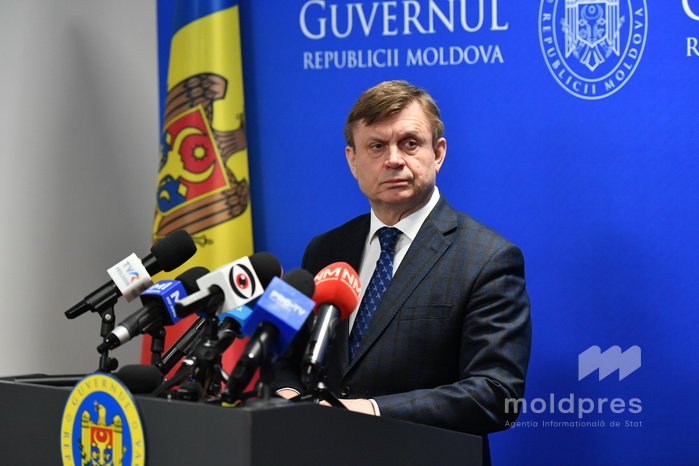
Deputy Prime Minister: Reintegration is no longer goal for future. It is goal being achieved today
The application of VAT and excise duties to economic operators from the Transnistrian region represents an important step in the country’s reintegration process, says Deputy Prime Minister for Reintegration Valeriu Chiveri. The official stated that tax harmonization began on September 1 with non-essential and luxury goods, with the measures to be extended to other categories of products in subsequent stages.


„The reintegration objective is no longer an objective for the future. It is an objective being achieved today, including through this decision adopted by the Government,” Valeriu Chiveri said at a TV show.


In the first stage of tax harmonization, which entered into force on September 1, VAT and excise duties apply to goods considered non-essential or luxury items. This category includes alcoholic beverages, tobacco products, perfumes, pyrotechnic articles, furs, jewelry, precious metals, caviar and its substitutes, certain means of transport, and other similar products.

The Deputy Prime Minister for Reintegration noted that the preparation period for this measure had been longer than he would have liked, but that the decision represents an important result after more than three decades of conflict and a lack of economic uniformity.


„Through this measure, we are not only harmonizing the rules, but also creating fairness for economic operators on both the left and right banks. They will operate under the same conditions, which, unfortunately, has not been the case until now. (...) Prices in Chișinău and Tiraspol for diesel or gasoline are practically the same. Meanwhile, our importers pay VAT. So where is the difference between the VAT paid by our importers and that not paid by companies operating there? From our point of view, this is excess income that, unfortunately, continues to end up in someone’s pocket,” the Deputy Prime Minister emphasized.


According to the official, the initial reactions from the region rejected the decision, with accusations of a supposed „economic blockade” or „fiscal missile” being made. Chiveri emphasized, however, that once it has entered into force, the decision must be respected, and economic operators on the left bank of the Dniester must operate within the legal framework of the Republic of Moldova.

Chiveri explained that the choice of non-essential goods for the first stage was intended to reduce the impact on the population. Further stages, scheduled for January 1 and April 1, will target categories of goods with greater financial and economic importance, while economic operators will benefit from transition periods to adjust their activities.

Another indicator of economic rapprochement is the number of economic operators from the region using the national banking system. By mid-2026, 838 bank accounts had been opened for legal entities, a figure that had increased by approximately 10% since the beginning of the year. The number is currently higher, given that approximately 2,500 companies from the Transnistrian region are registered in the Republic of Moldova.


„Economic operators pay customs duties. How do they pay them? Those who have bank accounts in the national banking system can make these payments through those accounts, but not all of them have such accounts, because the procedure is quite complicated for economic operators in the region who do not want to adjust their activities and transparency in accordance with the requirements of the banking system, or they can use the Bilateral Payments Centre. This is a centre licensed by the National Bank, and the money is transferred directly to the account of the Ministry of Finance from the respective account. This is a way to ensure the payment of VAT and excise duties by economic operators on the left bank of the Dniester. There will be no blockage, which is what we were accused of. As long as there is no possibility to transfer these amounts, economic operators will not be able to import, because if you do not pay VAT, you cannot import. We have ruled out this possibility,” the Deputy Prime Minister explained.


The Government decided to introduce VAT and excise duties gradually for certain categories of goods brought into the Republic of Moldova by economic operators based in the Transnistrian region. The measure aims to ensure the uniform application of tax and customs legislation throughout the country, provide fair competitive conditions, and gradually integrate economic operators from the region into the national tax and customs system.

In the first stage, beginning September 1, 2026, the new regime applies to alcoholic beverages, tobacco and nicotine products, perfumes, pyrotechnic articles, furs, jewelry and precious stones, as well as certain means of transport.
 Facebook
 Instagram
 X/Twitter
 Telegram
European integration and more open economy for entrepreneurs
Minister Eugeniu Osmochescu announces mandate priorities: EU accession and smart agriculture
Eugeniu Buzatu wins competition for position of general director of Moldova's Energocom company
State of alert in energy and hydrological sectors to be extended
PHOTO // NBM puts into circulation two coins dedicated to 35 years of independence
Currency liberalization: 250,000-euros ceiling without authorization of National Bank of Moldova, foreign currency payments in certain commercial units
New subscription round via the eVMS.md platform in Moldova; citizens can invest online in government bonds with interest rates up to 7.85 per cent
National Wine Day returns to Chișinău with anniversary edition on October 3–4
European gas prices remain high as TTF benchmark reaches 68.19 EUR/MWh
Chisinau – Cainari railway section of Moldova to be rehabilitated with support of top European bank
Harvest of grapes for wine might increase by up to 15 per cent in Moldova in 2026; reference price between 6.8 and 8.2 lei per kilogram
Roads' safety to be assessed at least once every five years in Moldova; drivers to be able to report dangerous areas online
Energocom company of Moldova announces price of natural gas delivered in last July
Financial instruments market of Moldova to be aligned with EU standards
Deputy Prime Minister: Reintegration is no longer goal for future. It is goal being achieved today
Speaker: 2027 local elections to be held under new administrative-territorial structure
Speaker’s reaction to Russia’s intention to open polling stations in Transnistrian region
President meets with Ambassador of Turkey at end of term
 National Bank of Moldova
President meets with Ambassador of Turkey at end of term
Prime Minister and Denmark’s Ambassador approach new opportunities for investment and economic cooperation
Head of state, at 35th anniversary of National Army's establishment, says peaceful Moldova needs Moldova capable of defending its peace
Moldovan president’s speech at event on online safety, digital determinants of children’s, adolescents’ mental health, emotional well-being
Deputy PM for reintegration has meeting with new Head of OSCE Mission to Moldova

Protest note to Russia’s ambassador
ARMENPRESS: EU Council backs temporary trade-liberalization measures for Armenian products
Schools to come under Ministry of Education and Research and be managed by Territorial Education Agencies: reform approved by Parliament in second reading
Prime Minister and Denmark’s Ambassador approach new opportunities for investment and economic cooperation
Moldovan parliament proposes new regime for strategic investments
Solutions for children’s online safety analyzed in Chisinau; Romania's First lady: “We must work together to protect children in an ever-changing digital environment”
Moldovan deputy PM for European integration meets with Ukraine’s new deputy PM for European and Euro-Atlantic Integration
Head of state, at 35th anniversary of National Army's establishment, says peaceful Moldova needs Moldova capable of defending its peace
Moldova's foreign affairs minister to visit Lithuania: meetings' agenda
PHOTO GALLERY // Children’s online safety at center of international conference in Chisinau, attended by Moldovan president, Romania’s First Lady
Import of cereal, oilseed crops to be temporarily licensed in Moldova
Moldovan president, at international online safety conference, says each child must grow up healthy, free, safe in world where physical, digital realities intersect
Searches conducted in more settlements of Moldova in case concerning illegal financing of parties through cryptocurrencies
Moldovan president’s speech at event on online safety, digital determinants of children’s, adolescents’ mental health, emotional well-being
Electronic monitoring of domestic abusers to be strengthened: Moldova's National Probation Inspectorate to receive 200 new bracelets, 2027 budget to be doubled
Moldovan parliament speaker, on National Army Day, says National Army symbol of defending peace
Receive the latest news directly to your email

Receive the latest news directly to your email