
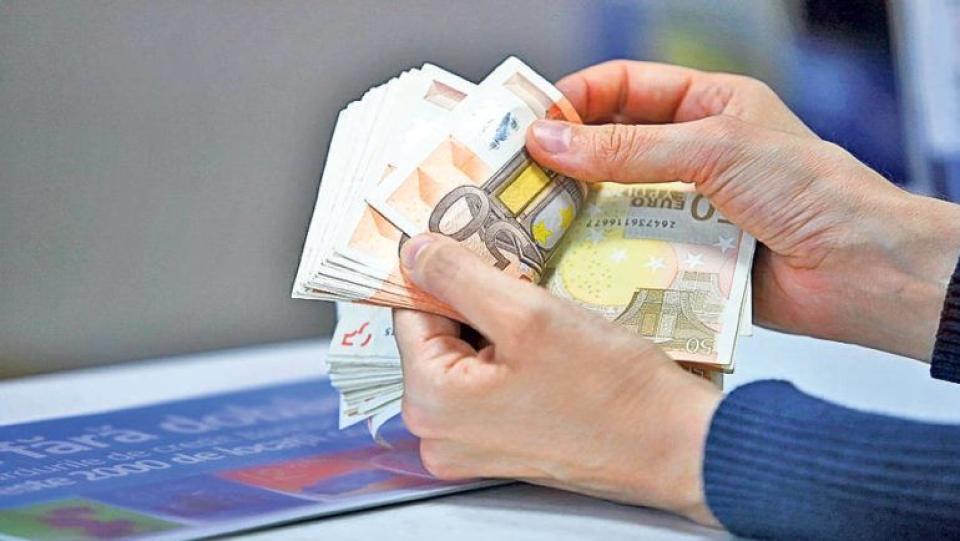
Currency liberalization: 250,000-euros ceiling without authorization of National Bank of Moldova, foreign currency payments in certain commercial units
The ceiling for conducting certain capital foreign exchange operations without authorization from the National Bank of Moldova (BNM) will be increased to 250,000 euros and payments in foreign currency will be allowed in specific commercial units in international airports and on board of aircrafts operating international flights. At the same time, non-resident individuals will be able to pay in foreign currency for hotel services provided in Moldova. The parliament today approved, in the first reading, a draft law that provides for a new stage in the liberalization of capital foreign exchange operations, as part of the process of aligning national legislation with European Union rules.

State Secretary of the Ministry of Finance Elena Grumeza said that the draft represented the second stage of liberalizing capital foreign exchange operations, the first having been approved in 2025.

According to the state secretary, the Treaty on the Functioning of the European Union enshrines the free movement of capital and payments as one of the four fundamental freedoms of the EU and eliminates restrictions on the movement of capital between member states, as well as between member states and third countries. Currently, national legislation provides for certain capital foreign exchange operations that require prior authorization on behalf of the BNM. The liberalization schedule assumed by Moldova entails the gradual elimination of these restrictions in three stages, with the goal of full liberalization by the time of EU accession, Grumeza noted.

“In the first place, the authorization threshold applied by the BNM to certain operations, such as the purchase of foreign financial instruments, granting of loans, financial credits and guarantees to non-residents, is being increased. It is to be set at 100,000 euros, entering into force one month after the date of publication, but as of January 1, 2028, the ceiling will be further raised to €250,000.

Another amendment introduced at this stage concerns giving foreign exchange offices the right to provide payment services in order to increase the financial inclusion of the population. At the moment, they only provide foreign exchange services, but under the new provisions, they will be able to act as payment service providers.

The third change is the removal of the authorization regime for opening accounts with foreign banks by residents of Moldova during the period in which they establish their residence abroad or during their stay there,” noted the state secretary of the Finance Ministry.

The head commission for economy, budget and finance, Dorian Istratii, specified in the commission’s report, that the new ceilings would also apply to certain personal operations, such as donations and loans between individuals, the opening of certain accounts abroad, foreign exchange operations abroad, as well as other capital operations.

“The rules concerning operations of a personal nature have been clarified, namely, the new provisions stipulate that persons who emigrate may transfer the assets they hold at the time of establishing their residence abroad or during their stay abroad (Art. 15); the right has been established for resident individuals who emigrate (at the time of establishing their residence abroad or during their stay abroad) to open accounts with non-resident banks without BNM’s authorization (Art. 13); the right has been established for resident non-bank payment service providers (PSPNR) to open accounts with non-resident banks without BNM’s authorization, as necessary for carrying out the activities under the license issued by the BNM (Art. 13),” the commission’s report reads.

The draft also restores the right of resident individuals to make payments in foreign currency, including cash, in commercial units located in international airports beyond customs and border control areas, at international border crossing points, or on board of aircrafts performing international flights.

At the same time, the prohibition on non-resident individuals paying in foreign currency for hotel services provided in Moldova is removed.

During the debates, the lawmakers asked whether the liberalization of foreign exchange operations and the increase in ceilings does not create risks related to capital outflows from Moldova.

Elena Grumeza stressed that the measures do not remove the BNM’s control and supervision mechanisms.

“We cannot restrict citizens from doing what they want with their money. When the amount exceeds the ceiling, they need BNM’s authorization, but such restrictions do not exist at the European level,” said the state secretary.

According to the state secretary, the liberalization schedule was drawn up by the BNM with the support of an IMF technical assistance mission in 2024 and is based on an analysis of the European framework and the steps needed to align Moldova with it.

The commission for economy, budget and finance found that the draft was in line with IMF recommendations and with the recommendation of the European Commission in the 2025 Enlargement Report on Moldova, which calls for the continued gradual liberalization of capital movements.

At the same time, the measures fall within the strategic objectives of the BNM regarding the promotion of the liberalization of capital foreign exchange operations.

The report of the Commission for European Integration underlines that, from the perspective of EU law, the project falls within Cluster II – “Internal Market”, Chapter 4 – “Free movement of capital”.

“The Commission notes that the legislative initiative aims to remove certain administrative barriers and simplify the regime applicable to foreign exchange operations, including by increasing value thresholds and gradually liberalizing certain capital operations carried out by residents and non-residents. At the same time, the draft maintains the supervisory and reporting mechanisms necessary to monitor foreign exchange operations. These interventions are part of the process of progressive liberalization of foreign exchange operations, which is to be carried out in successive stages within the process of accession to the European Union,” said the head of the Commission for European Integration, Marcel Spatari.

The Commission for European Integration will monitor the implementation of subsequent stages provided for under Chapter 4 “Free movement of capital”, including the regulatory measures needed to continue the liberalization of foreign exchange operations and to adjust the subsequent regulatory framework of the BNM.

The parliament is to consider the draft in the second reading.
 Facebook
 Instagram
 X/Twitter
 Telegram
Deputy Prime Minister: CFM must attract transit of Ukrainian grain to increase revenues
Energocom to supply Termoelectrica with almost 1.9 million MWh of gas during cold season
Prime Minister to hold expanded meeting with farmers on transit of Ukrainian grain by rail
Minister of Energy calls for mobilization of efforts to ensure conditions needed for start of commercial operation of Vulcănești–Chișinău Line
Electricity and gas meters could be checked less often
European gas prices reach highest level in last three weeks
Government discusses solutions to problems in grain sector with farmers
Moldova has sufficient fuel stocks and diesel shortage temporary, Ministry of Energy says
MOLDOVA#35 – What We Have Built // Deputy Prime Minister: We Have Followed Complex Economic Path. Next Step Is Full Integration into European Economy
Moldovan carriers will no longer pay road taxes in Armenia for ECMT trips
DOC // Deadline for submitting bids in privatization of Zarea hotel extended
DOC // Strategic Programme for Aquaculture Sector 2026–2030 published in Official Journal
Bălți–Dnestrovsk power line put back into operation
Moldova increased renewable energy capacity by nearly 94 MW in first half of year
PHOTO // Exhibition dedicated to country's foreign path inaugurated at National Museum of History of Moldova
Currency liberalization: 250,000-euros ceiling without authorization of National Bank of Moldova, foreign currency payments in certain commercial units
Romanian-language TV programmes, domestic content to have a greater share in audiovisual space of Moldova; legislative initiative supported by parliament
Eugeniu Osmochescu accepts position of Minister of Agriculture and Food Industry
Deputy Prime Minister for Reintegration and Ambassador of Ukraine to Moldova approach current issues on Transnistrian case
Former Romanian Economy Minister joins Chişinău Government
VIDEO // President invites citizens to events dedicated to Independence Day
 National Bank of Moldova
Lack of own premises remains main obstacle to development of Romanian-language educational institutions in Transnistrian region
Deputy Prime Minister for Reintegration and Ambassador of Ukraine to Moldova approach current issues on Transnistrian case
Presidents of Romania and Ukraine invited to celebrate 35 years of Moldova’s independence
Moldovan president advocates in Kyiv for strengthening Ukraine’s air defense
Moldovan PM conveys message to Ukrainian people at opening of exhibition dedicated to Ukraine’s sacred heritage

National Wine Day returns to Chișinău with anniversary edition on October 3–4
Speaker invites citizens to events on 35 years of independence
European gas prices remain high as TTF benchmark reaches 68.19 EUR/MWh
PHOTO // Over 20 medals for Moldova at U-15 and U-17 European Weightlifting Championships in Pristina
UPDATE // Mirnoe-Tabachi border customs post resumes operations
Presidents of Romania and Ukraine invited to celebrate 35 years of Moldova’s independence
Moldovan president advocates in Kyiv for strengthening Ukraine’s air defense
PHOTO GALLERY // Fourth edition of National Teachers' Forum organized in Chisinau
Candidates for position of judge or prosecutor to be allowed to retake exam in Moldova
Moldovan president in Kyiv says more air defense for Ukraine means safer sky for Moldova as well
Moldova to have new law on mass media's activity, aligned with European standards
Moldovan parliament speaker says ammunition at Cobasna used by Russia as argument to maintain troops in Transnistrian region
Chisinau – Cainari railway section of Moldova to be rehabilitated with support of top European bank
Voted by Moldova's parliament: Electoral Code supplemented with provisions on postal voting, organization of elections in Gagauz autonomy
Moldovan parliament changes rules of work: new provisions for MPs, parliamentary factions
Inga Ionesii assumes office of Moldova's Ambassador to India
Receive the latest news directly to your email

Receive the latest news directly to your email