
Deputy Prime Minister: CFM must attract transit of Ukrainian grain to increase revenues
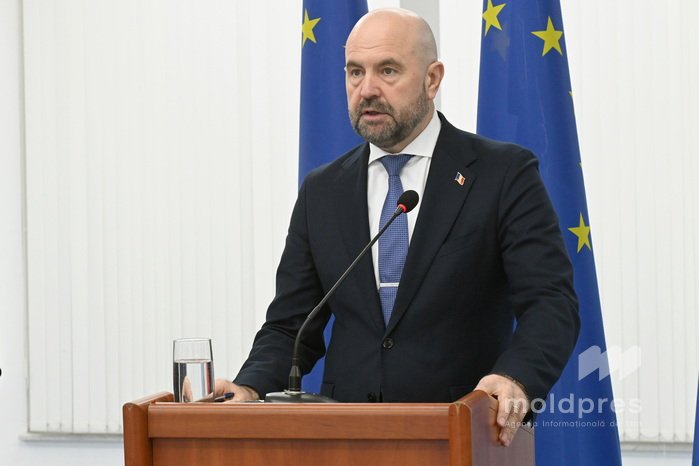
Moldovan Railways (CFM) must be involved in the transit transport of goods, including Ukrainian grain, in order to increase its revenues and maintain its operations. Deputy Prime Minister, Minister of Infrastructure and Regional Development Vladimir Bolea made the statement after today’s Government meeting.

According to Bolea, CFM has carried out its own calculations regarding the economic benefits of transit and is to present them publicly.

“The Railways of the Republic of Moldova have done the calculations and they need revenue, because we have 3,400 employees who must earn a living,” said Vladimir Bolea.

The Deputy Prime Minister rejected the idea that attracting Ukrainian transit could be done to the detriment of economic agents or farmers from the Republic of Moldova.

“They are in no way detrimental to the interests of economic agents from the Republic of Moldova. The Government’s priority is the country’s economic agents and exporters from the Republic of Moldova,” the minister specified.

Vladimir Bolea explained that the transit transport of Ukrainian grain through the Republic of Moldova is carried out with Moldovan locomotives, while the wagons belong to the Ukrainian side.

“Obviously, there is no kind of danger or problems regarding the wagons, because transit is carried out with locomotives from the Republic of Moldova, while everything that means wagons comes from Ukraine,” the minister said.

According to him, this means there is no risk that Moldovan farmers will be left without the wagons they need to transport their own grain.

“No wagons from the Republic of Moldova are being allocated for the transport of grain in Ukraine. So there are no problems for Moldovan farmers who want to load their grain into wagons. At least this is the up-to-date information from CFM,” Bolea explained.

The Deputy Prime Minister stressed that attracting additional revenue is important not only for balancing the company’s financial situation, but also for improving working conditions and increasing salaries.

“At some point, CFM will speak not only about balancing its economic situation, but also about raising salaries,” Bolea stated.

The minister maintains that salaries at CFM are currently among the lowest in the national economy.

“Today at CFM we probably have the lowest salaries in our national economy. We are talking about 5,000–6,000 lei, which makes it very difficult for CFM to hire young people, to hire drivers, to hire other categories of workers it needs,” said Vladimir Bolea.

As for the amount of grain that could transit the Republic of Moldova, Bolea pointed out that no fixed volume can be guaranteed.

“There are no such notions whereby someone guarantees 6,000 tonnes, 700,000 tonnes, 500,000 tonnes. When volumes were mentioned, all we can say is that flows depend on several factors,” the minister explained.

Bolea gave as an example the flows of grain transported to Romanian ports. According to him, in the period 2022–2023, about 7 million tonnes of grain passed through the port of Constanța, some of which entered Romania via the Dornești crossing point.

“There are large transshipment stations there, and a new wagon transshipment station has even been built. For this reason, the Ukrainians preferred to transit via that segment, where they also found a transshipment station with higher speed,” Bolea said.

At the same time, according to data presented by the minister, approximately one million tonnes of grain were transported through the territory of the Republic of Moldova by road and rail.

“They are not carried out to the detriment of anyone; they are carried out to supplement revenues and this is an economic activity,” Vladimir Bolea stressed.

The Minister of Infrastructure maintains that the rail network of the Republic of Moldova must be exploited for international freight transport. CFM has around 1,157 kilometres of railway, and the existing infrastructure can be used for transit towards ports in the region.

“The Railways of the Republic of Moldova, with 1,157 kilometres, have the technical capacity to be traversed, and they must be included in Moldova’s transit processes. This is the source of revenue,” Bolea declared.

The Deputy Prime Minister underlined that CFM is, first and foremost, an economic operator that must capitalise on its services.

“The Railway of the Republic of Moldova is an economic agent that provides freight and passenger transport services. And this economic agent, like all the others, fights for survival and for its salaries,” the minister said.

According to Bolea, the authorities have been discussing since 2023 with partners so that as large a share as possible of regional transit is directed onto the railway, including towards the ports of Reni, Galați and Constanța.

“First, the Railways secure their financial resources. Second, we are talking about removing a very large number of trucks from the roads of the Republic of Moldova,” the minister explained.

Bolea also recalled the pressure exerted on national roads in the period following the outbreak of the war in Ukraine, when the Republic of Moldova became an important route for the transport of goods.

“For this reason, we are very, very interested in having the vast majority of that traffic—whatever it may be, as no one can guarantee a specific quantity—shifted to the Railways of the Republic of Moldova,” Vladimir Bolea concluded.

In the coming days, a meeting dedicated to the transit of Ukrainian agricultural goods through the Republic of Moldova will take place. The discussions will be attended by representatives of the Ministry of Infrastructure and Regional Development, Moldovan Railways company (CFM), as well as representatives of the agricultural sector.
 Facebook
 Instagram
 X/Twitter
 Telegram
Moldova offers Ukraine 50% railway transit discount to attract millions of euros to CFM
Ceiling for foreign exchange operations without NBM authorization to be increased to 100,000 euros
VIDEO // Moldova ready to facilitate transit of Ukrainian grain
Prime Minister orders changes to tax procedures after entrepreneur misses tax relief due to late filing
Moldelectrica to be reorganized: decision approved by Government
DOC // Moldova ratified Cape Town Agreement on fishing vessel safety
PHOTO // Ungheni Bridge over Prut takes shape: physical progress of works reaches 55%
Energocom paid average of 133.86 euros per MWh of electricity in July
DOC // Rail transport to be eligible for co-financing to boost mobility in localities
PHOTO GALLERY // Arionești–Otaci road open to traffic following rehabilitation
Energocom reserved necessary electricity for today: Energy available on external markets remains more expensive, especially during peak hours
PHOTO // Traffic now open on new section of road R8.1 between Arionești and Otaci
Prime Minister at Diaspora Forum: We must improve people’s lives and restart engines of economy
VIDEO // Moldelectrica: Final consumers were not affected by damage to Bălți–Dnestrovsk Line
Deputy Prime Minister meets with U.S. Congress delegation
Public sector employees’ salaries to increase starting 1 January 2027
President meets with Turkish MP, Vice President of ruling AK Party
President received bipartisan delegation of U.S. House Appropriations Committee
 National Bank of Moldova
Speaker spoke with Turkish Parliament member about development of Gagauzia and strengthening partnership with Turkey
Moldova and Turkey to strengthen economic and investment partnership
Prime Minister held talks with Latvian counterpart
Wage Law: Government announces one-off compensation payments from October and public sector salary increases starting 1 January 2027
President meets with Turkish MP, Vice President of ruling AK Party

Deputy Prime Minister: CFM must attract transit of Ukrainian grain to increase revenues
LIVE // Salary increases to be applied starting 1 January 2027
Public sector employees with gross salary below 20,000 lei to receive one-off payment in October
Energocom to supply Termoelectrica with almost 1.9 million MWh of gas during cold season
Parliament convenes in extraordinary session. MPs to meet on 24 - 25 August
VIDEO // Moldova’s Ambassador to Kazakhstan presents letters of credence
PHOTO GALLERY // Teachers protested in Great National Assembly Square demanding salary increases from September 1. Government promises solutions
Republic of Moldova received humanitarian aid from 35 countries in first half of year
Prime Minister and Education Minister joined teachers demanding pay raises
Government approves Implementation Program for Education 2030 Development Strategy
Moldovan driving licences to be recognized in Latvia
Famine caused by Soviet totalitarian regime in 1946–1947 is to be officially recognized as crime against humanity
Government initiates negotiations with NATO on regulating exchange and protection of classified information
Clearer rules for storing petroleum products intended for emergency situations
Government increases budget for supporting investments in manufacturing industry to 4 billion lei
Government accepts resignation of Director of State Agency on Intellectual Property
Receive the latest news directly to your email

Receive the latest news directly to your email