
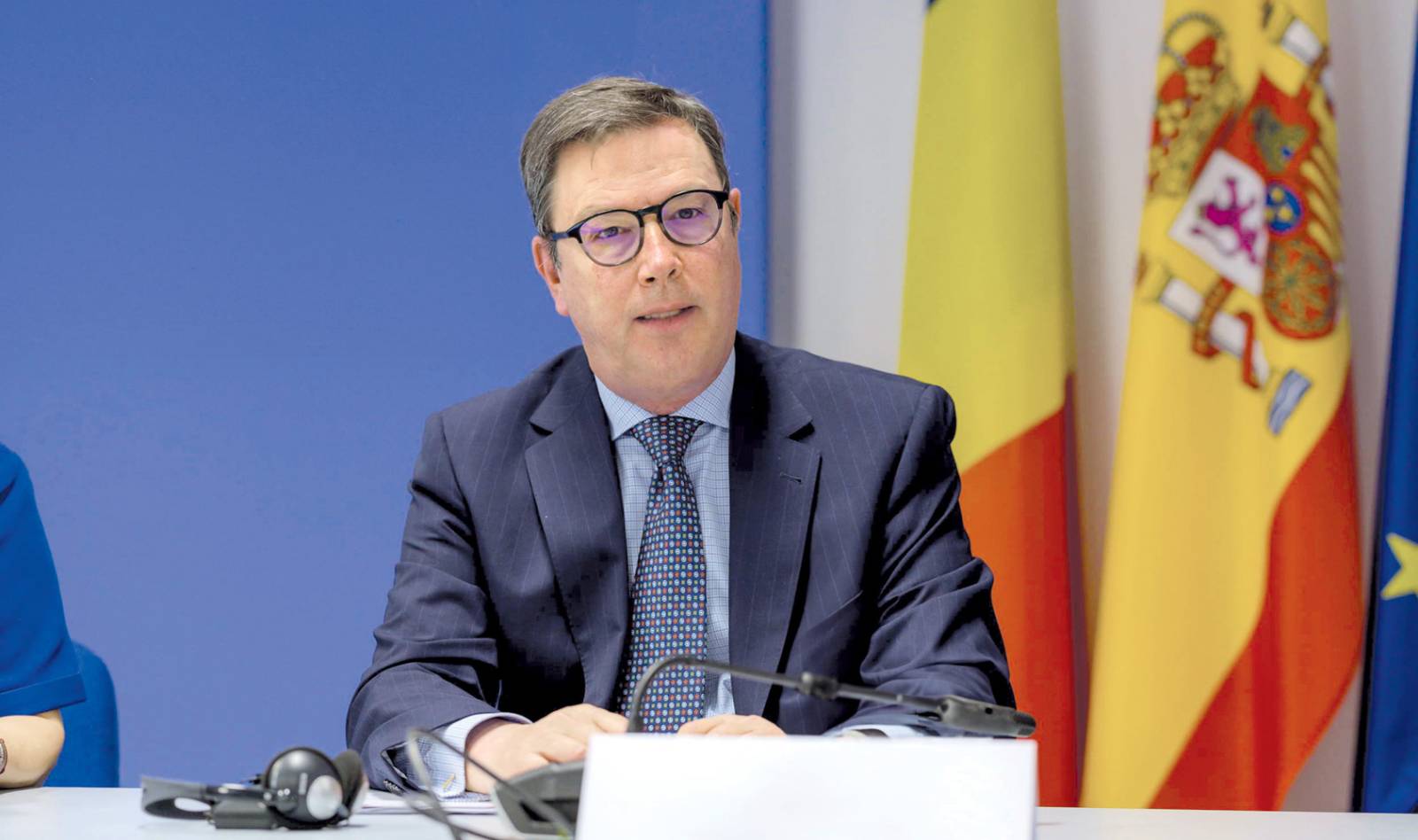
MOLDPRES INTERVIEW // Spanish Ambassador: Moldova’s resilience - matter of European security
The Republic of Moldova can count on Spain’s support in joining the European Union, strengthening democratic institutions and increasing resilience in the face of security threats. In an interview with MOLDPRES, Ambassador of the Kingdom of Spain to the Republic of Moldova, based in Bucharest, José Antonio Hernández Pérez-Solórzano emphasizes that the progress to European integration must be reflected in citizens’ daily lives through the consistent enforcement of laws and the improvement of public services.
The diplomat also highlights the importance of European cooperation in security, justice and combating corruption, as well as opportunities to deepen Moldovan-Spanish economic relations. The interview was conducted in a year of special significance for Spain, which is marking 40 years since joining the European Union.
The ambassador speaks about the experience Madrid can share with Chișinău, Spain’s contribution to strengthening the Republic of Moldova’s European path and prospects for developing partnerships between the two countries. The diplomat also explains the significance of Spain’s National Day, celebrated on October 12, as an occasion to celebrate the history, diversity of Spanish society and ties with the Hispanic world.
MOLDPRES: Excellency, Spain is one of the European Union member states supporting the Republic of Moldova’s European path. How do you assess the progress of the accession process, and which reforms do you consider the most important for the Republic of Moldova to complete at this stage?José Antonio Hernández Pérez-Solórzano: Spain firmly supports the Republic of Moldova’s accession to the European Union. The progress achieved is significant, especially considering the difficult context in which it was made. The agreement on opening negotiations on Chapters 2, Internal Market, and 3, Competitiveness and Inclusive Growth, represents another step forward. I would also like to recall that the decision to open accession negotiations was adopted in December 2023, during the Spanish presidency of the Council of the EU.
At this stage, I believe the priorities remain strengthening the rule of law, combating corruption and reinforcing the administration’s capacity. It is important that adopted laws be applied consistently and that citizens be able to see the results in their everyday lives.
This year, Spain is celebrating the 40th anniversary of its accession to the European Communities, which later became the European Union. We know from our own experience how much European integration can contribute to a country’s modernization. We also know that reforms require time and effort. Therefore, we support the Republic of Moldova both politically and through practical cooperation. The European twinning project in the field of labor inspection, led by Spain, is an example of this support.
MOLDPRES: The war in Ukraine and the actions of the Russian Federation are creating new security challenges for the Republic of Moldova, ranging from drone incidents and airspace violations to hybrid threats. How can the Republic of Moldova strengthen its capacity to address these challenges, and what role can Spain play in this effort?José Antonio Hernández Pérez-Solórzano: Russia’s war of aggression against Ukraine has direct consequences for the Republic of Moldova. Spain supports this country’s sovereignty, independence and territorial integrity. We also appreciate the solidarity shown by Moldovan citizens toward Ukrainian refugees, despite the difficulties they themselves face.
The threats facing Moldova are not isolated incidents, but part of a context of increasing pressure on the security and democratic institutions of the region. Disinformation, cyberattacks and energy vulnerabilities seek to undermine citizens’ trust in their institutions and limit states’ ability to freely decide their future. Therefore, Moldova’s resilience is also a matter of European security. Strengthening airspace surveillance, protecting critical infrastructure and improving the ability to respond to hybrid threats must be a joint effort, within which the European Union plays a fundamental role.
Spain contributes to the European effort to support the Republic of Moldova. The EUPM civilian mission plays an important role in strengthening the capacity to respond to crises and hybrid threats. There is also a bilateral dimension: the visit of Spanish Defence Minister Margarita Robles to Chișinău in April reflected the will to develop cooperation in the field of defence. We can continue building on this foundation, starting from the needs identified by the Moldovan side.
MOLDPRES: Cooperation in the field of justice is one of the important areas on the Republic of Moldova’s European agenda. What experience and expertise from Spain could be used to strengthen the rule of law, judicial independence and the fight against corruption in the Republic of Moldova?José Antonio Hernández Pérez-Solórzano: Cooperation in the field of justice takes place both at ministerial level and between judicial self-governance institutions. In September 2025, Spanish Justice Minister Félix Bolaños received Veronica Mihailov-Moraru, then Minister of Justice of the Republic of Moldova, in Madrid. The discussions focused on the digitalization of justice, the fight against corruption and the strengthening of international legal cooperation. This provides a solid basis for continuing exchanges between our specialists.
There has also been a recent development: the Superior Council of Magistracy of the Republic of Moldova and Spain’s General Council of the Judiciary have completed negotiations on the text of a memorandum of understanding. The translation of the document into Romanian and Spanish, as well as its electronic signing, remain to be completed. This initiative opens up new opportunities for direct cooperation between the two institutions.
Spain can share its experience in training magistrates, organizing court activities, digitalization and citizens’ access to justice. In the fight against corruption, exchanges of experience concerning the investigation of economic crimes and the recovery of assets derived from criminal activities could prove useful.
Each country has its own system and its own difficulties. What matters is that these contacts lead to practical cooperation adapted to the needs of our Moldovan partners. The common objective is an independent, professional and accessible justice system that guarantees citizens that the law is applied equally to everyone.
MOLDPRES: How do you assess economic relations between the Republic of Moldova and Spain, and which sectors have the greatest potential for developing bilateral investment and trade? Are there sectors in which you believe Spanish businesspeople could have a more active presence on the Moldovan market?José Antonio Hernández Pérez-Solórzano: Our economic relations are based on a foundation that we can continue to build upon, but I believe there is still significant untapped potential. Spanish companies are present on the Moldovan market, and we want to encourage more contacts and business partnerships. Spain’s permanent diplomatic presence in Chișinău helps us monitor opportunities more closely and maintain dialogue with the authorities and the business community.
I would highlight transport infrastructure, renewable energy, energy efficiency and water management. These are sectors in which Spanish companies have experience and where the Republic of Moldova has modernization projects and needs. In the agri-food sector, there are opportunities for cooperation in irrigation, processing, storage and distribution. Digital services are also an area of interest.
Moldova’s gradual integration into the European single market can open up new opportunities for our companies and help strengthen investor confidence. Spain has competitive and internationalized companies in sectors that will be fundamental to the modernization of the Moldovan economy, such as infrastructure, energy, water management and the agri-food industry. The current challenge is to turn this potential into concrete projects by identifying investment opportunities and local partners and providing a stable, transparent and predictable business environment. We want Moldova’s rapprochement with the European Union to be accompanied by increasingly close economic ties between the two countries.
MOLDPRES: The community of Moldovan citizens in Spain is an important bridge between the two countries. How does this community contribute to the development of bilateral relations, and what role can it play in strengthening the economic, social and cultural ties between the Republic of Moldova and Spain?José Antonio Hernández Pérez-Solórzano: For many Moldovan citizens, Spain has become a second home. They contribute to the economy and the life of the communities where they live while maintaining close ties with the Republic of Moldova. This closeness between people is one of the strongest foundations of our bilateral relationship.
Knowledge of both countries can contribute to business development, the establishment of professional contacts and the organization of cultural and educational initiatives. Young people who grow up familiar with both languages and societies play a particularly important role in this regard.
It is important that the relationship between the two states also respond to their concrete needs. The bilateral Convention on Social Security, in force since June 2024, allows, under its provisions, contribution periods completed in both countries to be taken into account when determining pension entitlement.
At the same time, cooperation in education brings us even closer. The bilingual section of the Miguel de Cervantes High School in Chișinău is a good example. Learning Spanish opens up opportunities for study, work and mutual understanding, complementing the ties created by the Moldovan community in Spain.
MOLDPRES: On October 12, Spain celebrated its National Day. What significance does this day have for Spanish society, and what message would you like to convey to the citizens of the Republic of Moldova on this occasion?José Antonio Hernández Pérez-Solórzano: National Day is an occasion to celebrate what unites us as a country, our history and the diversity of Spanish society. October 12 also has international significance because of the historical, cultural and human ties with the Hispanic world. For us, it is also an opportunity to share this celebration with Spain’s friends.
This year has special significance because we are commemorating 40 years since our accession to the European Communities. Accession to the European project contributed significantly to Spain’s transformation and to expanding opportunities for its citizens. It is an experience that we confidently share with our Moldovan partners.
To the citizens of the Republic of Moldova, I would first like to convey a message of friendship, admiration and confidence. We know that you are going through a difficult period, but we also know that you have shown extraordinary determination in building your own future. Forty years ago, Spain experienced a profound transformation thanks to its European integration, and we know well the value of this project. Therefore, when we look toward Moldova, we do not see only a country aspiring to join the European Union, but a future partner with whom we wish to share this project. Spain will continue to accompany you on this path, convinced that Moldova’s future belongs to its citizens and that Europe will be stronger through their participation.
Diplomatic relations between the Republic of Moldova and the Kingdom of Spain were established on January 31, 1992, through the signing in Prague of a joint communiqué by the foreign ministers of the two countries. In June 2022, Spanish Prime Minister Pedro Sánchez paid first visit by a head of the Spanish Government to the Republic of Moldova.
Spain’s National Day is celebrated annually on October 12 and is an occasion to celebrate the history, identity and diversity of Spanish society, as well as the historical, cultural and human ties with the Hispanic world. On this occasion, the Embassy of the Kingdom of Spain in Chișinău will organize a reception on Friday, October 16, at the National Museum of the History of Moldova, attended by representatives of the authorities, the diplomatic staff and other institutions.
 Facebook
 Instagram
 X/Twitter
 Telegram
MOLDPRES INTERVIEW // Vice President of Romanian Academy says academic, research environment of Moldova advanced, can be efficiently integrated into European, international structures
MOLDPRES INTERVIEW // Rector of University from Romanian city says if someone overturns your history, national identity, it means you don’t have enough knowledge
MOLDPRES INTERVIEW // Director of South Regional Development Agency says Agency creating better living conditions, easier life for thousands of residents
MOLDPRES INTERVIEW // Lithuanian Ambassador about prospects of Moldova’s EU accession: If you make things real, they will become achievable
MOLDPRES INTERVIEW // Moldovan finance minister says government aims to modernize financial system for benefit of businesses, citizens
MOLDPRES INTERVIEW // Ambassador of State of Qatar to Moldova: We are working to improve ways of attracting Qatari investors to Moldovan market
MOLDPRES INTERVIEW // President of Moldova's Chamber of Commerce and Industry says country must use opportunities provided by European integration to attract investments, become competitive
MOLDPRES Interview // Minister of Internal Affairs: Interior Ministry applies European security standards and is ready to advance in EU accession process
MOLDPRES INTERVIEW // Moldovan energy minister says foremost interest citizens to have secure energy at affordable prices
Moldovan justice minister says, according to European Commission’s Report, Moldova made greatest progress among EU candidate states, including in justice field
INTERVIEW MOLDPRES // Moldovan defense minister says Russia's war in Ukraine highlighted vulnerability of defense sector, need of building strong, prepared, resilient army to current challenges
INTERVIEW WITH MOLDPRES // Deputy PM says wants Moldova where a child from any village has same opportunities as a child from Chisinau
INTERVIEW MOLDPRES // Deputy Prime Minister on Ukraine Peace Agreement: No discussion about Moldova can take place without Chișinău's participation
INTERVIEW MOLDPRES // Moldovan agriculture and food industry minister says European integration fundamentally changes way leadership supports agriculture
Government launches in-depth assessment of Yandex Go’s activities in Moldova
Speaker welcomed Norway’s decision to turn mission in Chișinău into full-fledged embassy
DOC // Official Journal publishes decision on modernization of 25 technical vocational education institutions
Gagauzia enters electoral campaign for 15 November elections
MOLDPRES INTERVIEW // Spanish Ambassador: Moldova’s resilience - matter of European security
Four drones flew over airspace of Moldova last night
EU Ambassador to Moldova says justice reform, fight against corruption remain priorities on country’s European path
 National Bank of Moldova
Speaker held talks with counterparts from Italy, France and Türkiye
Moldovan PM attends event on launch of Moldova AI Hub
Moldovan parliament speaker presents Moldova’s experience in countering foreign interference at European Conference of Presidents of Parliament
Progress in implementing public administration reform roadmap discussed with civil society of Moldova
Moldovan deputy PM for reintegration has meeting with Special Representative of OSCE Chairperson-in-Office for Transnistrian Settlement Process

“Unprecedented progress”: Moldova might open all six negotiation clusters by end of 2026 year
Moldova counts on France’s support to open final two clusters of EU accession negotiation chapters
Eight companies of Moldova to receive grants for setting up family-, child-friendly spaces
Moldovan prosecutors’ evaluation commission says Constitutional Court’s ruling produces effects for future, does not affect acts issued previously based on challenged provisions
Moldovan parliament speaker in Rome says cooperation between Moldovan, Italian parliaments essential to Moldova's EU accession process
Moldovan PM attends event on launch of Moldova AI Hub
Moldovan parliament speaker presents Moldova’s experience in countering foreign interference at European Conference of Presidents of Parliament
PHOTO // European Village: Over 7 million lei invested in Taraclia museum
ARMENPRESS: Guterres praises Armenia’s ‘remarkable’ leadership and diplomacy in organizing COP17
Moldova, Council of Europe assess progress in implementing 2025–2028 Action Plan
Moldova's Constitutional Court declares unconstitutional amendments that allowed Herman von Hebel’s appointment to prosecutors’ evaluation commission
Approved by Moldova's government: personal allowance to rise to 46,680 lei, VAT-free electricity consumption threshold to reach 150 kWh
Progress in implementing public administration reform roadmap discussed with civil society of Moldova
Moldovan deputy PM for reintegration has meeting with Special Representative of OSCE Chairperson-in-Office for Transnistrian Settlement Process
Training for future teachers to be reformed in Moldova: practical experience from first year, master’s degree tailored to specialization
Moldovan energy minister speaks about new value added tax thresholds for energy, additional funding for energy efficiency
Receive the latest news directly to your email

Receive the latest news directly to your email