
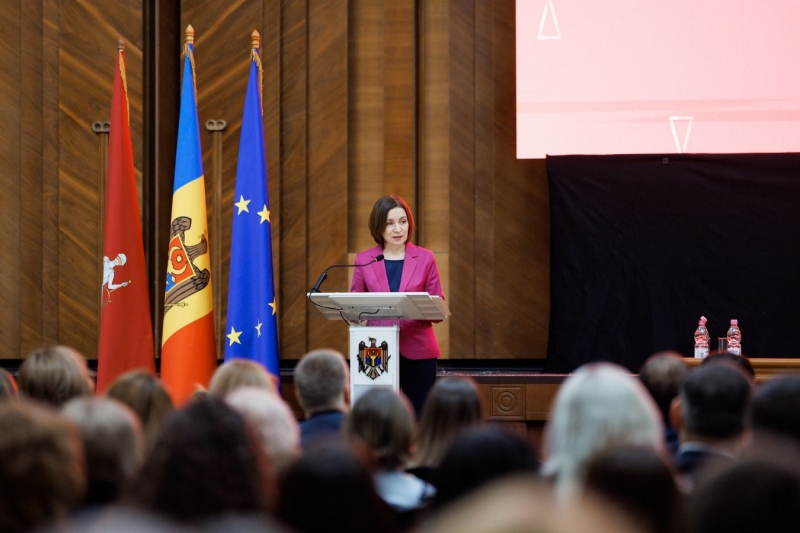
President’s address to General Assembly of Judges
Mr. Commissioner,

Mr. President of the Superior Council of Magistracy,

Madam President of the Constitutional Court,

Mr. Minister,

Mr. Acting Prosecutor General, Ladies and Gentlemen Judges,

Building a peaceful, safe, and prosperous country is our common aspiration. But to achieve it, no matter how dynamic economic and social development may be, we need justice. Because without a fully functional rule-of-law state, we cannot speak of a truly civilized country.

A few years ago, we embarked on a process of transformation that few believed possible. A complex process, which is taking longer than we would have liked and which requires enormous effort. Efforts whose results are beginning to show.

Despite a difficult year, with internal and external challenges, the 2025 Enlargement Package highlighted the results achieved by the Republic of Moldova, including those related to justice. Perhaps more importantly, the first surveys are appearing that show an increase in our citizens’ trust in justice—after decades in which people’s trust went only downward.

These results, still fragile but valuable, are due in large part to the work of honest and dedicated people within the system. But we must acknowledge that there is still considerable work to be done before the entire judicial system is imbued with the spirit of justice. For the proper functioning of justice, we must continue the process of integrity vetting.

Further action is needed in areas such as court and resource management, magistrates’ accountability, unification of case law, and professional training. Commitments in this regard are also included in the reform agenda and the rule-of-law roadmaps. I have said it before and I repeat: we are not reforming the justice system because the European Union or the Commissioner demands it, but because the people of our country want the law to have the final say; they want, when they seek justice in court, to be confident that they will find it.

And time is limited. In recent years, the institutions of judicial self-administration have been strengthened. The creation of the specialized boards of the SCM, the strengthening of the Judicial Inspection and the SCM’s administrative apparatus, as well as the completion of the Council’s composition, have already led to a more efficient functioning of the system and to the outlining of a common vision regarding integrity standards.

The efforts of the SCM must continue to be directed towards solving systemic problems and adopting the necessary measures in the accession process. On March 30 it will be three years since the adoption of the new law on the Supreme Court of Justice. In practice, we are talking about a new supreme court, which must bring clarity, predictability, and professionalism to the system.

The activity of the court’s current composition has already demonstrated transparency and the ability to manage a difficult situation, marked by the burden of backlogs. At the same time, sustained efforts are needed, especially at the level of the Courts of Appeal, where there is a large number of vacant positions. But to see the reform through to completion, we cannot allow vulnerabilities generated by rapid and superficial appointments. It must be noted that there is better progress in the examination of corruption cases.

The proper resolution of these cases contributes not only to the reduction of corruption, but also to the protection of national security. The safety of judges is a priority. Parliament recently adopted legislative amendments to strengthen court security and protect magistrates in the exercise of their duties. Professional training and continuous education within the National Institute of Justice, performance evaluations by the SCM’s specialized bodies, and communication from the Supreme Court of Justice with the lower courts must function consistently.

The process of justice reform also involves recruiting and preparing future generations of judges who will meet the highest standards. This means having high criteria for admission to the system, reforming higher legal education, and investing in the NIJ. These and many other measures are necessary to ensure a functional system, as well as to advance the process of European integration. I have said many times and I repeat: the most important reform for the European integration of the Republic of Moldova is justice reform.

The next steps in the accession negotiations depend on how the situation in the justice sector evolves. And the completion of this process depends on the consistency of our actions. I am sure that no one in this hall wants our country to miss the chance of EU accession because of an insufficiently reformed justice system. Because this is not just about us; it is about our children and grandchildren, to whom we have a duty to leave a safer country.

We must build a system in which society can trust that integrity and quality standards in justice are fully respected, and that judicial decisions provide litigants with clarity regarding the elements that led to the establishment of judicial truth. I encourage you to fulfill your duties with honesty, strength of character, and strict respect for the law.

Because society’s trust is built through results. Each decision delivered with integrity and professionalism brings the Republic of Moldova closer to the European Union, to a future in peace and freedom. Each step on the path toward an independent judiciary is a step toward economic development and better living conditions for our citizens. This is a path that requires consistency and responsibility. A path that we cannot postpone and from which we cannot deviate. Thank you.
 Facebook
 Instagram
 X/Twitter
 Telegram
Moldova’s Growth Plan – development, investment opportunities discussed at EBA Business Outlook 2026
Combating cross-border crime – priority for National Security Council of Moldova
Moldovan president participates in EBA Business Outlook 2026 conference
Speaker to attend Parliamentary Summit of the Three Seas Initiative in Zagreb
Forest Generation: State Chancellery participated in afforestation campaign in Dereneu village, Călărași
President: Future of democracy depends on how we protect each person's ability to think independently
Moldovan PM has meeting with European Commission's Director-General for Neighbourhood and Enlargement Negotiations
PM, Chair of NATO Military Committee discuss modernizing security sector of Moldova
President meets with Admiral Giuseppe Cavo Dragone, Chair of NATO Military Committee
Consultations on local public administration reform held in all districts of country and Gagauzia: Over 4,500 mayors and citizens participated
Moldovan President met with UK Minister of State
Water supply in Bălți, Soroca, Sîngerei and Florești restored
Moldovan government's secretary general participates in European Social Charter Conference
Moldovan deputy PM has meeting with Chargé d’Affaires of United States in Moldova
Moldovan President attends General Assembly of Judges
PHOTO // Republic of Moldova opened Honorary Consulate in Almaty, Kazakhstan
President on 108 years since Union of Bessarabia with Romania
Farmers from 14 districts to receive irrigation grants
 National Bank of Moldova
Moldovan President attends General Assembly of Judges
TeConsult strengthens role in open government: second edition of training program completed
Moldovan parliament takes note of MP's resignation
Moldovan government approves new measures to protect consumers, ensure access to fuel
Road passenger transport fares to be adjusted in Moldova

Prime Minister conveys message on anniversary of Bessarabia's Union with Romania
Around 300 magistrates attend General Assembly of Judges
DOC // Official Journal publishes amendment to fuel price-setting mechanism during state of emergency
DOC // Amendment to methodology for calculating tariffs in road transport published in Official Journal
Speaker - 108 years after Union of Bessarabia with Romania
ANTA: All regular passenger routes resumed
Risk of power outages during peak hours
CNMC warns of risk of temporary disconnections during peak hours
Collaboration memorandum with Slovak Investment and Trade Development Agency signed in Bratislava
Moldova may face difficulties in ensuring electricity supply
Moldova's national football team defeated by Lithuania at friendly match held in Chisinau
Moldovan president delivers message at Economic Forum in Bratislava
Moldovan law-enforcers uncover “legalized” smuggling scheme causing damage of over 4 billion lei
Moldovan parliament takes note of MP's resignation
Moldovan government approves new measures to protect consumers, ensure access to fuel
PHOTO // Moldovan foreign affairs minister meets Romanian senators
Receive the latest news directly to your email

Receive the latest news directly to your email