
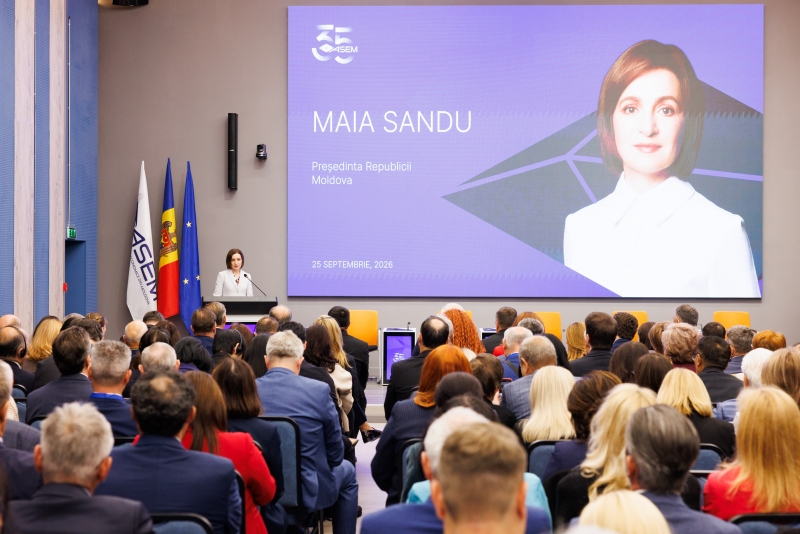
President’s speech at ASEM’s 35th anniversary
Mr. Rector,

Honoured guests,

Ladies and gentlemen,

Dear professors and students,


I am pleased to return to ASEM, this time to celebrate together 35 years since the Academy was founded.

This anniversary also has a personal dimension for me. I am an ASEM graduate, and my professional education began here.

The Academy was founded practically at the same time as the Republic of Moldova. Thirty-five years ago, it was called upon to prepare people for an economy at the beginning of profound transformations, whose course and consequences were difficult to anticipate. It also had to train specialists for a state that was being built from scratch.

The transition from a planned economy to a market economy was difficult. New institutions, rules, and professions were needed. For ASEM, many of the answers had to be found along the way.

There was no blueprint for carrying out such an economic transition, and the transformations were not easily accepted by everyone—I remember professors who still insisted on Vadim Medvedev’s Political Economy, while other professors courageously promoted Paul Samuelson’s Political Economy.

Despite the difficulties inherent in such a beginning, over these three and a half decades ASEM has succeeded in training generations of economists, managers, accountants, and financial specialists. Today, we find them in companies and banks, in state institutions, in international organizations, and in businesses established here or abroad.

And now, after 35 years, we once again find ourselves in the midst of profound changes that are fundamentally transforming humanity and the way we work, produce, learn, and build our future.

These transformations are different, but the questions we ask ourselves are, in a way, similar to those ASEM faced in its early days.

How do we find our place in a world where the rules of the economy, work, and global competition are being redefined?

How do we prepare young people for professions that are transforming before our eyes? How do we build an economy capable not only of withstanding shocks, but also of benefiting from the opportunities they bring?

In a world where technology can produce a text, an analysis, or a financial model in a matter of seconds, the ability to formulate the problem correctly, verify an answer, understand the context, think critically, and make responsible decisions matters more and more.

At the same time, the energy transition and climate change are transforming entire industries and economic models.

And today’s wars and geopolitical tensions show us how vulnerable economies are in such an interdependent world, where conflicts even thousands of kilometers away can disrupt supply chains, markets, and trade flows.

We have many reasons for concern—but we also have reasons to be optimistic.

There is one fundamental difference compared with the complicated beginnings of the 1990s—the Republic of Moldova is no longer alone in facing major challenges.

We have strong friends and partners. We have access to the experience and knowledge of a Europe that we are drawing closer to with each passing day.

And, perhaps most importantly, we know where we want to go.

Our economy is already becoming increasingly closely linked to the economy of the European Union. Most Moldovan exports go to the European market, while investments and infrastructure are connecting us ever more closely to the European space.

But access to a large market does not, by itself, guarantee prosperity. We must have something to offer this market: we must produce more, more competitively, and with greater added value here, in Moldova. And we must have people capable of bringing about this change.

And this is where ASEM has an important role to play. We cannot afford to waste anyone’s talent or the potential of any generation. We must build an economy where well-prepared people can find opportunities to work, conduct research, start a business, and invest. An economy where a young person is not forced to choose between a successful career and life at home.

This means a closer connection between the university and the real economy—between professors, companies, entrepreneurs, and public institutions. It also means economic research that reflects our own economy, vulnerabilities, and advantages, and that brings forward our own ideas and answers, adapted to our economic and social realities.

Especially since membership in international academic networks and cooperation with universities abroad give ASEM professors and students the opportunity to access centers of knowledge that today contribute to the debate on the directions of tomorrow.

In conclusion, I would like to thank everyone who has contributed—and continues to contribute—to what ASEM has become since 1991. I would like us to remember with gratitude ASEM’s first rector, economist and professor Paul Bran, who came from across the Prut River to help us create the Academy.

And to everyone who is part of this wonderful community today, I wish you continued success in building on everything that has been created here.

Happy anniversary, ASEM!
 Facebook
 Instagram
 X/Twitter
 Telegram
Enhanced protection for persons targeted by abusive lawsuits: Moldovan parliament votes on anti-SLAPP legislative package in second reading
Moldovan, Norwegian Prime Ministers approach bilateral partnership
Judicial reform, rule of law in focus of discussions between Moldovan president, new Head of Council of Europe Office
Moldovan parliament's standing bureau approves agenda for September 24 plenary meeting
Topics considered at meetings of Moldovan parliament's standing commissions on September 23, 2026
New opportunities for professional development, salary supplements for employees in Moldova's social assistance system
Parliament to ratify new agreement between Moldova and Romania on strategic transport infrastructure
Civil protection and fire protection to be regulated by rules aligned with European standards
Clearer, more visible health warnings on tobacco products' packaging in Moldova
Legal framework for integration of foreigners in Moldova to be strengthened
National legislation on electronic evidence to be aligned with international standards
Energy communities: clearer rules for establishment and registration
Modernization works for district heating systems in Chișinău and Bălți to be declared matter of national public utility
Obtaining permits and approvals for renewable energy production to be simplified
Moldovan, Dutch Prime Ministers discuss European path and investments
Moldova, Egypt discuss expanding economic relations
Moldova condemns Russia’s organization of parliamentary elections in Transnistrian region at OSCE
PHOTO, VIDEO // NBM launches commemorative coin dedicated to ASEM’s 35th anniversary
 National Bank of Moldova
Children with hearing impairments teach MPs and officials sign language
Moldovan, Irish Prime Ministers discuss progress on European path
Summary of Moldovan parliament's plenary meeting from September 24, 2026
Moldova's social assistance system employees to benefit from new professional development opportunities, salary bonuses
Moldovan president attends ceremony on 80th anniversary of State University of Moldova

Children with hearing impairments teach MPs and officials sign language
PHOTO // Aircraft that exploded in Briceni had components marked “ГЕРАНЬ 4,” police announce
Moldovan, Irish Prime Ministers discuss progress on European path
Moldova seeks to diversify imports of gas, oil products from Azerbaijan
China, Moldova prepare new cooperation projects; Chinese Ambassador: “We are ready to deepen relations”
Summary of Moldovan parliament's plenary meeting from September 24, 2026
VIDEO // Moldova completes 95 percent of actions planned to date under Growth Plan
Moldovan government promises maximum transparency in gas procurement
Drone fragments discovered outside north Moldova settlement
Moldova's social assistance system employees to benefit from new professional development opportunities, salary bonuses
Moldovan president attends ceremony on 80th anniversary of State University of Moldova
New working meeting of political representatives in negotiations on Transnistrian settlement held in Tiraspol
Regulatory framework on civil protection, fire safety to be aligned with European standards in Moldova
Moldovan parliament ratifies new agreement between Moldova, Romania on strategic transport infrastructure
Moldovan PM, in interview with Bloomberg, says European path creates huge economic opportunities for Moldova, as well as for investors who come to country
Works of modernization of district heating systems in Chisinau, Balti to be declared of national public utility; draft passed in first reading
Receive the latest news directly to your email

Receive the latest news directly to your email