
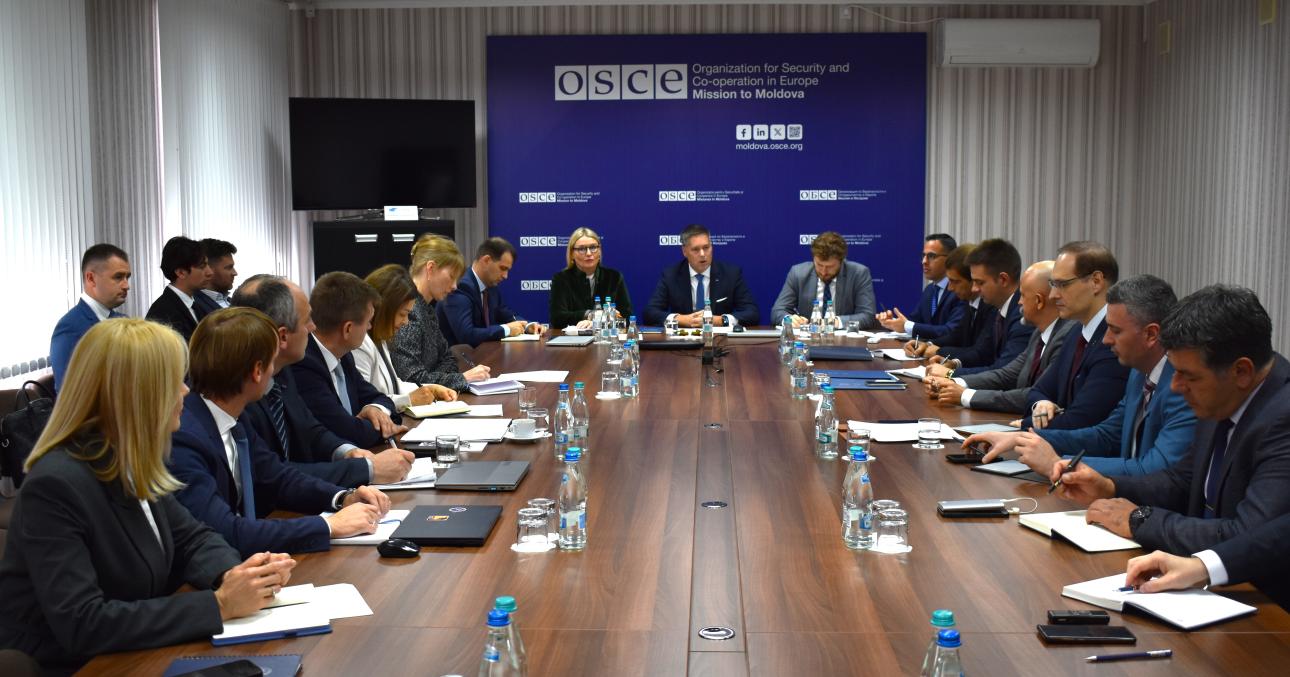
New working meeting of political representatives in negotiations on Transnistrian settlement held in Tiraspol
A new working meeting between the political representatives of Chisinau and Tiraspol in the negotiations on the Transnistrian settlement, Valeriu Chiveri and Vitalii Ignatiev, mediated by Christopher W. Smith, Head of the OSCE Mission to Moldova, was held in Tiraspol, Republic of Moldova, today

The discussions focused primarily on the social and economic aspects of reintegration and respect for fundamental human rights.

Deputy Prime Minister Valeriu Chiveri reaffirmed the authorities’ firm commitment to a peaceful and sustainable settlement, with respect for the sovereignty and territorial integrity of Moldova within its internationally recognized borders. The Moldovan official emphasized that the goal of the dialogue was the reintegration of the country and the restoration of unified national spaces — legal, economic, social, educational and others — and that the solutions under discussion must contribute to this objective and bring tangible benefits to citizens.

A central topic was the Convergence Fund, designed as an instrument for reducing the social and economic disparities between the Transnistrian region and the rest of the country. The areas of support and the stages of the implementation mechanism were presented, with an emphasis on social protection, healthcare, education and infrastructure. The Fund’s resources will be directed toward people and communities through legal, transparent and verifiable mechanisms that ensure direct access to the support provided by the state. In the context, Valeriu Chiveri  noted that, during the first half of 2026 alone, the constitutional authorities had allocated more than 218 million lei for the social, medical and educational support of region’s residents.

In order to bring public services closer to citizens, Chisinau proposed opening a social services center and a family doctors’ office in the Bender municipality. The initiative would facilitate access for residents of Bender, Tiraspol and neighboring localities to social benefits, consultations and primary healthcare, reducing their travel and expenses. The project is designed as a first step toward expanding national public services in the region and the removal of any obstacles to the activities of the competent institutions and to beneficiaries’ access was requested.

As for the economic dimension, the Moldovan deputy PM explained the rationale and phased nature of applying value added tax (VAT) and excise duties to certain categories of goods imported by economic operators from the region. Chiveri emphasized that the gradual unification of the fiscal and customs space aimed to ensure fair conditions for entrepreneurs throughout the country and to integrate economic activity into a fair, predictable framework that complies with the legislation of Moldova.

Particular attention was paid to the right to education. Chisinau insisted on the full and unconditional return of the premises of the “Evrica” theoretical lyceum in Rabnita and the “Ștefan cel Mare și Sfânt” theoretical lyceum from Grigoriopol, with respect for property rights and ensuring unrestricted access. In the case of the “Evrica” lyceum, the need to return the entire complex of buildings and the adjacent land was reiterated, while regarding the high school in Grigoriopol, the readiness to finance the necessary rehabilitation works after the building is returned and access obstacles are removed was reconfirmed. Children’s right to study in their own cities and in appropriate conditions cannot be politically conditioned or postponed indefinitely.

At the same time, the proposal to return to education in the Romanian language in Moldovan educational institutions of the region that use the Cyrillic script was reiterated.

Freedom of movement was reaffirmed as a fundamental right that must be permanently guaranteed. Chisinau requested the removal of travel restrictions between localities and across the bridges over the Dniester.

Regarding the registration of vehicles with neutral-design license plates, a willingness to examine options for continuing to apply the mechanism under the national legal framework was expressed. At the same time, the removal of obstacles imposed by Tiraspol on owners of vehicles with national license plates was requested, including dual-registration practices and parallel payments that generate additional expenses for citizens.

Deputy Prime Minister Valeriu Chiveri confirmed his openness to continuing a regular and constructive dialogue focused on achieving tangible results for the benefit of the population, and reiterated the proposal to hold the next meetings, including in Chisinau, in accordance with the principle of rotating venues.

Restoring citizens’ rights, access to state services and removing barriers between the two banks of the Dniester stay priorities of Moldova’s reintegration policies.
 Facebook
 Instagram
 X/Twitter
 Telegram
Parliament to ratify new agreement between Moldova and Romania on strategic transport infrastructure
Civil protection and fire protection to be regulated by rules aligned with European standards
Clearer, more visible health warnings on tobacco products' packaging in Moldova
Legal framework for integration of foreigners in Moldova to be strengthened
National legislation on electronic evidence to be aligned with international standards
Energy communities: clearer rules for establishment and registration
Modernization works for district heating systems in Chișinău and Bălți to be declared matter of national public utility
Obtaining permits and approvals for renewable energy production to be simplified
Parliament to examine legislative measures to strengthen NBM independence in line with European standards
Moldovan and Romanian lawmakers to discuss cooperation in education
Moldovan PM says government must have necessary tools before crises materialize
Moldovan parliament declares nationwide state of emergency in energy, hydrological sectors for 60 days
Moldovan PM, European Commission official discuss accelerating growth plan projects
Moldovan PM's speech at parliament's plenary meeting on establishment of emergency state
New working meeting of political representatives in negotiations on Transnistrian settlement held in Tiraspol
Moldovan PM, in interview with Bloomberg, says European path creates huge economic opportunities for Moldova, as well as for investors who come to country
MOLDPRES INTERVIEW // Slovak Ambassador: Moldova deserves to be part of EU in near future. It can complete accession process by 2030
VIDEO // Russia tried to destabilize our country and spent hundreds of millions of dollars for this purpose. Moldova resisted, Prime Minister says
PM, former U.S secretary of state discuss regional security, investment opportunities of Moldova
The first meeting of Growth Plan's Monitoring Committee: Moldova maintains high pace of reforms' implementation
More than 50 UN member states called on Russia for complete, immediate and unconditional ceasefire in Ukraine
 National Bank of Moldova
Regulatory framework on civil protection, fire safety to be aligned with European standards in Moldova
Moldovan parliament ratifies new agreement between Moldova, Romania on strategic transport infrastructure
Works of modernization of district heating systems in Chisinau, Balti to be declared of national public utility; draft passed in first reading
Process for getting permits to produce energy from renewable sources to be simplified in Moldova
PM, former U.S secretary of state discuss regional security, investment opportunities of Moldova

National mechanism for protection, legal assistance, financial compensation of crime victims to be strengthened in Moldova
PHOTO GALLERY // 80 years since founding of USM and century of Romanian education in Bessarabia
ARMENPRESS // James Cameron to meet Yerevan fans in November
The first meeting of Growth Plan's Monitoring Committee: Moldova maintains high pace of reforms' implementation
Moldovan president's speech at ceremony marking 80th anniversary of founding of State University of Moldova, centenary of Romanian university education in Bessarabia
More than 50 UN member states called on Russia for complete, immediate and unconditional ceasefire in Ukraine
More than 50 UN member states called on Russia for complete, immediate and unconditional ceasefire in Ukraine
VIDEO // Prime Minister - interview with CNN: We welcome United States involved in energy support projects for Moldova
Moldovan parliament approves new rules for tobacco products' packaging
Moldovan parliament speaker says Russia triggers tensions, seeks to sow fear by unauthorized overflights of airspace
Moldova discusses strengthening airspace protection capabilities with Romania and Ukraine, Speaker says
Republic of Moldova reaffirms commitment to refugee protection at UN meeting dedicated to 1951 Convention
Parliament votes, in first reading, on legislative measures to strengthen independence of National Bank of Moldova in line with European standards
Moldovan parliament adopts amendments to Law on Constitutional Court
Moldovan parliament adopts legislative amendments to make procedure for selecting, appointing candidates for position of Constitutional Court judge more transparent
Medical, pharmaceutical qualifications got in EU to be able to be recognized in Moldova; parliament adopts draft law
Receive the latest news directly to your email

Receive the latest news directly to your email