
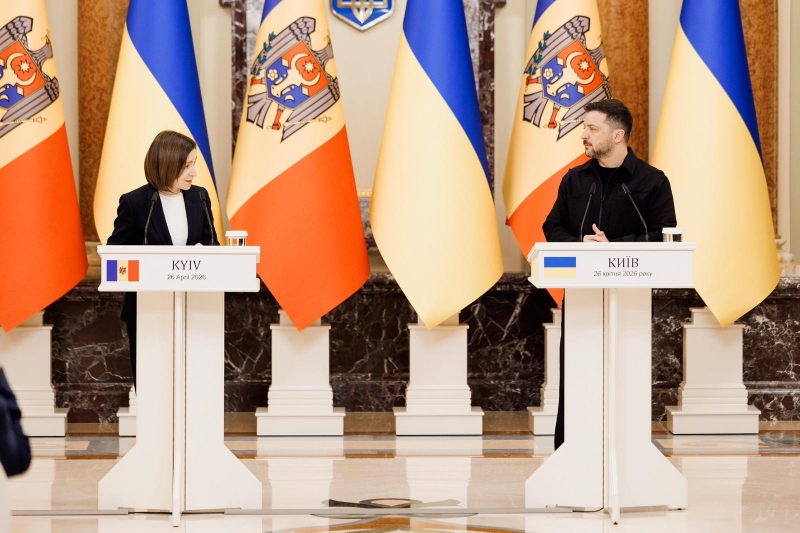
President Maia Sandu’s speech at the joint press conference with the President of Ukraine, Volodymyr Zelenskyy

President Zelenskyy,
Thank you for receiving me in Kyiv. I am always moved to be in this city — a city that has shown the world what it means to refuse to be broken. I am here this morning knowing that the other night, Russia struck again — in Dnipro, in cities across Ukraine. People were killed in their homes.
And I want to say to the people of Ukraine: we see you, we are with you, and the world must not look away.
Today is a day of remembrance. Forty years ago, the Chornobyl disaster reminded an entire continent that the threats of an authoritarian regime do not stop at borders. The Soviet regime knew what had happened — and chose to hide it, while radiation spread across Europe, putting millions at risk.
They sent liquidators — among them, Moldovans — without protection, and without telling them the truth. Many paid for that service with their health and their lives. We remember them today.
Chornobyl laid bare the Soviet regime's contempt for human life. Little has changed in the Kremlin since. That same contempt is visible in Russia's conduct today.
And yet, facing it, Ukraine fights. Ukraine innovates. Ukraine endures.
Dear Volodymyr, what your country has accomplished in defending its people and its sovereignty is remarkable. Ukraine has rewritten the doctrine of modern defence.
Your soldiers and engineers have developed capabilities now studied and sought after across Europe and beyond. Ukraine has become a security provider for the entire continent, and what is learned here shapes how nations think about their defence for years to come.
Such an achievement deserves consistent, firm, unwavering support. I therefore welcome the European Union's decision to extend a 90 billion euro loan to Ukraine, and the new sanctions package against Russia.
This is the way forward: maximum support for the country defending European values, maximum pressure on the aggressor attacking them. More support for Ukraine, more pressure on Russia.
Sustaining that pressure also means ensuring that every act of destruction, every war crime, is answered for. Durable peace requires accountability.
Moldova is proud to be a founding member of the Special Tribunal for the Crime of Aggression against Ukraine, established within the Council of Europe framework. As current Chair of the Committee of Ministers of the Council of Europe, accountability sits at the heart of our presidency — through the Register of Damage caused by Russia's aggression, through the International Claims Commission for Ukraine, and through the Special Tribunal itself.
In a few weeks, Chișinău will host the Council of Europe Ministerial, where we expect the Enlarged Partial Agreement on the Management Committee of the Special Tribunal to be formally adopted — moving it from political commitment to operational reality.
That accountability is personal for us. Russia’s war reaches Moldova too.
Earlier this year three hundred thousand people in northern Moldova were left without safe drinking water for nearly a week after the Russian attack on the Novodnistrovsk power plant. Several weeks later, our electricity supply was disrupted when Russia targeted Ukraine's energy infrastructure. Our airspace has been violated dozens of times.
We are grateful to Ukraine for working with us to address the river pollution and restore the power connection — and for so much more. Because Ukraine, in defending itself, has also been defending us.
[pause]
We feel Russia's aggression very close — in our homes and in our lives. Not in the way Ukraine does. But Moldova has faced its own version of this assault: disinformation campaigns, electoral interference, energy blackmail, cyberattacks — hybrid tools designed to divide us, destabilise us, and turn us into a weapon against Ukraine and the EU.
So we have been building resilience and deepening security partnerships. And that firsthand experience of defending democracy under real pressure has made Moldova a more committed, more capable partner — for Ukraine, and for European security.Chornobyl forty years ago taught us what shared vulnerability means. Russia's war today is teaching it again. That is why we say it plainly: Moldova's security and Ukraine's security are intertwined.
And this is precisely why our European path matters so much.
The EU's promise has always been that progress is rewarded. Moldova and Ukraine have both met the conditions to formally open accession negotiations. Honouring that commitment is not only fair — it is essential to the credibility of the entire enlargement process.
When the EU extended the 90 billion euro loan and adopted new sanctions on Russia, it acted with unity and resolve. The EU should bring that same unity to the enlargement process — and open negotiations for both our countries without further delay.
Dear Volodymyr,
Our shared European future also means working together towards a real, lasting, principled peace — grounded in Ukraine's sovereignty and territorial integrity.
Moldova is prepared to play a meaningful role in the Coalition of the Willing, and to contribute to the reconstruction of Ukraine. Rebuilding Ukraine is Europe's shared responsibility, and Moldova embraces it as its own.
Dear friends,
The people of Moldova stand with the people of Ukraine — today, as yesterday, and as tomorrow.
We remember Chornobyl together. We face today's challenges together. We will build our European future together.
Slava Ukraini.
 Facebook
 Instagram
 X/Twitter
 Telegram
Relaunch of competition for selecting civil society representatives in Open Governance Coordination Committee
President participates in Antalya Diplomacy Forum at invitation of Turkish President
Moldovan head of state meets former president of Poland
Political representatives in process of negotiations for Transnistrian settlement convene at second working meeting of 2026
Dialogue between Moldova's central and local authorities in Comrat
Head of State at commemoration of victims of 1946–1947 famine: When truth is told, even after decades, it brings justice
President’s message at commemoration event for victims of 1946–1947 famine
Moldovan PM pays tribute to maestro Gheorghe Urschi
Moldova consolidates mechanism for implementing international sanctions with EU's support
Government accelerates development of regional waste management infrastructure
Government Program Youth Capital approved by cabinet
Allocation of housing for participants in Chernobyl disaster response – clearer and fairer process
Increased access to digital educational resources: they will be stored on modern national platform
Moldovan deputy PM for Reintegration has meeting with delegation of Estonia's Foreign Affairs Ministry
Child rushed to hospital in Moldova, after wind-felled tree collapses on him
Orange wind alert // Possible flight delays, cancellations at Chisinau-based Eugen Doga Airport
VIDEO // Moldovan environment minister warns: strong winds up to 27 m/s, frost on nights to come
Chernobyl, 40 years after nuclear accident // Moldovan energy minister in Kyiv reaffirms top priority of safety in nuclear projects
Moldova ready to help rebuild Ukraine; Moldovan president Kyiv says Ukraine's recovery shared responsibility of Europe
Commemorative rally for victims of Chernobyl catastrophe held in Chisinau
Orange Wind Warning // Moldovan capital's residents urged to avoid old trees, unnecessary walks
 National Bank of Moldova
Moldovan president has meeting with representatives of Farmers' Force
Moldovan president says what is not allowed offline cannot be allowed online
Moldovan parliament votes on ending of emergency state
Moldovan president has meeting with President of European Economic and Social Committee
Prime Minister’s address in Parliament regarding lifting state of emergency in energy sector

Moldovan PM says learned about Chernobyl tragedy from Voice of America
Moldovan parliament speaker conveys message on 40 years since Chernobyl catastrophe
Moldovan president pays visit to Kyiv, Chernobyl
Forty years since Chernobyl disaster: commemorative events for victims take place in Moldovan capital
Chisinau hosts Moldova Open K-1 Cup: 250 athletes from both sides of Prut River compete for trophy
BTA: Bulgaria Pushes for Formal Coalition Agreement of Continue the Change and Democratic Bulgaria and Common Centre-Right Presidential Candidate
National competition in Chisinau: students from non-Romanian language schools test mother-tongue skills
Moldovan government's secretary general says 376 amalgamation decisions adopted locally; parliament simplifies procedure
Attempted murder in north Moldova settlement: victim transported to hospital in unconscious condition
Orange wind warning issued in Moldova; authorities provide recommendations for population
VIDEO // Europe Day to take place in Chisinau, Soroca; EU Ambassador to Moldova invites citizens to celebration
Chisinau residents urged to buy local products: fairs held in all districts of Moldovan capital
DOC // EU sanctions extended until 2027: Moldova updates list of targeted individuals
DOC // State of emergency in energy sector ends in Moldova
Moldovan president has meeting with representatives of Farmers' Force
VIDEO // Romanian president says there is European-wide consensus to support Moldova, Ukraine, despite nuances on pace of accession to EU
Receive the latest news directly to your email

Receive the latest news directly to your email