
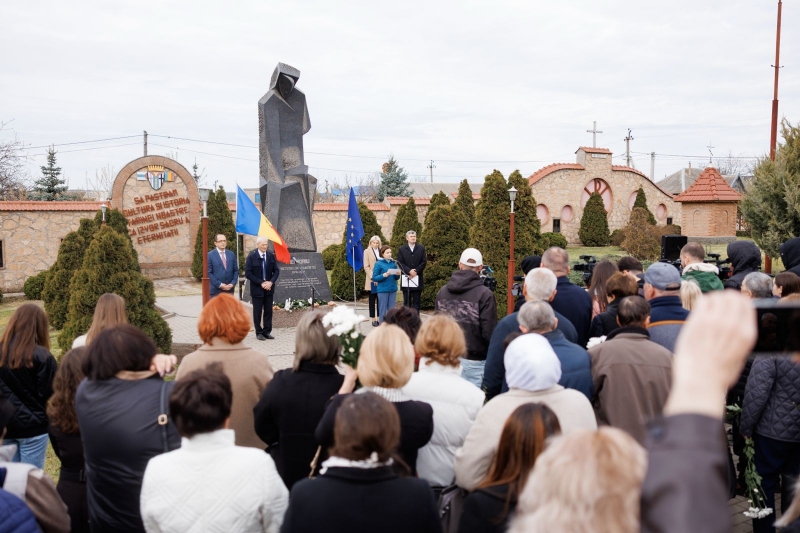
President’s message at commemoration event for victims of 1946–1947 famine
We have gathered here to remember one of the greatest tragedies our people has gone through.

The famine of 1946–1947 affected hundreds of thousands of people and led to the loss of 200,000 lives. Figures that horrify us even today, but which cannot fully encompass the trauma endured by parents and children, young and old.

All communities of our country suffered, without exception, especially since Moldova was the most affected region in the entire Soviet Union. In the wake of this calamity, families were torn apart, children were orphaned, and entire villages were overwhelmed by grief. Villages like Mingir.

Here, around 1,400 people died – almost half of the population at that time.

The commemorative plaques consecrated today in the cemetery restore the dignity of people who were denied it when their lives were cut short too soon. Because in those years, death had become so omnipresent that those who passed away were buried in haste, without a cross, without a service. A silent pain that we can barely imagine. The famine was triggered by a drought. But it was turned into a large-scale tragedy by the criminal decisions of the Stalinist regime. Even when the land yielded nothing, people were forced to give everything they had – or even what they no longer had – down to the last crumb.

The harvests, the reserves, the seeds – everything was taken. Without mercy, without soul. The Stalinist regime cynically used the famine to trample human dignity, pushing people to the edge of survival and, for very many, beyond it.

We speak about this turning point in our history for those who are no longer with us. For their suffering. But also for those who survived and carried for decades the consequences of those losses and the effects of the famine on their health.

We do this for our children and grandchildren, so that they understand how precious and fragile freedom is, and what can happen once it is lost. And because these lessons cannot be left only in books, but must be lived and understood, it is entirely fitting that here, in Mingir, there should be a Museum of the Famine. A place where people can learn, can understand, and can feel what happened. Because this community has borne the burden of those years of suffering perhaps more than any other.

Ladies and gentlemen,

Today we are facing a war for the truth.

There are voices – including in Moldova – that glorify the Soviet past and refuse to call the aggressor by its name, when we speak both about the past and about the present. This is, in fact, another form of aggression against those who endured famine and humiliation.

An aggression against those who, although they survived, could not speak openly about the torment they went through, being forced to remain silent for decades or to recall those moments of horror only in whispers.

That is why today, when we have the privilege of speaking without fear, we must speak for those who can no longer do so. Only in this way can we ensure that lies will not replace the truth. And it is the responsibility of each of us to keep this truth alive. In this regard, we can all follow the example of Mr. Iacob Lupanciuc, who gave every victim in Mingir a name.

Through his work, he shows us how important it is not to let time cover the traces of those who passed through these places and not to allow silence to erase what must be spoken.

To bring back into our collective consciousness people who, for far too long, have remained only in the memories of their loved ones.

Ladies and gentlemen,

The truth about the years of famine is not easy. But it is necessary. Because the truth does not wound – the truth heals. When the truth is spoken, even after decades, it brings justice.

The truth helps us understand what happened – and especially why it happened.

It helps us not to forget.

It helps us not to repeat.

Above all, only the truth makes us free.

Thank you!
 Facebook
 Instagram
 X/Twitter
 Telegram
Involvement of Moldova's authorities in Interreg programming process, in context of new EU multiannual financial framework 2028–2034
MOLDPRES INTERVIEW │ Deputy Prime Minister: Gradual reintegration in different areas - path toward lasting settlement of Transnistrian conflict
Deputy Prime Minister for Reintegration meets with Head of International Committee of Red Cross Mission
Head of State to pay official visit to Ireland, which will hold rotating presidency of Council of European Union starting July
Moody’s Agency upgrades Moldova’s rating to B2, highest level in last 25 years
Moldovan authorities step up prevention, response measures on Dniester, amid anticipated new pollution wave
Moldovan PM participates in awards ceremony recognizing rescuers' achievements
Environmental protection experts from two banks of Dniester hold new working meeting
Moldovan deputy PM has meeting with Ambassador of Germany
President met with U.S. Senator
Proposals for improving efficiency of ministries discussed at roundtable
Prime Minister visited agricultural business in Unguri village, Ocnița district
Prime Minister visited rescuers and firefighters unit in Ocnița
Weekly meeting of Joint Control Commission of 2 April 2026
Moldova's General Police Inspectorate launched internal investigation into police officer who drew up report in name of deceased person
Dialogue between Moldova's central and local authorities in Comrat
Number of fraud attempts rising in Moldova: over 500 attempts reported to 112 in just one week
New local elections: 40 polling stations to be open in 12 localities of Moldova
Progress achieved by Moldova in implementing structural reforms discussed with World Bank Vice President for Europe and Central Asia
VIDEO // Chisinau–Tiraspol dialogue continues; deputy PM reiterates commitment to reintegration, European integration
Head of State at commemoration of victims of 1946–1947 famine: When truth is told, even after decades, it brings justice
 National Bank of Moldova
Dialogue between Moldova's central and local authorities in Comrat
Head of State at commemoration of victims of 1946–1947 famine: When truth is told, even after decades, it brings justice
Moldovan PM pays tribute to maestro Gheorghe Urschi
Moldova consolidates mechanism for implementing international sanctions with EU's support
Government accelerates development of regional waste management infrastructure

PHOTO // Victims of 1946–1947 famine commemorated in Mingir
General Prosecutor’s Office announces legislative initiatives to strengthen preventing and combating domestic violence, developed following analysis of recent cases, including that of Ludmila Vartic
PHOTO // Moldova could become strategic hub for U.S. business
New local elections: CEC announces number of candidates and referendum participants
CSP gives green light: Acting Prosecutor General passes external evaluation
Silver and bronze medals for Moldova at World Sambo Cup
ARMENPRESS: Armenia to restrict drone, private flights during EU summit
Romanian Embassy in Moldova says creation of Relations with Romania Service strengthens bilateral cooperation
Improved access for people with disabilities in Moldova: 30 ramps to be installed in public institutions hosting polling stations
VIDEO // Moldovan government transfers land needed to continue work on bridge across Prut river at Ungheni, connecting Moldova and Romania
Ana Racu elected vice-chair of UN Committee Against Torture
Victims of the organized famine from 1946–1947 to be commemorated in central Moldova settlement
Moldova strengthens economic diplomacy under coordination of Foreign Affairs Ministry
Moldovan PM pays tribute to maestro Gheorghe Urschi
PHOTO GALLERY // Well-known artist of Moldova escorted on path of eternity, amid thunderous applause
Governor of National Bank of Moldova in Washington says country counts on IMF's support to strengthen a resilient financial sector, capable of attracting investment, supporting economic development
Receive the latest news directly to your email

Receive the latest news directly to your email