
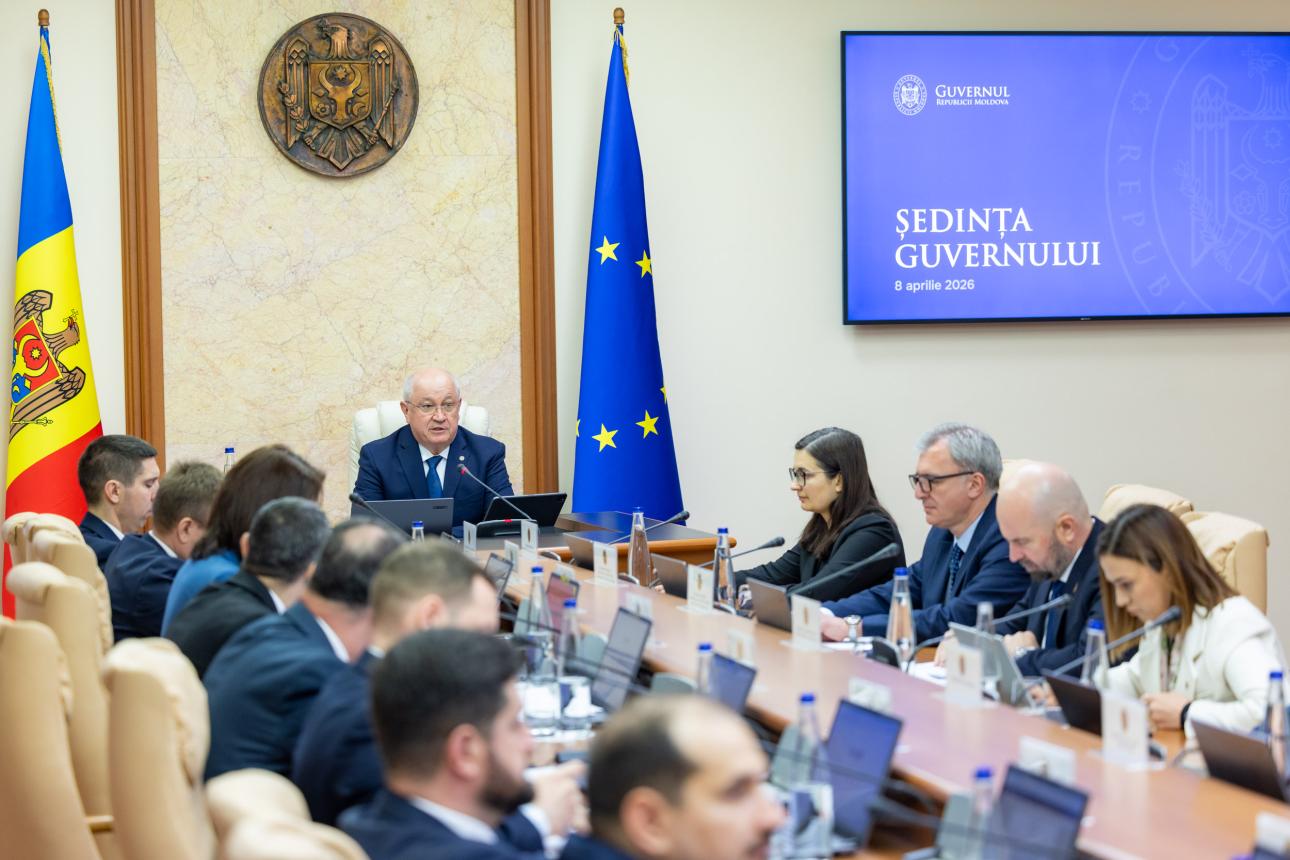
Government maintains state of emergency in energy sector
Government is maintaining the state of emergency in the energy sector, given that the situation on foreign markets remains volatile. The state’s interventions to protect energy security were presented at today’s Government meeting by the National Crisis Management Center (CNMC).

“I promised we would not maintain the state of emergency in the energy sector even one day longer than necessary. We had planned and were preparing to go to Parliament this Thursday with a proposal to repeal it – as I announced last week during the cabinet meeting. Regrettably, reality has changed. The situation on foreign markets remains extremely volatile,” said Prime Minister Alexandru Munteanu.

According to the CNMC, the crisis in the energy sector should not be interpreted as an isolated event linked to Vulcănești–Isaccea overhead power line, but as a sequence of external shocks that required a gradual, firm response focused on protecting citizens. These include the situation in the Middle East, where disruptions in the Strait of Hormuz continue to put pressure on global oil and gas flows; maintenance of refineries in Romania, which has limited the volumes available for import; and Russian attacks on infrastructure in southern Ukraine.

The declaration of the state of emergency in the energy sector on 25 March made it possible to repair the Vulcănești–Isaccea power line in record time; it was put back into operation on 28 March 2026, just five days after the Russian attack. It also allowed, by way of derogation from the Urban Planning Code, the rapid installation of storage and balancing systems without the bureaucracy of construction permits. This measure was taken in order to significantly reduce the implementation time of green energy projects. In addition, a consumption reduction plan was implemented, leading to an approximately 3% decrease in national energy consumption, saving vital resources during peak hours.

The measures taken under the state of emergency in the petroleum products sector were the most visible for citizens. Whereas on 26 March, 182 fuel stations reported a lack of diesel, today, after the introduction of balancing measures, there are only 41 stations (6.9% of the total). The measures applied included: reducing the price calculation period from 14 to 7 days; unblocking existing funds of Lukoil-Moldova operator exclusively for the purchase of fuels and their delivery only within the country; limiting sales in containers to a maximum of 20 liters, which stopped impulsive stockpiling and stabilized consumption at the normal average of 1,500 tons per day.

An important aspect of the crisis management strategy was the protection of the agricultural sector, given that this period of instability coincided with seasonal agricultural work. Energy security is directly linked to food security, which is why diesel reserves intended for agricultural operations were permanently monitored in order to identify and prevent in time any major shortage risks for farmers.

At present, although Vulcănești–Isaccea power line has been repaired, risks in the energy sector have not disappeared, and maintaining the state of emergency during the Easter holidays is a precautionary measure, giving the Government the necessary tools to prevent possible disruptions.

“It is taken into account that the Easter holiday period involves maximum population mobility and implicitly, increased fuel consumption due to higher domestic and cross-border travel. At the same time, the shutdown of Heat and Power Plants could significantly reduce cogeneration capacity, by up to 200–220 MW. Meanwhile, in April, the resumption of full-capacity activity is expected in several industrial sectors, which will generate an additional increase in consumption. Under these conditions, although the market has been stabilized at a coverage level of 6–7 days of available fuel, there is a risk of a gradual decrease of these stocks,” the CNMC Report reads.

“The risks have not disappeared. Attacks can be repeated at any time, including during the Easter holidays. Under these conditions, repealing the state of emergency now, on the eve of the holidays and in an extremely unstable geopolitical context, would be an irresponsible decision. Still, I want it to be very clear: we will use this instrument with maximum prudence, responsibility and transparency,” underlined Prime Minister Munteanu.

The CNMC and Ministry of Energy report will be presented to Parliament and made public by the end of the week. If the situation in the energy sector stabilizes, after the Easter holidays, on April 23, Parliament will examine the repeal of the state of emergency.
 Facebook
 Instagram
 X/Twitter
 Telegram
Moldovan PM visits settlement in northern district, where 260 households benefit from access to water with government's support
PM pays a working visit to north Moldova district
Moldovan government's secretary general says reform of local public administration one of most important reforms for Moldova
Moldovan president in Riga says Latvia knows what it means to regain your freedom, that is why its voice matters
President Maia Sandu’s speech in the Parliament of Latvia
Deputy PM for reintegration has meeting with Ambassador of Sweden to Moldova
Moldovan President’s speech at joint press conference with President of the Republic of Latvia
New rules to protect health of workers exposed to occupational risks
Cases of violence to be monitored uniformly at national level for early prevention and more effective intervention
Government tightens penalties for drug-related offences
Moldovan driving licences to be recognized in Ireland
Moldovan PM has meeting with Romanian counterpart
Moldovan government's secretary general in Strasbourg says good reforms achieved through strong partnerships, dialogue, solutions for people’s well-being
Moldovan PM has discussions with Romania's president
Environment Minister about mandate priorities and response to mayor: Chișinău residents need solutions, not political circus
CNMC director about need to maintain state of emergency
ANRE explains impact of Middle East ceasefire on fuel market in Moldova
State starts paying heating compensation for March
 National Bank of Moldova
Moldovan government launches concept of local public administration reform
New rules for egg marketing: More precise packaging information and stricter product traceability
Government simplifies reporting of workplace accidents and improves data collection
Better access to treatments: Government modernizing medicine authorization system
Involvement of Moldova's authorities in Interreg programming process, in context of new EU multiannual financial framework 2028–2034

Government simplifies reporting of workplace accidents and improves data collection
Better access to treatments: Government modernizing medicine authorization system
Ministry of Justice without state secretary
Moldovan experts learn about European experience on biodiversity conservation during study visit to Greece
Prime Minister: Risks still high. Repealing state of emergency would be irresponsible decision
PHOTO GALLERY // Voices of Romani women resonate in Chișinău in march of solidarity and equal rights
PHOTO // Ambassador of the Republic of Moldova to Ukraine presented letters of credence to President Volodymyr Zelenskyy
President on International Romani Day: Only through appreciation and mutual support we can build more inclusive and stronger country
VIDEO // Strong Town Halls Reform in Moldova: minimum threshold of 3,000 inhabitants per town hall and decrease in districts from 32 to 10
Moldova to have three new ambassadors
Daniel Vodă: For Moldova, ceasefire in Middle East creates useful window of opportunity
President pays official visit to Ireland
Giurgiulești–Reni customs post temporarily suspends operations
PHOTO // International platform on preventing, combating violence against women held in Moldovan capital: decisive actions, joint efforts
Involvement of Moldova's authorities in Interreg programming process, in context of new EU multiannual financial framework 2028–2034
Peaceful protest staged in Moldovan capital on April 7, 2009 compromised; political analyst says provocations orchestrated by structures subordinate to Russia's interests
Receive the latest news directly to your email

Receive the latest news directly to your email