
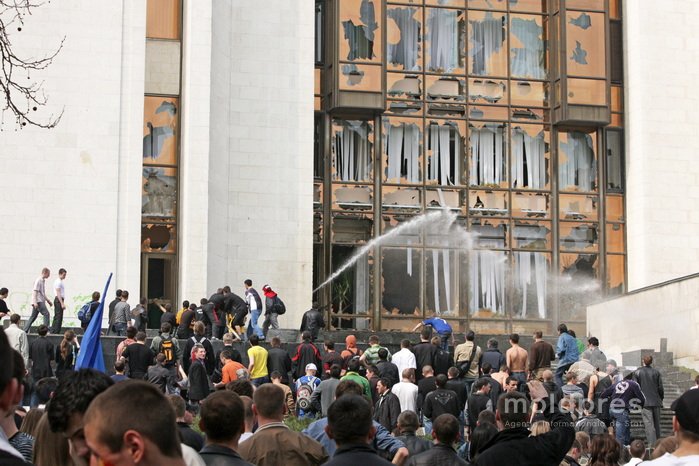
Peaceful protest staged in Moldovan capital on April 7, 2009 compromised; political analyst says provocations orchestrated by structures subordinate to Russia's interests
The events of April 7, 2009 are viewed in different ways and the society is still divided in its interpretation of them. Some see the protests 17 years ago as a moment of civic awakening; others perceive them as an attack on the authorities of the time. April 7, 2009 has not been closed either historically or morally, says Romanian political analyst Mihai Isac.
The expert argues that a major problem stays the lack of a full clarification of the events. “Investigations have been reopened, but there are no concrete public results, and the case files have not been fully declassified,” Isac told MOLDPRES.
“Provocations orchestrated by structures subordinate to the interests of the Russian Federation”
Mihai Isac, political analyst: “On April 7, 2009, after the parliamentary elections of April 5, tens of thousands of people, mostly young people, took to the center of Chisinau, challenging the result of the falsified vote. The protest, which started peacefully, degenerated against the backdrop of provocations orchestrated by structures subordinate to the interests of the Russian Federation.More than 600 young people were detained, beaten, humiliated and tortured in police stations and the symbolic case of the repression remains the death of Valeriu Boboc. Seventeen years later, the investigation has not been fully clarified, and the state has paid more than 5 million lei in compensation following convictions at the European Court for Human Rights (ECtHR) and agreements with the victims.
Today, April 7 is seen in two ways. For the current leadership and an important part of civil society, it is a moment of civic awakening and a lesson about how quickly the state can attack its own citizens. For former actors of the Communist regime or those close to Russian interests, it remains described as an attack on the authorities of the time or an atypical revolution.
The fact that these competing interpretations still exist today shows that April 7 has not been closed either historically or morally.
The greatest outstanding issue is that no government has fully shed light on the events. Amnesty International Moldova notes that, although investigations were reopened in 2021, no concrete results have been made public and the case files have not even been completely declassified. The memory of the events is fading precisely because of the silence of institutions and the lack of access to documents.
In short, the political class has failed not only to deliver justice, but also to build an honest public memory of April 7.
The reliability of the European project, compromised by corruption, bank fraud and state capture
The expectations of the public were however betrayed by part of the political class, which legitimized itself through a pro-European discourse. In the Filat era and in the years dominated by Plahotniuc, corruption, bank fraud and state capture compromised the reliability of the European project.
Filat was sentenced in 2016 to nine years for corruption and abuse of power, and in 2019, the parliament declared that state institutions had been captured, denouncing the oligarchic regime led by Vladimir Plahotniuc. At the same time, the European Union reduced or suspended funding because of the deterioration of the rule of law.
Therefore, the conclusion is simple: the European hope has remained, but blind trust in pro-European politicians has been broken.
“The European hope of 2009 has materialized”
In 17 years, Moldovan society has become freer and more pluralistic than it was in 2009. Today, Moldova has a competitive electoral environment and the freedoms of expression, association and religion are, by and large, protected.
However, it is also a deeply polarized society, and this polarization was clearly visible at the constitutional referendum from October 20, 2024 on the EU, validated with 50.35 per cent of votes in favor and 49.65 per cent against. If we look at the European path, the hope of 2009 has not died out, but has materialized.
Moldova got a visa-free regime in 2014, the Association Agreement with the European Union fully entered into force in 2016, the country became a candidate state in 2022, and accession negotiations were officially opened in June 2024. After the referendum was validated by the Constitutional Court, European integration also became a strategic goal enshrined in the Constitution. Thus, the European hope has remained.
How much has the political class changed?
The political class has changed only partially. Generations and public language have changed and integration into the EU has become a central axis of political life. However, the old problems persist.
The decisive test remains April 7. As long as the full truth is not told, the case files are not fully declassified and justice is not done to the end, the transformation of the political class remains incomplete.
A political class is measured not only by European declarations, but also by its ability to deliver justice for its own founding traumas.
And here, Moldova still has a major outstanding issue.”

 Facebook
 Instagram
 X/Twitter
 Telegram
Government approves national reintegration activity program: 25 million lei for 30 projects to be implemented this year
Moldova completed clearing land for construction of new US Embassy
Ministry of Health to have new state secretary
European Parliament supports Moldova in European integration process; MEP Siegfried Muresan: "We support the opening of accession negotiations across all clusters"
Russian Embassy’s chargé d’affaires summoned to Moldovan Foreign Affairs Ministry after drone incident in Galati, Romania
POLITICO: Moldova, Ukraine might start official EU accession talks in June
Moldovan president, after Russian attack on Ukraine, says more support for Ukraine, stronger pressure on Russia – both needed now
Seven Moldovan MPs to pay study visit to United States
Prime Minister condemns Russia’s recent attack on Ukraine
Strengthening collective defense and support for Ukraine discussed at NATO Parliamentary Assembly Spring Session
Washington announces nomination of Joseph Burkhalter as ambassador to Chisinau
PHOTO // After two weekends of debates, Citizens’ Assembly put forward 15 recommendations to authorities on local administration reform
Bulgaria reconfirms support for European path of Moldova
Moldovan MPs discuss opening EU accession negotiations in Brussels
PHOTO // European Commissioner for Enlargement visits household in central Moldova district: cherry exports to EU open new opportunities for Moldovan farmers
VIDEO // Car swept away by floodwaters, four people evacuated in central Moldova districts; authorities intervene in more localities
PHOTO // European Commissioner for Enlargement, Moldovan environment minister participate in visit on Dniester bank
Homes flooded, roads blocked after heavy rainfall in Moldova; authorities urge caution
UN Food and Agriculture Organization launches farmer field schools in central Moldova district: climate-resilient vegetables, market access
PHOTO // European Commissioner for Enlargement returns to Marta and Maria Monastery of Moldova
Energy invoices to be digitalized in Moldova in next five years: real-time access to data on consumption, energy costs
 National Bank of Moldova
Moldovan president attends ceremony on 24th anniversary of foundation of National Anticorruption Centre
Prime Minister at Moldova Digital Summit 2026: Our ambition is not only to join EU, but to help build Europe’s digital future
Over 1 billion euros in new investment partnerships, financing announced for Moldova
Topical issues addressed at meeting of Joint Control Commission
Moldovan president, European Commissioner for Enlargement discuss reforms, next steps in accession process

PHOTO // European Commissioner for Enlargement meets mayors of Moldova: EU to help modernize another 20 schools
Over 1,000 Diaspora Moldovans register for Online Career Fair
PHOTO // European Commissioner for Enlargement urges young people to defend democracy, combat disinformation
BTA // Ishtar: Music Is Like Perfume, It Is about Feeling
Moldova Presents exhibition inaugurated in Vaslui: Moldovan products promoted in Romania by 60 local companies
Moldovan president conveys message on World Environment Day
Moldovan president attends ceremony on 24th anniversary of foundation of National Anticorruption Centre
Environment Minister announces when fish safety to be checked
Moldova prepares new edition of Red Book
Prime Minister at Moldova Digital Summit 2026: Our ambition is not only to join EU, but to help build Europe’s digital future
PHOTO GALLERY // Chișinău hosts Moldova Digital Summit 2026: two days dedicated to innovation and digital transformation
Republic of Moldova to receive 250 million dollars from World Bank to advance reforms
Moldova Digital Summit 2026 starts in Chișinău
Moldova prepares case against Russia over Dniester pollution
Chișinău and Bratislava discuss next steps in EU accession negotiations
International post-disaster needs assessment mechanism launched in Chișinău following Dniester river pollution crisis
Receive the latest news directly to your email

Receive the latest news directly to your email