
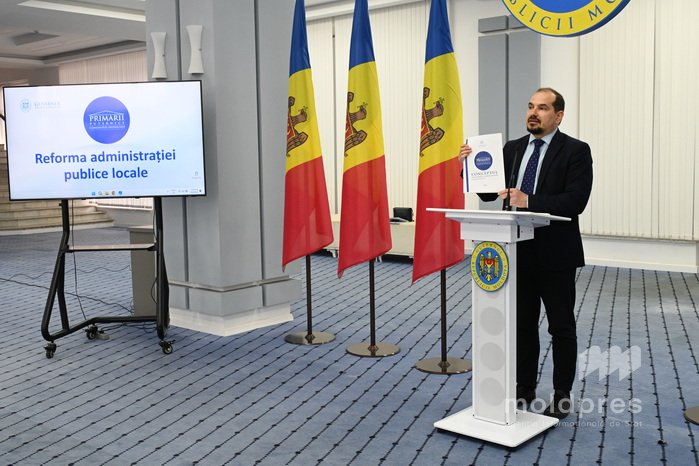
VIDEO // Strong Town Halls Reform in Moldova: minimum threshold of 3,000 inhabitants per town hall and decrease in districts from 32 to 10
The Republic of Moldova is embarking on a broad reform of local public administration, a strategic initiative presented today by Secretary General of the Government Alexei Buzu. The concept made public by the official provides for a minimum threshold of 3,000 inhabitants per town hall and drop in the number of districts from 32 to 10.

Buzu stressed the urgent need to strengthen the administrative and financial capacities of town halls in order to ensure quality services and a decent standard of living for all citizens, while also preparing the country for European integration.

Current challenges: depopulation and poor services

Presenting the concept of local public administration reform, Alexei Buzu described a bleak reality for local public administration, marked by depopulation, a low tax base and weak institutional capacities, especially in small town halls.

“Most town halls in our country are caught in a vicious circle of depopulation, a reduced tax base, weak institutional capacities, because they manage public affairs for a smaller population,” Buzu said.

He highlighted the direct impact on quality of life.

“If at the national level the number of inhabitants has decreased by 13.9%, at the level of small town halls, those under 3,000 inhabitants, the population has decreased by 32%,” the official estimated.

The Secretary General of the Government provided concrete examples of service deficits.

“Of 10 families that do not have sewerage, 8 are in town halls with a population of less than 3,000 inhabitants. Seven out of 10 families without a connection to the water supply are in town halls with fewer than 3,000 inhabitants. These figures show that proximity to local government is not a supreme argument when citizens do not have access to quality services and a decent standard of living,” Buzu noted.

The reform: a “long overdue” necessity

Buzu emphasized the imperative nature of the reform.

“The reform is not only necessary, it is long overdue. Any argument that we should wait longer, in my personal view, shows a lack of respect for local elected officials, but especially for those citizens who, even in 2026, still do not have access to water and sewerage,” the official underlined.

Consolidating town halls and the opportunity of European funds

A major objective of the reform is the consolidation of town halls through voluntary amalgamation, an essential process to prepare the Republic of Moldova for accessing EU pre-accession funds, which will be available starting in 2028.

“In the Balkans, the share of own revenues in those town halls is three times higher than the average in town halls in the Republic of Moldova. This means those town halls are more competitive. We do not have this time. In 2028, we will have these funds and therefore we must hurry, we must make these changes, otherwise we will miss a huge opportunity to bring our citizens a better standard of living and quality services,” Buzu warned.

The reform proposes a minimum threshold of 3,000 inhabitants for a functional and sustainable town hall, ensuring that “after the 2027 general local elections, in the Republic of Moldova we will not have any town hall administering public affairs for fewer than 3,000 inhabitants.”

To encourage this process, the Government will triple financial incentives for town halls that choose to consolidate, enabling them to address essential problems such as water and sewerage connections.

“We are very pleased that as of today we have 310 local councils that have approved the first decision to initiate the amalgamation process,” Buzu mentioned, expressing his “gratitude and admiration” for the local elected officials who prioritize local development.

Modernization, transparency and attracting young people into administration

The reform also aims at modernizing the local civil service. Buzu pointed out that “50 percent of civil servants are beyond retirement age,” which shows that “the civil service in town halls and district councils is not attractive for young people.” Therefore, a modern structure is proposed, with new positions related to audit, financial control and interaction with entrepreneurs, in order to attract professionals. The digitalization of town halls, the introduction of a one-stop shop and increased transparency are other key objectives.

“We aim to digitalize town halls. Many processes in town halls have not changed for 25 years. We want to use this reform opportunity to digitalize processes in town halls. This will increase transparency, integrity and the accuracy of processes in our town halls,” the Secretary General explained.

The number of districts will also be reduced from 32 to 10, with their role refocused on regional development, and the tax base of town halls will be expanded by sharing certain taxes collected at the national level, such as VAT.

“The more ambitious the amalgamation effort will be, the higher the sharing percentage will be,” Alexei Buzu said.

Interactive tools and commitment to the future

To support the process, the Government has launched two interactive tools on primariiputernice.gov.md platform: an “amalgamator” to visualize consolidation scenarios and a tool to monitor the budget execution of town halls.

“These two tools will provide more evidence, more understanding and will facilitate the consolidation and amendment process,” Alexei Buzu concluded.

Although he recognizes that “this process will be a difficult one,” the Secretary General of the Government expressed his hope that the reform will be carried out “with maximum responsibility” and “always in the interest of our citizens,” in order to build stronger town halls and more developed localities in the Republic of Moldova.

Tomorrow, April 9, Alexei Buzu will present the concept of local public administration reform in the plenary of Parliament.
 Facebook
 Instagram
 X/Twitter
 Telegram
PAS faction to have new MP
Foreign Ministry: We condemn violation of airspace. Such actions endanger citizens’ security
Over 25,000 residents from left bank of Dniester commute daily to right bank, Deputy Prime Minister for Reintegration says
Speaker about permanent withdrawal from CIS statutory bodies: Moldova has sovereign and independent right to decide which union to be part of
Moldovan government representatives to present to parliamentary factions actions taken during emergency state, proposals on future developments
Moldovan foreign affairs minister meets MEP: continuing reforms, leveraging EU support on agenda
Parliament votes for Moldova’s definitive withdrawal from Commonwealth of Independent States
Reform of local public administration of Moldova in spotlight of Congress of Council of Europe
PHOTO, VIDEO // Moldovan president in Latvian parliament says supporting Moldova’s accession, defending Latvia's democracy represent same act of resistance
Foreign affairs minister meets Turkey’s Ambassador to Moldova
PHOTO // President in Riga: European Moldova cannot be destabilized and cannot be used as pressure point against continent
Stricter rules against terrorism: Moldova joins new European protocol
VIDEO // Moldovan President welcomed by Latvian counterpart at Riga Castle
Government staff reshuffle
Natural gas prices recorded sharp decline in Europe on Wednesday, reaching lowest level of last five weeks
Ministry of Justice without state secretary
Prime Minister: Risks still high. Repealing state of emergency would be irresponsible decision
PHOTO // Ambassador of the Republic of Moldova to Ukraine presented letters of credence to President Volodymyr Zelenskyy
 National Bank of Moldova
New rules for egg marketing: More precise packaging information and stricter product traceability
Government simplifies reporting of workplace accidents and improves data collection
Better access to treatments: Government modernizing medicine authorization system
Involvement of Moldova's authorities in Interreg programming process, in context of new EU multiannual financial framework 2028–2034
MOLDPRES INTERVIEW │ Deputy Prime Minister: Gradual reintegration in different areas - path toward lasting settlement of Transnistrian conflict

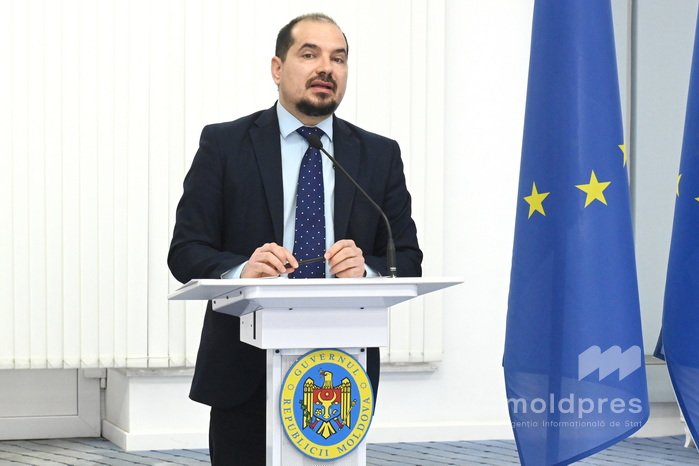
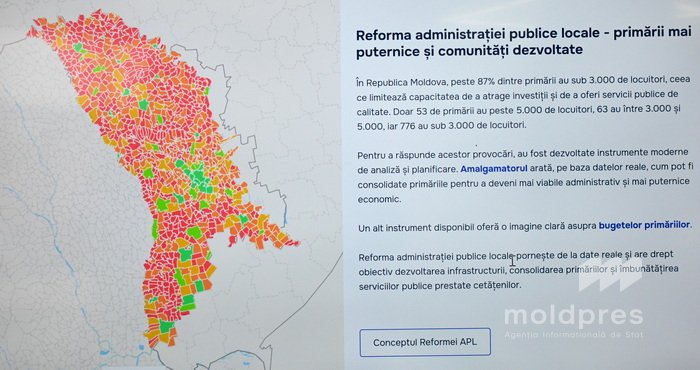
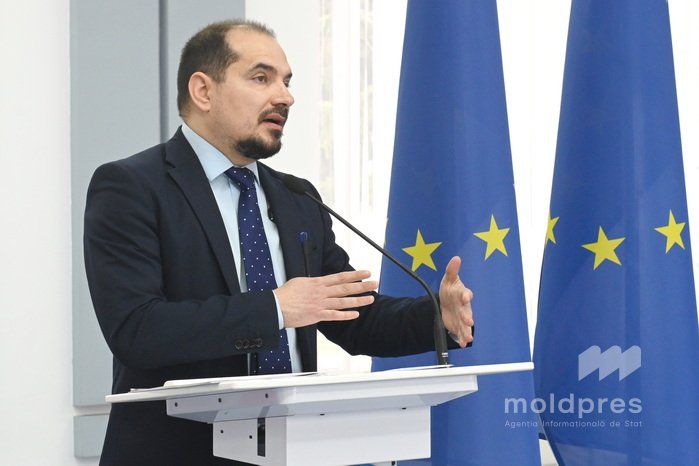
PHOTO // Ambassador of the Republic of Moldova to Ukraine presented letters of credence to President Volodymyr Zelenskyy
President on International Romani Day: Only through appreciation and mutual support we can build more inclusive and stronger country
VIDEO // Strong Town Halls Reform in Moldova: minimum threshold of 3,000 inhabitants per town hall and decrease in districts from 32 to 10
Moldova to have three new ambassadors
Daniel Vodă: For Moldova, ceasefire in Middle East creates useful window of opportunity
President pays official visit to Ireland
Giurgiulești–Reni customs post temporarily suspends operations
PHOTO // International platform on preventing, combating violence against women held in Moldovan capital: decisive actions, joint efforts
Involvement of Moldova's authorities in Interreg programming process, in context of new EU multiannual financial framework 2028–2034
Peaceful protest staged in Moldovan capital on April 7, 2009 compromised; political analyst says provocations orchestrated by structures subordinate to Russia's interests
Moldovan deputy PM, business environment's representative discuss progress on European agenda, priority reforms
Leova–Bumbata border customs post of Moldova resumes normal operations
Moldovan Central Electoral Commission asks Justice Ministry to initiate procedure of dissolution of three political parties
Meteorologists issue yellow frost warning in Moldova
Model Bulgarian language classroom opened at lyceum in Gagauz autonomy
Expert comments on protests staged in Moldova on April 7, 2009
Receive the latest news directly to your email

Receive the latest news directly to your email