
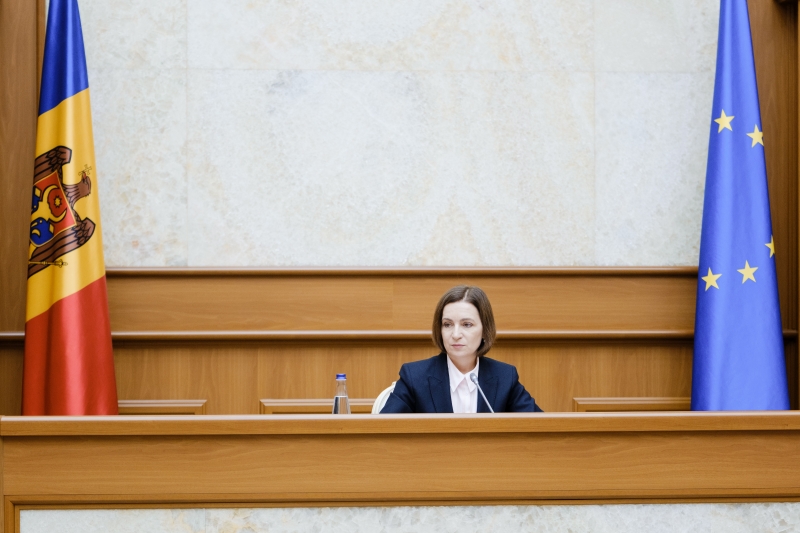
Moldovan president's message following meeting of National Security Council
I convened the National Security Council for the second time in recent months, as  Moldova is facing a critical situation in the energy sector.

Moldova has no oil or natural gas deposits; we depend entirely on what we can purchase on the international market. The global situation is becoming increasingly complicated—the prices are rising everywhere, while the increasingly pressing problem is now the capacity to secure energy supplies.

The benchmark price for natural gas on the European exchange has recently exceeded 83 euros per MWh, or approximately 1,000 dollars per 1,000 cubic meters—an increase of more than two and a half times compared with last year.

The blockade in the Strait of Hormuz is continuing and large vessels carrying liquefied natural gas from Qatar are not reaching the European market. A new blockade has emerged at the second strait, Bab al-Mandab in the Red Sea, following a new escalation of the conflict in Yemen and attacks on oil infrastructure in Saudi Arabia.

In addition, the low level of underground gas storage facilities in Europe and increased gas consumption for electricity generation during the hot summer period in the western part of our continent are keeping prices high.

As for diesel imports, prices have exceeded 1,500 dollars per ton, including because of the shortage of diesel on the international market. Some of the diesel reaching the market came from the Middle East, and the closure of supply routes is making the situation more difficult. Petrol and diesel have reached their highest prices ever recorded in the EU. In Romania, standard diesel currently costs an average of more than 41 lei. Prices have also risen sharply in Moldova, with one litre of diesel reaching approximately 36 lei.

As far as electricity is concerned, we are also affected by regional price instability, because energy production has fallen considerably as a result of reduced river flows caused by drought. Although significant progress has been made in renewable energy in recent years—the share of renewables in total consumption has increased from 3 per cent to approximately 22 per cent, while storage capacity has grown from zero to 210 MWh—we still do not have the necessary capacity, especially during peak hours. To cover peak hours, we need 600–1,000 MWh.

Regarding the hydrological situation on the Dniester River, we are seeing an alarmingly low inflow of water persist. The water level in the Novodnistrovsk reservoir has reached a historic low, while the average inflow was 23 m3/s during the period from 1 to 20 September, compared with the normal 100–120 m3/s for this time of year.

Therefore, we must be prepared for any development and ensure that, regardless of what happens externally, Moldova has access to water, electricity, natural gas and fuel. Unfortunately, we cannot influence prices. The greatest risk, however, is being left without sufficient quantities. That is why, the mobilization of all institutions is essential—the economy and citizens must have uninterrupted supplies of energy resources and water.

The National Security Council adopted a string of decisions in this regard.

Together with the parliament, the government and the responsible institutions, we agreed on the need to declare a state of emergency in the energy and hydrological sectors. The government must be able to act quickly in the most unpredictable situations: if rapid decisions are needed to purchase fuel, if the water flow in the Dniester continues to decrease, or if fuel prices continue to rise.

First, the government will prepare plans for different scenarios, so that each institution knows what it must do if supply problems arise.

Second, the institutions must ensure import capacity and alternative electricity supply routes for the cold season, the possibility of using the 110 kV interconnections with Romania on an emergency basis and the maximization of commercial capacity at the Romania–Moldova border.

The responsible institutions are required to create reserves of equipment and spare parts, so that they can intervene quickly in the event of malfunctions. We are ensuring that the necessary gas stocks are established and are gradually preparing emergency stocks of petroleum products as well.

I know that some people still ask why we do not buy natural gas from Russia. I want to remind them that Russia first reduced and then interrupted gas deliveries to our country in 2022, in violation of the provisions of the contract. Moreover, after the transit agreement through Ukraine expired, Russia no longer supplies Russian natural gas even to the Transnistrian region, where it supports a separatist regime. Russia is facing a severe shortage of automotive fuel. And let us not forget that the money Russia earns from selling energy resources is used to kill innocent people in Ukraine and to send drones, including into our airspace, endangering people's security.

Third, we are aware of the impact of regional prices on people's invoices. In recent winters, people have faced significant pressure from their invoices and the government has supported them through compensation. Every tariff increase is strongly felt by our families. I know that citizens are worried about the coming winter.

The fact that we do not know what prices will be, that we do not know how regional and international conflicts will evolve—all these unknowns weigh heavily on each of us. And I know that I asked for patience and strength last winter and the winter before that as well. But I also know that we have overcome even greater hardships together, because we care about one another and we care about our country.

I will not tell you that it will be easy, but I am convinced that we will get through this winter as well and that we will continue to stand by families, especially the most vulnerable ones. The government is to ensure the necessary resources, so that the compensation mechanism operates throughout the cold season. Compensation will take into account tariff developments and the vulnerability of each household.

The government will also provide clear information about what people can do to save energy and how they should proceed, if temporary interruptions of electricity, gas or heating occur.

Another important issue is the protection of energy infrastructure. The Council also examined and ordered measures to ensure that the facilities on which the country's supply depends are better protected against hostile actions, including drone attacks, and that, if a problem arises, their operation can be restored as quickly as possible. The same applies to cyberattacks: the critical vulnerabilities identified are to be remedied as a priority.

Regarding the protection of energy infrastructure, I would like to address in greater detail the threats posed by Russian drones. Unfortunately, instead of being treated seriously and responsibly, this issue is being exploited politically and cynically by those who consciously and deliberately weakened the National Army when they were in decision-making positions.

By contrast, they are the same people who mock the danger of war and the violation of our airspace by Russian drones, and who challenge investments in defence. Some even called for the dissolution of the National Army. And now, overnight, they have begun to worry about why the Army does not detect every drone. It is good that they have begun to understand the danger to national security. It would be good, if they also spoke about who exactly is endangering the security of Moldova.

The problem of Russian drones is a regional one; they are coming down in the Baltic countries, Poland and Romania. Armies that are far more advanced and better equipped than Moldova's have encountered difficulties in preventing drones from entering their airspace.

Russian drones are evolving very rapidly, with more advanced versions being produced every few months that can evade the air-defence solutions developed in the meantime. This is a technological race against the clock. The modernization of the Army and the protection of citizens cannot be a political debate; they represent  a duty of the state, as well as a shared responsibility of all politicians and society as a whole.

In 2026, we have already recorded 39 violations of our airspace, compared with 17 in 2025. What is Moldova doing in these circumstances to be capable of defending its infrastructure and citizens?

First, it is continuing to invest its own resources and attract external grant funding to develop and improve the defence system. This system has two components: detection and neutralization.

To improve drones’ detection, we are modernizing the airspace surveillance system. Even though we can see what is happening more clearly, the existing capabilities are still insufficient. Thirty years of neglect of the defence system cannot be made up for in five years. We are working with our partners to accelerate this process.

To neutralize drones, we have portable anti-aircraft missile systems, anti-aircraft machine guns and electronic warfare equipment. These capabilities are operational, but their range is limited to protecting critical infrastructure that provides basic services essential to the functioning of the economy.

The Army is investing resources to expand the coverage of air defence. The Defence Ministry has recently said that it got 120 million euros in grant funding from the European Union, which will be used to purchase a medium-range air-defence system—an advanced system for detecting and destroying aerial targets. All these measures require time.

Second, we are strengthening partnerships with neighbouring countries to improve the exchange of information, complementing the data provided by national surveillance systems.

Third, we are working with our partners to benefit from modern, effective and less expensive solutions against drones. I cannot provide more details, but I want to assure citizens that protecting our country is a priority and a constant focus for me and the government.

Any drone that violates our airspace endangers people and the only party responsible for this is the Russian Federation. A state that sends you drones is not seeking your friendship, but your fear and submission. Moldova will continue to develop its defence capabilities, protect its hard-won freedoms and its future in peace, as well as its citizens.

We will also identify ways to warn the population in crisis situations until the MD-Alert system becomes operational. The implementation of this system, which costs 5 million euros, will take some more time before it is completed. Therefore, I have asked the institutions to identify alternative ways of providing rapid information, including digital ones.

Dear citizens, all state institutions know what they must do: ensure that we have water, gas, heating and electricity; help people, especially those who are struggling the most; and act quickly and professionally when problems arise. We will continue working to identify and implement the best solutions.

Thank you!
 Facebook
 Instagram
 X/Twitter
 Telegram
Roman Rosca takes over as chair of special parliamentary commission for monitoring and oversight of Moldova’s reintegration policy
Working of small farms in built-up areas of localities to be regulated by law in Moldova
Moldova accedes to convention in marine environmental protection sector
Moldovan deputy PM for reintegration has meeting with Sweden’s Ambassador
Moldovan PM meets Director of European Bank for Reconstruction and Development for Ukraine and Moldova
Voted in first reading: Railway of Moldova state enterprise to be reorganized by late 2026
Clear requirements for classification, labelling of chemical products in Moldova
Regulatory framework for extractive waste management harmonized with EU standards in Moldova
Moldovan parliament denounces agreement with Commonwealth of Independent States on interlibrary lending
Moldovan government creates single structure for implementing strategic infrastructure projects
Defence Staff institutionalized by law in Moldova
Moldovan parliament adopts measures to prevent phone scams, electronic communications fraud
Moldova's legislation establishes mechanism for authorizing operators holding emergency stocks of oil products
One-off allowances of up to 4,000 lei for public sector employees; Moldovan parliament adopts rectification of 2026 state budget
Moldovan parliament speaker says leadership seeks closest possible cooperation with Lithuania during its presidency of Council of EU
Investing in government securities: Ministry of Finance launches new subscription round
VIDEO // Caligula, Ivan Franko Theatre’s production from Kyiv presented in Chișinău
Foreign Ministry condemns Russia’s organization of State Duma elections in Transnistrian region without consent of Chișinău’s constitutional authorities
 National Bank of Moldova
Moldovan PM meets with Irish Ambassador
Deputy PM for reintegration has meeting with new Ambassador of Austria to Moldova
Europe at Your Home – dialogue on European path continues in Ungheni city of Moldova
Moldovan deputy PM for reintegration has meeting with members of Foreign Affairs, Defence and Security Committee of Czech Republic's Senate
Documentary play to be presented on Moldovan parliament's square

VIDEO // Caligula, Ivan Franko Theatre’s production from Kyiv presented in Chișinău
Foreign Ministry condemns Russia’s organization of State Duma elections in Transnistrian region without consent of Chișinău’s constitutional authorities
Aircraft object illegally entered airspace of Moldova near Palanca
Three athletes from Moldova become beach wrestling world champions
PHOTO // Judges and prosecutors from Moldova trained on integrated environmental permits and liability for damage
Centre for Strategic Communication warns of propaganda following drone incidents
Parliament hosts visit by delegation of Senate of Czech Republic
Territorial Education Agencies to take over responsibilities of education directorates
National Security Council to convene on 21 September
Deputy Prime Minister to attend 81st session of UN General Assembly in New York
Old-Style Orthodox Christians celebrate Nativity of Mother of God
Head of State convenes Security Council
Moldova's airspace violated again
VIDEO, PHOTO // Ethnicities' Festival, at its 25th edition, brings together more than 45 ethno-cultural organizations in Chisinau
PHOTO GALLERY // 2026 Ethnicities' Festival brings together traditions, cultures from all over Moldova in Chisinau
Moldovan president's speech at National Forum of Social Protection Professionals
Receive the latest news directly to your email

Receive the latest news directly to your email