
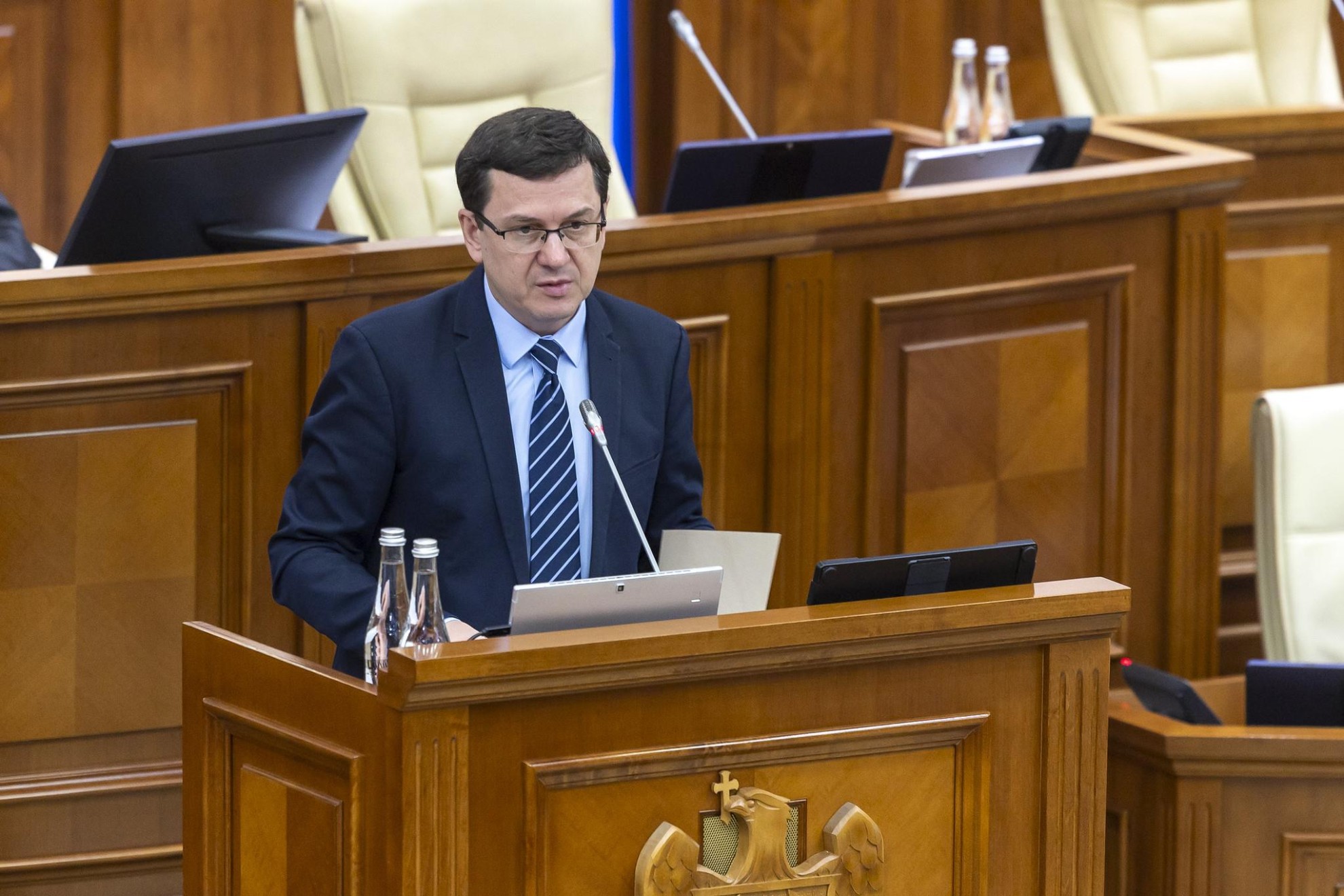
Moldovan parliament adopts fiscal, customs policy package for 2027
Chisinau, October 22, 2026 – The parliament has adopted the draft law on simplifying tax and customs legislation. The document provides for lower taxes on labor, greater support for investment and measures to protect essential consumption. In the second reading, MPs submitted almost 70 amendments, while representatives of the business community and other stakeholders proposed more than 100 changes. Some of the proposals were accepted and included in the draft law.

The legislative initiative, drafted by the government, aims to improve the mechanisms for applying legislation, eliminate provisions that are susceptible to inconsistent interpretation and strengthen a more accessible and efficient regulatory framework. The document also includes proposals submitted by public authorities, representatives of the business community, professional associations, and taxpayers.

As for personal taxation, the authors of the draft partially supported amendments submitted by MPs concerning an increase in the personal allowance from 29,700 lei to 40,020 lei. At the MPs’ proposal, the personal allowance was increased to 46,680 lei for certain categories of citizens, including people with disabilities since childhood and those who suffered as a result of participating in combat operations or in the relief works at the Chernobyl Nuclear Power Plant. At the same time, the child allowance will increase from 9,900 lei to 11,040 lei. These measures aim to reduce the tax burden and increase household incomes. The conditions for granting an income tax exemption on capital gains from the sale of a primary residence have also been amended. Thus, taxpayers who have lived in the property for at least three years may benefit from this facility, if it is their only residence, even if they were not officially domiciled at that property.

The income tax rates applicable to individuals’ investment income, as well as the conditions for determining capital gains have also been revised. Capital gains will be taxed at a rate of 12 per cent.

Another amendment stipulates that income tax arrears of up to 100 lei will no longer prevent taxpayers from exercising their right to designate 2 per cent of their income tax.

The draft also provides for narrowing the category of income exempt from income tax, in order to broaden the tax base and strengthen tax equity. Adjustments are also provided for the provisions regulating the taxation of non-residents.

The draft law includes amendments concerning the taxation of legal entities and individuals conducting entrepreneurial activities.

To stimulate economic growth and attract investment, the period of application of the 0% income tax rate on undistributed profits has been extended until 2029. At the same time, the eligibility criteria for companies have been revised by raising the turnover or total assets threshold from 100 million to 200 million lei. Income tax on profits earned during the 2027–2029 tax periods may be deferred until dividends are distributed or losses from previous years are covered. The conditions under which taxpayers may benefit from the 4-per cent tax regime have also been revised. At the same time, the income tax exemption granted to savings and loan associations, trade unions and employers’ associations, as well as private educational institutions will be eliminated. Starting from 2027, an 18-per cent tax rate will apply to income from financial and insurance activities. The dividend tax rate will also increase from 6 to 8 per cent.

The draft provides for the introduction of a sin tax on participation in gambling and lotteries. Organizers of these activities will pay a 6-per cent tax on funds deposited to top up gaming accounts or on the sale of tickets.

The document also contains a string of amendments concerning value-added tax (VAT), aimed at reassessing existing tax facilities and creating a coherent, simplified and neutral system. Thus, the VAT rate applied to goods supplied and services provided by the HoReCa sector will increase from 8 to 12 per cent, remaining lower than the standard rate. A 12-per cent rate will also apply to livestock, crop and horticultural production, as well as to quinces and currants produced or imported into the country.

For cereals and oilseeds, the VAT rate will be 8 per cent until December 31, 2027, and will increase to 12 per cent as of January 1, 2028. A reduced 8-per cent rate will be maintained for such products as bread, medicines, medical devices, biofuels, fresh vegetables and fresh fruit.

For household consumption of natural gas, starting April 1, 2027, a reduced VAT rate of 8-per cent will apply to monthly consumption of up to 150 m³ per consumption point. Consumption exceeding this threshold will be taxed at the standard rate. The VAT exemption with the right to deduct will also be maintained for electricity for the first 150 kWh per consumption point. These measures will enter into force on April 1, after the end of the heating season.

To harmonize the VAT system, distance sales of goods worth up to 150 euros per parcel will be taxed. Starting from November 1, a special VAT regime and a fee of 12 lei per parcel will be introduced.

In the area of excise duties, excise taxes will be introduced for nicotine-free liquids, energy drinks, certain non-alcoholic beverages containing sugar or sweeteners and pyrotechnic articles.

The document also contains measures to improve tax administration. Arrears of up to 20 lei per economic classification will be automatically cancelled. Amendments to the wealth tax are also provided. The threshold for real estate will be set at 4 million lei, and the 0.8-per cent tax rate will apply only to the value exceeding this threshold.

According to the Finance Ministry, implementation of the budgetary and fiscal policy for 2027 will generate 5.1 billion lei in budget revenue. Of this amount, 820 million lei is expected to come from income tax and the sin tax, 1.6 billion lei from VAT, and 2.7 billion lei from excise duties. Most of the draft’s provisions will enter into force on January 1, 2027.


Public Communication and Public Relations Directorate of Moldova’s Parliament
 Facebook
 Instagram
 X/Twitter
 Telegram
Moldovan citizens working in Ireland to receive pensions for years worked in both countries
French support for continuing reforms in energy sector
Moldovans working in Ireland to benefit from pensions and social benefits
Moldovan Prime Minister held phone conversation with Romanian counterpart
Implementation of Growth Plan for Moldova discussed with civil society, business community
PM has meeting with China's Ambassador to Moldova
Parliament speaker meets Ambassador of China to Moldova
Meeting between Deputy Prime Minister for Reintegration and delegation of ambassadors of Weimar format member states to OSCE
PM visits factories in two settlements of Moldova
Moldovan president attends National Forum of Ethnic Minorities
Moldovan PM visits Chisinau Electrical Substation, in final preparation stage
Moldovan PM, Ambassador of State of Qatar discuss investments, expanding bilateral economic cooperation
Moldovan parliament speaker in Rome has meetings with counterparts from Norway, Lithuania, Armenia
Moldovan parliament's secretary general participates in meeting of secretaries general of parliaments of Council of Europe member states
Moldova's parliament speaker calls on Moldovan, Ukrainian border authorities to find solutions to prevent incidents on Dniester
Moldovan foreign affairs minister meets Argentina’s Ambassador
Moldovan parliament speaker announces solutions to protect personal data, control payments after journalistic investigation into taxi platform
Speaker after Constitutional Court’s decision in von Hebel case: We will amend law where necessary
 National Bank of Moldova

Access to education, quality public services in focus during visits by secretary general for reintegration to Tiraspol, Bender, Varnita
Moldovan government's deputy secretary general says Moldova’s European path runs through country's villages, benefits of reforms must be felt locally
Moldovan president to visit Hungary
Adopted by parliament: taxi platforms to be required to process payments through financial institutions licenced in Moldova
Access to cadastral information extended to more categories of individuals, institutions in Moldova

Persons with disabilities since childhood to be able to combine disability, survivor’s pensions; Moldovan parliament adopts relevant draft
Works for modernization of district heating systems from Chisinau, Balti declared to be of national public interest
Moldova's parliament speaker calls on Moldovan, Ukrainian border authorities to find solutions to prevent incidents on Dniester
Moldovan foreign affairs minister meets Argentina’s Ambassador
PHOTO GALLERY // Moldova Team for Dakar 2026 Youth Olympic Games officially presented
Moldovan parliament speaker announces solutions to protect personal data, control payments after journalistic investigation into taxi platform
Speaker after Constitutional Court’s decision in von Hebel case: We will amend law where necessary
Environmental impact, energy efficiency made mandatory when purchasing vehicles with public funds in Moldova
Grant to strengthen cybersecurity: Republic of Moldova to receive $1.2 million in U.S. support
Parliament ratifies Agreement between Moldova and Denmark on gainful employment of family members of diplomatic staff
PHOTO GALLERY // Moldova to receive $1.2 million U.S. grant to strengthen cybersecurity
Clear rules for traffic organization, public transport development and establishment of paid parking
Voted in first reading // More enterprises could benefit from SME support programs
Prime Minister meets with IMF Mission visiting Chișinău
Students in grades 9–11 can receive fully funded scholarship for one year of high school in United States
More opportunities for small and medium-sized enterprises
Receive the latest news directly to your email

Receive the latest news directly to your email