
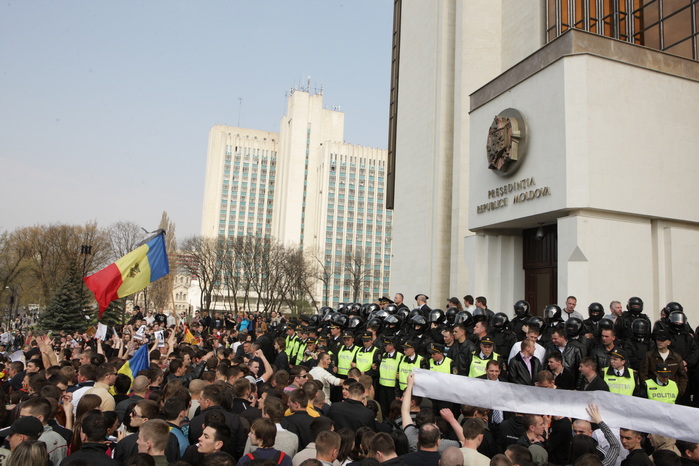
Political analyst: 7 April 2009 protests allowed change in governing paradigm and removal of old nomenklatura
The April 7, 2009 protests led to a change of political generation and the launch of new development projects for the Republic of Moldova, including the project of accession to the European Union, says political analyst Alexandru Tănase, who was an eyewitness to these events, being present in the square. In an exclusive interview for MOLDPRES, Tănase emphasized that, although even today, after 17 years, “the truth has not been found” and many aspects remain unclear – who was behind the protests, who ordered the mistreatment of young people, who organized the provocation against Romania – the protests allowed a change in the governing paradigm and the removal of the old nomenklatura.

Was it an initiative of society for European integration? Unlikely, the analyst states. People were tired of an “archaic,” “repressive” system that could not offer anything to society.

“THE TRUTH ABOUT THOSE EVENTS WAS NEVER FOUND”

Alexandru Tănase, political analyst: “So many years later, we can unequivocally state that in the end the truth about those events was never found, so we did not find out who were the ones who organized these events, these provocations.

Who were the persons behind the provocation organized against Romania? I am referring to the raising of the map of Greater Romania on the façade of Parliament, which then led to the expulsion of Romania’s ambassador from Chișinău. It is still unclear to this day who gave the orders to the police to mistreat the young people that night; in other words, we are exactly where we were in 2009. Absolutely nothing has moved forward in this regard.

“CHANGE OF THE GOVERNING PARADIGM AND REMOVAL OF THE OLD NOMENKLATURA”

From a practical point of view, these events certainly had a revolutionary effect. The events of April 7 allowed a change in the governing paradigm and the removal from power of the Communist Party, the removal of the old agrarian and communist nomenklatura, and the launch on the political scene of a new generation of politicians. In this sense, I believe these two dimensions are the most relevant.

As to why there was no clarification, why we still have no answers to the questions, it is probably an objective matter. I don’t think we will find in the history of mankind revolutionary events for which it would have been possible to provide exhaustive answers. Let us try to see how many years have passed since the Romanian revolution up to today: we still do not have clarity on that subject and many, many others. Thus, the essential element of these events is that they triggered a generational change in politics.

“PEOPLE WERE TIRED OF THE ARCHAIC, REPRESSIVE SYSTEM”

I don’t know if at that time anyone was necessarily thinking about European values. I want to say that the atmosphere in 2009 was different from the one we have today. Yes, it is true, these events allowed the reset of European integration mechanisms, which later culminated in the signing of the Association Agreement and the lifting of the visa regime. Here, clearly, there is a causal link, but I do not think that when people protested they necessarily had a European project in front of them. Rather, it was not so. Most likely, people were tired of this archaic, repressive system which clearly could offer nothing to society. The symbol of society back then was the policeman dressed in black, whom everyone feared. Everyone wanted change, because we had entered a phase of stagnation. Two regimes, two mandates of the Communists, had pushed the country into a system of stagnation, and we had turned into a closed country – nobody was coming here, and there was no perspective. In this sense, April 7 somehow blew up the entire society, but it also launched a series of projects, including the European project.

“WHEN THE ELECTIONS SUGGESTED THAT NOTHING HAD CHANGED, SOCIETY DECIDED TO PROTEST”

Regarding the relationship with Romania, we must remember that from the moment the Communist Party took power until its departure, this was a Romanophobic, deeply anti-Romanian government, where Romanophobia was an essential element of state policy. They had developed their own theories, included in the so-called concept of national policy, where they denied the identity between the inhabitants on the left and right banks of the Prut, the ethnic identity, and talked about a Moldovan language distinct from Romanian. There had been protests against censorship at Teleradio-Moldova; it was an unbearable atmosphere that could not continue, and all these elements generated a state of discontent and protest. When, on April 6, the elections suggested that things would not change for another four to five years, society decided to protest. No, I don’t think we should classify the events of April 7 as a classic popular protest, because they were not. Certainly, behind these events there were specific people who organized and guided them, but as long as we do not have clarity on this aspect – who these people were, why to this day we do not have an answer to the question of who mistreated the young people – I think we are unable to speak with solid arguments on this topic.

WHAT FOLLOWED AFTER 7 APRIL 2009 PROTESTS? “WE WITNESSED TWO CHANGES OF THE POLITICAL CLASS”

We witnessed two changes of the political class: the first change was in 2009, when a new generation of people removed the Communist Party from power, opened up the Republic of Moldova and placed it back on the European path on which we are still moving today. The second change came after the second revolution, which took place in 2018, 2019, 2020, when the Democratic Party was removed from power, and those people who govern the Republic of Moldova today and had not been associated with politics managed to come to power. It is important that these changes also entail substance. In the end, a simple change, if it has no substance that allows society to move forward, does not, I believe, have a practical impact, although we cannot deny the historical importance of these events.
 Facebook
 Instagram
 X/Twitter
 Telegram
Foreign affairs minister meets Turkey’s Ambassador to Moldova
PHOTO // President in Riga: European Moldova cannot be destabilized and cannot be used as pressure point against continent
Stricter rules against terrorism: Moldova joins new European protocol
VIDEO // Moldovan President welcomed by Latvian counterpart at Riga Castle
Government staff reshuffle
Prime Minister about state of emergency: We will not maintain it for even one day longer than necessary
Moldovan President pays official visit to Latvia
Romanian president says Moldova can always count on Romania’s support
VIDEO // Moldovan parliament speaker at Bucha Summit says Ukrainians deserve just victory, Ukraine to prevail
Moldovan president conveys message at Romania Government Roundtable conference
Moldovan expert says Moldova becomes strategic constant in Romania
Romania supports Moldova's economic integration; Romanian president says Romania to continue to support Moldova's integration into European Union, integration of two economies
Prime Minister at The Economist conference on accelerating EU accession process: Moldova moves forward despite challenges
PAS to have new MP in Parliament
Steady increase in passenger numbers at Eugen Doga International Airport – Chișinău: most popular destinations in March
MOLDPRES INTERVIEW // Moldovan deputy PM for reintegration says gradual reintegration in different sectors path toward lasting settlement of Transnistrian conflict
Political analyst: 7 April 2009 protests allowed change in governing paradigm and removal of old nomenklatura
Israeli visas expiring between April 1 and May 31 to be automatically extended
Head of State to pay official visit to Ireland, which will hold rotating presidency of Council of European Union starting July
Judge Ana Cucerescu passed external evaluation
Parliament may adopt new code of operation
 National Bank of Moldova
MOLDPRES INTERVIEW │ Deputy Prime Minister: Gradual reintegration in different areas - path toward lasting settlement of Transnistrian conflict
Deputy Prime Minister for Reintegration meets with Head of International Committee of Red Cross Mission
Head of State to pay official visit to Ireland, which will hold rotating presidency of Council of European Union starting July
Moody’s Agency upgrades Moldova’s rating to B2, highest level in last 25 years
Moldovan authorities step up prevention, response measures on Dniester, amid anticipated new pollution wave

Today - last day to submit documents for registration of candidates in new local elections
Over 1,200 tons of gasoline and diesel imported into Moldova on Monday
PHOTO GALLERY // 7 April 2009 protests captured by MOLDPRES
Prime Minister: 7 April 2009 changed country’s direction and left us with lesson we must never forget: freedom does not come by itself, it is won
Speaker about 7 April 2009 events: Memory of this day must unite us, because future of this country depends on choices we make
Moldovan President: 7 April remains lesson about how easily fundamental rights can be violated and about importance of defending freedom
Polish MPs visit Chișinău to strengthen bilateral relations
PHOTO // 17 years since 7 April 2009: Protests that changed country’s development path, still shrouded in uncertainty
Changeable weather, wind gusts forecast in Moldova for April 7: air temperatures up to 15 degrees
Justice reform, anti-corruption efforts in Moldova, essential conditions for concluding EU accession negotiations
Moldovan president to deliver speech in Dublin on reforms, European path of Moldova
Moldovan energy minister pays unannounced visit to Chisinau Electrical Substation
Moldova to benefit from Greece’s support in leveraging external assistance, advancing its European path
Moody’s Agency upgrades Moldova’s rating to B2, highest level in last 25 years
Over 800 teams registered for EuroQuiz 2026: final to take place in Chisinau on 8 May
Yellow wind warning in Moldova: authorities issue safety recommendations for residents
Receive the latest news directly to your email

Receive the latest news directly to your email