
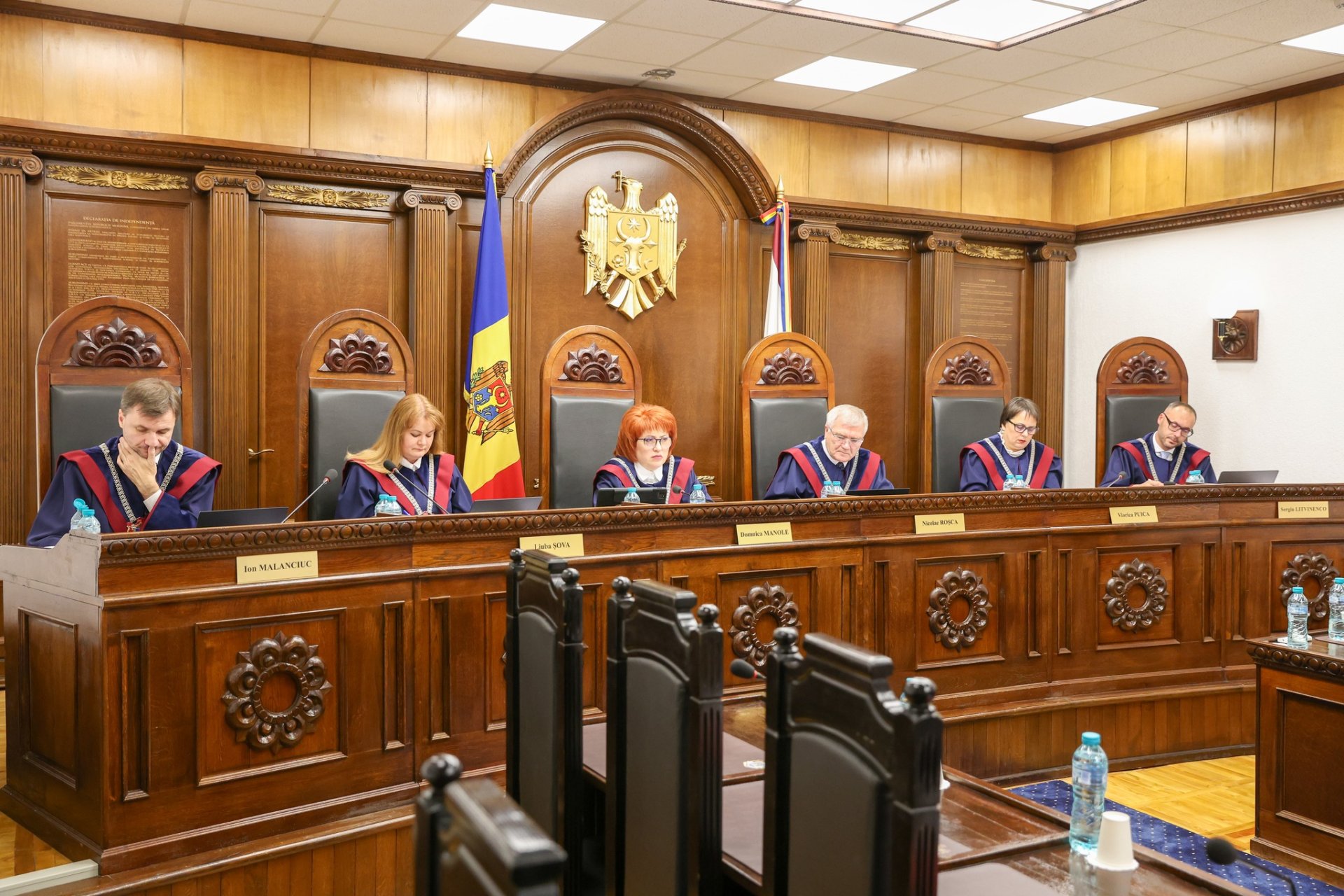
Constitutional Court rejects challenges to unconstitutionality filed by three parties and ruled that contested provisions of Law on Political Parties constitutional
The Constitutional Court has rejected the challenges to unconstitutionality submitted by three political parties and has declared the contested provisions of the Law on Political Parties to be constitutional. According to the President of the Constitutional Court, Domnica Manole, the ruling confirms that the dissolution of a successor party to a formation declared unconstitutional does not occur automatically, but may be ordered only following an individualized judicial assessment and with full respect for procedural safeguards.

In a briefing held after the ruling was delivered, Domnica Manole explained that Parliament has prohibited the creation or use of a political party for the purpose of continuing the activity of a formation declared unconstitutional, treating such a practice as a fraudulent exercise of the right to political association.

The President of the Court specified that the courts will examine, as a whole, the operational, ideological, and behavioral continuity between the party declared unconstitutional and the alleged successor formation, and that the criteria set out by law do not create an automatic presumption of succession.

"The criteria do not operate in isolation and do not establish an automatic presumption that the party has the status of a successor party. They must be examined globally, contextually, and in relation to the reasons that led to the declaration of unconstitutionality," said Manole.

According to her, dissolution may be ordered only if the court finds, on the basis of the evidence presented, that the party is engaging in activities prohibited by law. At the same time, mere past membership in a party declared unconstitutional is not sufficient for applying this measure; it is necessary to demonstrate an active role of the party leadership in the actions that led to the declaration of unconstitutionality.

The Court further held that when the violations do not justify dissolution, the court may apply an alternative measure – the temporary restriction of the party’s activities – which ensures compliance with the principle of proportionality.

Referring to the restriction of the activities of political parties, Domnica Manole noted that the law allows this measure to be applied in cases such as undermining electoral processes, disinformation campaigns, incitement to hatred, propaganda for military aggression, the promotion of extremist or terrorist messages, or large-scale corruption of voters.

According to the Court, the restriction of activity is temporary, for a period of up to 12 months, and the formation may resume its activity after the causes that prompted state intervention have been removed. The law also provides that, as a rule, the activity of a party may not be restricted during an electoral campaign, except in situations in which the party commits serious violations expressly provided for by law.

Domnica Manole also said that prior to issuing the ruling, the Court requested and analyzed the opinion of the Venice Commission regarding the status of and measures applicable to successor parties of formations declared unconstitutional. The Court’s ruling confirms that the contested provisions comply with the Constitution and provide the authorities with a legal mechanism to protect the constitutional order and democratic values.
 Facebook
 Instagram
 X/Twitter
 Telegram
Moldovan parliament adopts reform of Service for Prevention and Combatting of Money Laundering in first reading
Moldovan parliament speaker explains salary reform: “Ending disparities between institutions and setting a clear salary hierarchy”
European Commissioner for Environment expected on first visit to Moldova
Who does Maia Sandu see as President after her?
President: Withdrawal of Russian troops from Transnistria remains priority in dialogue with European partners
Moldovan president says scandal at MoldATSA very serious case, requires inspections at other enterprises too
Moldovan deputy PM meets OSCE High Commissioner on National Minorities
DOC // Moldova to have new ambassadors to India and Armenia, as well as Permanent Representative to Council of Europe
Moldovan authorities propose that Tiraspol holds meeting in 1+1 format
Moldova to attend Ukraine reconstruction conference
Ambassador of the Republic of Moldova to Portugal recalled from office
Members of Prime Minister’s Control Corps resigned
Promo-LEX: Moldovan parties attract more donations and rely less on state budget funds
Moldovan parliament speaker has high-level meetings at Czech parliament
Minister of Energy: Works on Vulcănești–Chișinău line completed
President met with former Prime Minister of Finland
Moldova and Romania expand cooperation for development of infrastructure projects
Approved by Government: electronic signatures to be available from age of 14
 National Bank of Moldova
Prime Minister met with EU Representative for Transnistrian settlement
Prime Minister and Strategic Counsellor at Tony Blair Institute discuss support for European reforms in Moldova
President met with former Prime Minister of Finland
20 model schools to undergo major modernization: Government approves ratification of Financing Contract between Moldova and EIB
President announced measures following abuses at MoldATSA

Moldova and Romania expand cooperation for development of infrastructure projects
Parliament to tighten rules for convicts trying to flee country
Military sappers neutralized 21 explosive devices remaining from World War II
Record on electricity exchange: 542 MWh traded in single day, equivalent to about 4% of consumption
Approved by Government: electronic signatures to be available from age of 14
Moldova continues withdrawal from CIS treaties
State Chancellery to launch comprehensive review of consultancy contracts
20 model schools to undergo major modernization: Government approves ratification of Financing Contract between Moldova and EIB
President announced measures following abuses at MoldATSA
President’s statements on measures announced following abuses at MoldATSA
Energy Minister in Montreal: Energy efficiency - best investment to reduce citizens’ bills
116 projects, including for opening new nursery groups included in Single Programming Document for 2025–2027
More road safety: Government sets clearer rules for market surveillance of motor vehicles
Investments for local development
Victims of human trafficking to benefit from greater protection and faster assistance
Better conditions for businesses in northern Moldova, at Multifunctional Industrial Park in Ocnița
Receive the latest news directly to your email

Receive the latest news directly to your email