
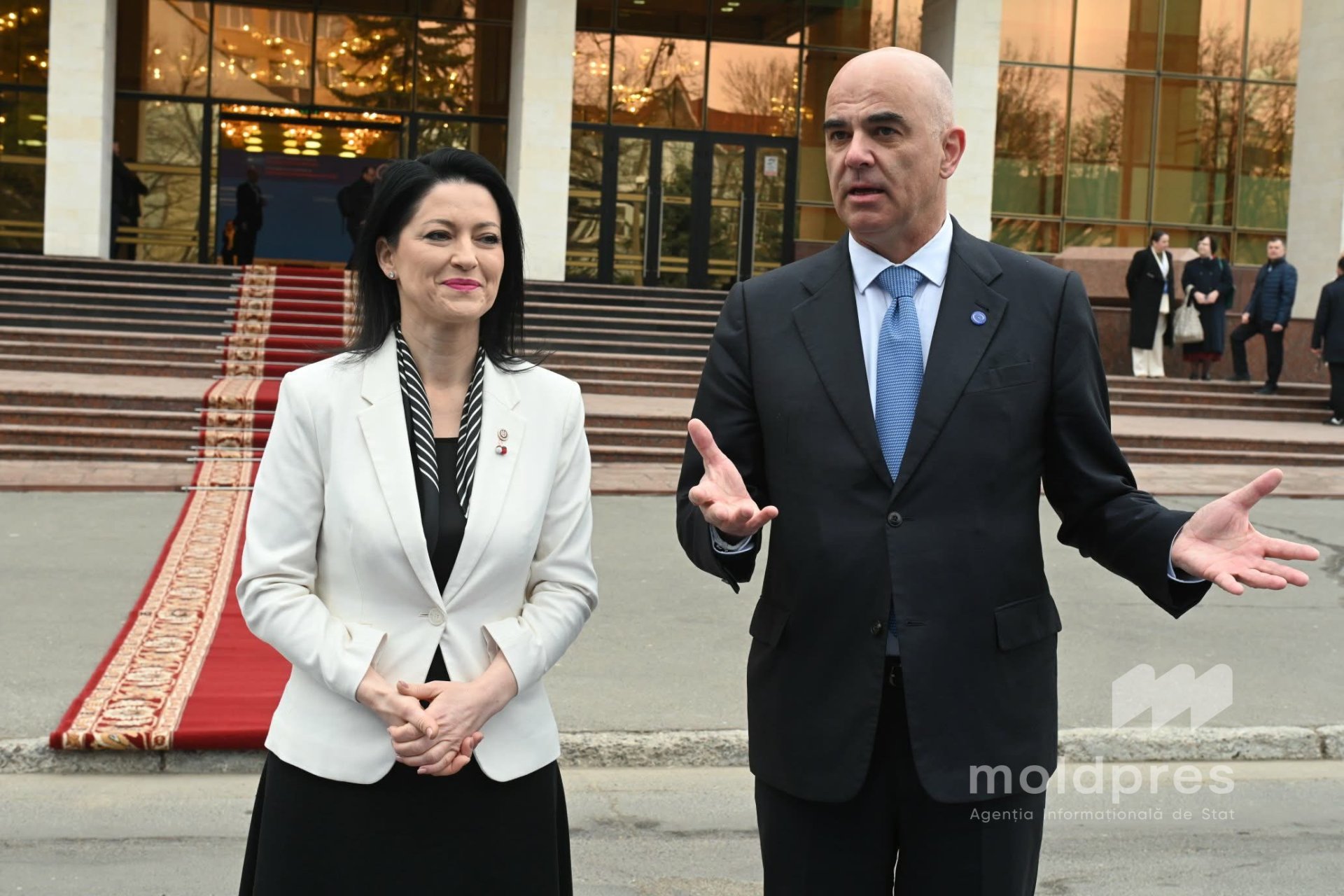
Council of Europe Secretary General in Chișinău: Global crises require strengthening social rights and institutions
Global and regional crises, including the war in Ukraine and conflicts in other regions, require the strengthening of social rights and democratic institutions, the Secretary General of the Council of Europe, Alain Berset, stated today at the opening of the High-Level Conference on Social Rights – European Social Charter, which is taking place in Chișinău.

The official stressed that inclusive societies cannot be built solely through infrastructure or efficient systems, but require sustained investment in democratic security, strong institutions and access to essential services such as healthcare and housing.


“Inclusive societies are not only about high-quality infrastructure, nor just about efficient protection systems. We are in a difficult moment, marked by multiple crises at global and European level – the war in Ukraine, the conflict in the Middle East and other situations that affect us all. In this context, it is essential to invest in democratic security, in strong institutions and in access to essential services such as healthcare and housing. Respecting and promoting social rights is the safest way to consolidate and stabilize societies across our continent,” the official said.


According to Berset, the promotion of social rights is one of the most effective ways to ensure the stability of European societies in the context of current challenges.

At the same time, the official welcomed the organization of the conference in Chișinău, in the context of the Republic of Moldova’s Presidency of the Council of Europe, noting the importance of cooperation among the 46 member states.


“We thank you for hosting this event. It is a great pleasure for us to be in Chișinău, together with representatives of the 46 member states. We are convinced that the European family is the best way to promote common standards and to move forward together in building a stronger and more united Europe,” Alain Berset declared.


Today, for the first time, the Republic of Moldova is hosting the High-Level Conference on Social Rights – the European Social Charter. The event is taking place in the context of our country’s Presidency of the Committee of Ministers of the Council of Europe.

Approximately 50 official delegations are expected to attend the meeting. The conference will be opened by the Secretary General of the Council of Europe, Alain Berset, and by the President of the Republic of Moldova, Maia Sandu.

At the opening of the event, the Minister of Labour and Social Protection, Natalia Plugaru, emphasized that it is a great honor for the Republic of Moldova to host the High-Level Conference on the European Social Charter.


“I warmly invite all governments, stakeholders and friends to join us in Chișinău at this significant conference. Your participation will shape the future of social rights in Europe and will reaffirm our common values. We look forward to welcoming you and working together for a fairer, more inclusive and more prosperous Europe. Together we will reflect on how to strengthen implementation, promote broader ratification and ensure that the promise of social justice guides our actions both now and in the future,” Natalia Plugaru stated on the eve of the conference.


On the margins of the event, two important agreements will be signed in Chișinău: a Social Security Agreement with Ukraine and a support agreement for the implementation of the RESTART reform with the Czech Republic.

The Republic of Moldova ratified the revised European Social Charter on 8 November 2001 and accepted additional provisions in August 2024. At present, our country has accepted 71 of the 98 paragraphs of the Charter. At the same time, the Republic of Moldova has not accepted the 1995 Additional Protocol, which provides for the establishment of a system of collective complaints.

In the context of the event, the authorities have announced that road traffic will be temporarily restricted on certain streets in central Chișinău to ensure the proper organization and security of the high-level meeting.
 Facebook
 Instagram
 X/Twitter
 Telegram
PHOTO // Moldovan parliament speaker in Ljubljana says Slovenia’s experience on road to EU valuable lesson for Moldova
Annual meeting of Conference of Regional and Local Authorities for Eastern Partnership held in Chisinau
Moldovan parliament speaker in Istanbul discusses Moldova-Turkey relations, elections in Gagauzia
Chisinau maintains position on withdrawal of Russian troops and demilitarization of Transnistrian region
5+2 format no longer works
PHOTO // Moldovan PM commemorates victims of September 11, 2001 terrorist attacks in Chisinau
European Commissioner reconfirms EU support for advancing reforms in European integration process
European Commissioner holds talks with Prime Minister
MOLDPRES INTERVIEW // Moldovan deputy PM for reintegration: “Reintegration cannot happen through a single decision. Citizens must feel that moving closer to the right bank brings them benefits”
Moldovan President, European Commissioner for Equality approach progress in implementing reforms
European Commissioner on first visit to Chișinău: Moldova - important partner in strengthening Europe’s resilience
Adrian Băluțel appointed co-chair of Moldova–EU Parliamentary Association Committee
How future Constitutional Court judges will be selected. Parliament changes rules
Speaker: Elections in Gagauzia must be fair
PM, at Etno Fest Taraclia, says diversity of cultures, traditions makes Moldova richer
Moldovan Foreign Affairs Ministry condemns incident near Colonita settlement
Moldovan Border Police monitor situation after explosion nearby border with Ukraine; no fragments found in Moldova
Moldova European leader in growth of tourist arrivals in first half of 2026
 National Bank of Moldova
Moldovan PM has meeting with mayors from Gagauz autonomy
Moldovan PM discusses with entrepreneurs from southern region, visits more local businesses
PM, at Etno Fest Taraclia, says diversity of cultures, traditions makes Moldova richer
Art Comes to Life – immersive exhibition hosted by Moldova's parliament
Data of 2024 Census used in public policy development in Moldova

Moldovan energy minister explains why security stocks cannot be used to reduce gas prices
Data of 2024 Census used in public policy development in Moldova
Estonia to continue providing expertise to Moldova in EU accession process
Moldovan PM meets with Head of Council of Europe Office in Chisinau
Over 20 companies from Moldova present products in Baia Mare, Romania
Moldovan PM to attend 81st session of United Nations General Assembly
Prime Minister visits Zarea Hotel: We want transparent auction and as many bidders as possible
VIDEO // Prime Minister about privatization of Zarea Hotel: Our goal - to generate as much money as possible for state budget, while also making good use of important property in central Chișinău
PHOTO // Fragments that may have come from drone found on land near Colonița
PHOTO // Ștefan cel Mare Academy inaugurates drone operator training laboratory
VIDEO // More than 218 million lei directed toward objectives of Convergence Fund, although mechanism has not yet begun operating
Five youth centers to receive €500,000 for equipment and technical support
PHOTO // Fire Shield 2026 exercise concludes
New edition of program „Sub cușma lui Guguță” launched at Parliament
DOC // New rules for recognition of professional qualifications obtained abroad
Joseph Mark Burkhalter sworn in as U.S. Ambassador to Moldova
Receive the latest news directly to your email

Receive the latest news directly to your email