
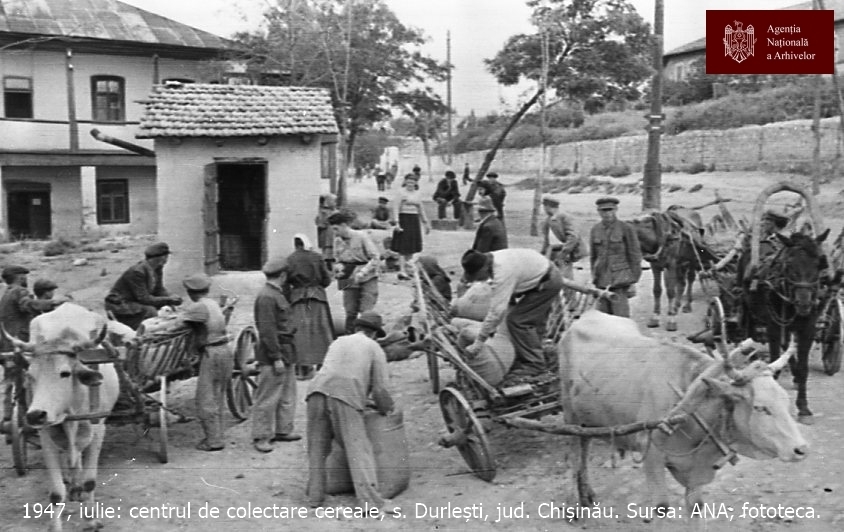
Moldovan head of state delivers message on Famine of 1946 – 1947
President Maia Sandu has conveyed a message in the context of commemorating the victims of the famine caused by the Soviet regime in 1946 – 1947.

"Our parents, grandparents and great-grandparents had even their last grain of wheat taken from their attics, leaving them to die of hunger. This was a deliberate gesture, a barbaric way of subjugating the population," the head of state said.

The Moldovan president noted that, for decades, this tragedy had been passed over in silence. But collective memory cannot be erased and the truth must be told, Maia Sandu stressed.

"We cannot build a just future without acknowledging the injustices of the past and without keeping alive the memory of the hundreds of thousands of people killed by this crime. Hunger did not ask what language its victims spoke or what blood they carried," said the head of state.

The president emphasized that the country’s duty, as a united society, was to defend the truth, stand on the side of good and build the future with dignity, in peace, in a Moldova where such horrors will never again be possible.

According to the National Archives Agency, the famine of 1946-1947 was one of the greatest humanitarian catastrophes which hit the current territory of the Republic of Moldova in the 20th century. It was not an unavoidable natural disaster, but a tragedy exacerbated by the authoritarian and repressive policies of the Soviet regime. According to data provided by the National Archives Agency, in just a few months, more than123,000 people died of hunger, accounting for about 5 per cent of the population of the Moldovan Soviet Socialist Republic. Proportionally, Soviet Moldova was the worst hit region in the entire Soviet Union, with a death  rate ten times higher than in Russia and five times higher than in Ukraine.
 Facebook
 Instagram
 X/Twitter
 Telegram
Tofan Government’s 100-day report to be presented on 5 November
President holds meetings with Hungary’s leaders in Budapest
PHOTO // President honors courage of Hungarian people, 70 years after 1956 anti-communist Revolution
Ukraine condemns violation of Moldova’s airspace
Moldovan president condemns incident in Telenesti district: “Russia’s war continues to endanger citizens’ lives”
Staff member of Russia's Embassy in Moldova to be declared persona non grata after explosive-laden drone crashed in Telenesti district
PHOTO, VIDEO // Moldovan head of state president welcomed by Hungarian president at Sándor Palace in Budapest
State Secretary for Reintegration: Revenue from taxes imposed in Transnistrian region will return to population through Convergence Fund
Joint border control, energy projects on Prime Minister’s agenda during visit to Kyiv
Ukraine's Ambassador to Chisinau: Dniester incidents must be investigated, findings made public
OSCE Permanent Council: Moldova rejects Russia’s claims concerning Transnistria, calls for withdrawal of military forces from its territory
Romania's new PM to pay first visit to Chisinau on October 27
Cooperation between Moldova, International IDEA discussed in Chisinau
Moldova's parliament speaker calls on Moldovan, Ukrainian border authorities to find solutions to prevent incidents on Dniester
Romania’s PM in Chisinau says European integration of Moldova strategic priority for Romania
VIDEO // PMs of Moldova, Romania discuss advancing bilateral cooperation: strategic infrastructure, energy projects prioritized
Moldovan PM says cybersecurity to stay priority for Moldova
LIVE // PMs of Moldova, Romania hold news conference
STISC: Personal data of around 750,000 people may have been extracted following cyberattack on digital public services in Moldova
VIDEO // Romanian PM welcomed with honors at Moldova's government
VIDEO // Romanian investments in Moldova created 12,000 jobs
 National Bank of Moldova
Discursul Premierului Vasile Tofan, la conferința de presă comună cu omologul român, Luca Niculescu
Deputy Prime Minister for Reintegration meets with Croatia’s State Secretary for European Affairs
Moldovan President held farewell meeting with Slovak Ambassador
Deputy Prime Minister for Reintegration holds talks with Romanian Foreign Minister
Prime Minister encouraged Ukrainian entrepreneurs to invest in Moldova

National Army receives logistical equipment from United Kingdom
Moldovan President held farewell meeting with Slovak Ambassador
Foreign Minister approached European integration and countering hybrid threats in Cyprus
Deputy Prime Minister for Reintegration holds talks with Romanian Foreign Minister
Old-Calendar Orthodox Christians celebrate Saint Venerable Paraskeva, patron saint of Moldova
Prime Minister encouraged Ukrainian entrepreneurs to invest in Moldova
Speaker at meeting with Slovak ambassador: Slovakia’s experience in European integration process remains valuable
Moldova strengthens relations with Cyprus: Honorary Consulate inaugurated in Nicosia
ANALYSIS // Moldovan Prime Minister in Kyiv, consolidation of Moldovan-Ukrainian cooperation
PM invites Ukrainian companies to invest in Moldova
Cahul boxer wins bronze at European U-15 Championships
Romania’s Prime Minister expected in Chișinău
Republic of Moldova aims to close two EU negotiation chapters in 2027
VIDEO // Moldovan, Ukrainian officials discussed current issues in Kyiv
Moldova could serve as platform for Ukrainian businesses expanding into Romanian market
Moldovan Prime Minister in talks with Ukrainian President
Receive the latest news directly to your email

Receive the latest news directly to your email