
PHOTO, VIDEO // Moldovan president in Latvian parliament says supporting Moldova’s accession, defending Latvia's democracy represent same act of resistance
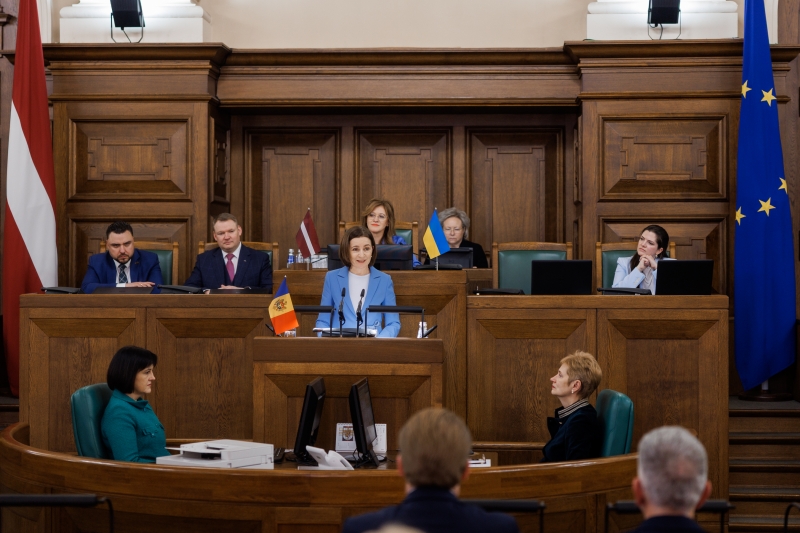
Moldova is counting on Latvia’s support on its path toward accession to the European Union. President Maia Sandu delivered a speech in the Riga parliament, the Saeima, in which she emphasized that Moldova and Latvia had shared a similar past, having been part of an empire “they did not choose.”

This past did not prevent Latvia from joining the European Union in 2004. The head of state highlighted that today, Latvia’s voice in Brussels carries the weight of a country that knows very well what values are at stake.

Maia Sandu warned that the same forces trying to block Moldova’s accession to the EU would attempt, in every possible way, to divide Europe.

“Supporting our accession and defending your own democracy are, in essence, the same act of resistance,” Maia Sandu said.

Maia Sandu started her speech with verses from Grigore Vieru’s poem, In Your Language, recited in Latvian, English and Romanian. She stressed that “Grigore Vieru’s poem has outlived the empire that tried to silence it.” In 1985, at a time when Latvia was regaining its independence, the band Līvi set this poem to music in Latvian.

“Think about this. Two countries, two languages that have no common roots; yet, have shared the same stubborn will: the refusal to be suppressed. Moldova is here today thanks to this stubbornness — the refusal to accept that our place is anywhere other than where we have always belonged: in the European family,” Maia Sandu said.

She underlined that the consequences of the Ribbentrop–Molotov Pact would not be fully undone until every country affected by that forced division is anchored in the European Union.

“Latvia joined the EU in 2004. Moldova hesitated. Not because we were less European, but because it took longer to recover what had been taken from us. We are recovering now. And the consequences of the Ribbentrop–Molotov Pact will not be fully undone — not truly — until every country it cast into grey zones is anchored in the European Union. Protected. Free. Finally home.

Despite Russia’s attempts to discourage us, the people of Moldova have demonstrated their will three times in two years: at the constitutional referendum, at the presidential elections, and at the parliamentary elections. Each time, support increased. Each time, our people chose Europe and we are honoring this commitment,” Maia Sandu said.

The official stressed that, in just three years, Moldova had secured its independence from Russian gas and reforms in priority areas were in full swing.

“We have reformed the judicial system from the ground up: we have evaluated judges and prosecutors and created courts with real accountability. We are also eliminating the vulnerabilities exploited by Russia and aligning national legislation with European Union standards. The European Commission considers us one of the best students in the class — and we intend to work even harder. We are not asking for compassion, but for a chance — just as Latvia once had — to see this journey through to the end,” Maia Sandu noted.

The president referred to the tools used by the Russian Federation during parliamentary elections held Moldova, in order to derail the country’s European course.

“Today, Russia is trying to take control by undermining democratic processes, and elections are the ideal tool. The real goal was to capture Parliament, install a government controlled by Moscow, destroy our democracy and use Moldova against Ukraine and Europe. Most concerning is that this attack exploits the very principles of democracy. Freedom of expression has been turned into a tool of political manipulation. In just three years, seven parties financed by Russia appeared, each claiming to represent the will of the people. When one was declared unconstitutional, another immediately took its place — one of them was even created in Moscow. Freedom of assembly was hijacked — protests were organized and paid for. Investigations uncovered lists of participants, routes and envelopes of money. Some people were receiving up to 3,000 euros a month. The online space became an instrument of influence through social networks and coordinated propaganda. On election day, the electoral infrastructure was targeted by cyberattacks, to create the impression that fraud was coming from within, not from outside. Disinformation was produced on an industrial scale. The narratives pushed claimed that Europe means war, that the state would be captured, and that leaders were involved in absurd actions. A network of hundreds of accounts on social platforms generated tens of millions of views in a country of only 2.5 million inhabitants. We estimate that Russia invested in these elections roughly 2 per cent of Moldova’s GDP — double what it spent to distort the referendum on EU accession,” the official said.

Maia Sandu spoke about the importance of institutional cooperation and the implementation of measures that would prevent Moscow’s attempts at interference. According to the head of state, these actions must be carried out to guarantee the security of the entire region.

“We must distinguish between genuine debate and manipulation. Not every protest is spontaneous and not each opinion is independent. Sometimes, these actions are coordinated and financed. I am saying all this because Moldova has been a testing ground, and Russia will learn from its mistakes and adapt its strategies. Moldova’s accession to the European Union is not just an internal matter. Moldova has a 1,200-kilometer border with Ukraine, which is our shield. Latvia has been one of Ukraine’s staunchest supporters from the very first hours of the invasion. Moldova is providing shelter to refugees, allocating funds and assistance, training demining specialists and joining in every form of support for Ukraine. We are also part of the coalition of states that will help ensure Ukraine’s security after the war ends,” the head of state said.

The Moldovan president emphasized that Moldova’s place is in the European Union and that, along this path, our country needs Latvia’s support.

“You have already turned back toward Europe, and we are now traveling the same road and are drawing close to its end. Latvia’s voice in Brussels carries the experience of the states that have followed this path. Use this voice — in the European Council and in each forum where our future is discussed — because the same forces that tried to block Latvia’s accession to the European Union will do everything possible to divide us. Supporting our accession and defending your own democracy are, in essence, the same act of resistance. We are close to the end of this road. Help us to see it through,” Maia Sandu added.

At the end of the speech, Latvian MPs rose to their feet and supported the head of state’s message with applause.

Maia Sandu today is paying an official visit to Latvia, at an invitation of Latvia’s President, Edgars Rinkēvičs. The visit aims to strengthen bilateral relations and deepen cooperation, with a focus on regional security and Moldova’s EU accession process.

During the visit, the head of state met her Latvian counterpart. The agenda also included meetings with Prime Minister Evika Siliņa and with the leadership of the Latvian parliament.
 Facebook
 Instagram
 X/Twitter
 Telegram
VIDEO // Moldova and Ukraine reaffirm: Our future in EU
VIDEO // News from Brussels on starting preparations for Cluster I in accession negotiations of Moldova to European Union applauded in Parliament
Strong support for Ukraine reaffirmed in Chisinau Parliament
Prime Minister at Moldova–EU Investment Conference: Moldova ready for accession and becoming part of European economy
European Commissioner in Chișinău: Moldova will be increasingly integrated into European economy, not only at time of accession, but long before it
President at Moldova–European Union Investment Conference: More and more friends from EU want to contribute to our country’s economic success
Siegfried Mureșan: Historic moment for European future of the Republic of Moldova: preparations start for opening cluster negotiations
European Commissioner for Enlargement expected in Chisinau, to advance EU accession reforms, boost investments; visit's agenda
European Parliament Vice-President calls for launch of political negotiations, opening of all clusters with Moldova
CEC launches web platform for district electoral councils
Government approves national reintegration activity program: 25 million lei for 30 projects to be implemented this year
Moldova completed clearing land for construction of new US Embassy
Ministry of Health to have new state secretary
European Parliament supports Moldova in European integration process; MEP Siegfried Muresan: "We support the opening of accession negotiations across all clusters"
Deputy parliament speaker says Moldova must strengthen defense capabilities
Works at Chisinau Electrical Substation progressing; Romanian Ambassador says Romania stays reliable partner of Moldova in strengthening energy security
EUROPEAN VILLAGE // Over 27 million lei invested in modernizing infrastructure in central Moldova settlement
Moldovan Foreign Affairs Ministry issues travel alert for Qatar, Kuwait: “Security situation stays volatile”
Economic, investment opportunities of Moldova promoted at Annual Meeting of Board of Governors of European Bank for Reconstruction and Development
PHOTO // Moldovan deputy parliament speaker says Grand Duchy of Luxembourg, as EU founding member, firmly supports Moldova's European path
Discover Moldova with #MOLDPRES // Sweet business in Prut Meadow
 National Bank of Moldova
Moldovan president attends ceremony on 24th anniversary of foundation of National Anticorruption Centre
Prime Minister at Moldova Digital Summit 2026: Our ambition is not only to join EU, but to help build Europe’s digital future
Over 1 billion euros in new investment partnerships, financing announced for Moldova
Topical issues addressed at meeting of Joint Control Commission
Moldovan president, European Commissioner for Enlargement discuss reforms, next steps in accession process

Romanian language teachers of Moldova to benefit from intensive training courses organized in Romania
Moldovan Foreign Affairs Ministry issues travel alert for State of Israel
Nicolae Testemitanu Medical University of Moldova hosts first edition of conference on management of antimicrobials' use in tuberculosis
Moldovan president congratulates acting Armenian PM on securing parliamentary majority
PHOTO GALLERY // “Melania’s Advice”, new premiere at Mihai Eminescu National Theatre
MOLDPRES INTERVIEW // Moldovan economic development minister: “One billion euros invested in the economy of Moldova means accelerating transformations, moving closer to the EU level of development”
Moldova and Switzerland to cooperate in labour and employment
Over half a million passengers at Eugen Doga International Airport – Chisinau in last May: most popular destinations
PHOTO // Group of MPs on visit to Washington
Moldovan winemakers win 80 medals at one of largest international competitions
€40 million investments in school modernization: 20 institutions to be renovated
Foreign Ministry in talks with Ukrainian authorities about drone exploded in Orhei: Responsibility for any drone that reaches our country’s territory lies with Russia
Ministry of Defense: Fragments of aircraft found in Orhei examined by responsible institutions
Foreign Ministry condemns incident in Orhei: Threat to security and violation of state’s sovereignty and territorial integrity
Five recycling companies to receive up to 425,000 euros to develop circular economy in Moldova
Luxembourg MPs visit Moldova for talks on European integration
Receive the latest news directly to your email

Receive the latest news directly to your email