
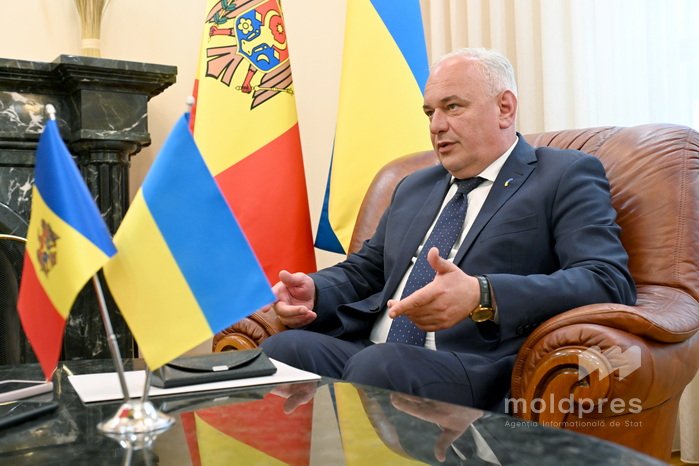
Ukraine's Ambassador to Chisinau: Dniester incidents must be investigated, findings made public
The incidents in which Ukrainian citizens attempted to swim across the Dniester River to reach the Republic of Moldova, as well as the cases in which Ukrainian border guards entered the territory of our country, must be investigated, and the circumstances of each situation must be established by the competent institutions. Ukraine's Ambassador to Chisinau Paun Rohovei made the statement during Forum programme on Vocea Basarabiei.

The diplomat stressed that Ukraine respects the sovereignty and territorial integrity of the Republic of Moldova, and that the border incidents must be examined separately, both with regard to the illegal crossing of the border by Ukrainian citizens and the actions of the border guards who reached the Moldovan bank of the Dniester.


“We consider that both cases are subjects for research and investigations, and, as a result, they should receive legal classifications regarding what actually happened there. First, the Ukrainian citizen intentionally crossed the border illegally. Second, the Ukrainian border guards who were trying to detain him unintentionally reached the bank of the Dniester on the territory of the Republic of Moldova. All of them were detained. The two border guards were subsequently detained under interinstitutional cooperation protocols between the Republic of Moldova and Ukraine, then released and handed over to the Ukrainian side to continue the investigations in accordance with the regulations governing the activities of the Border Police and the Ukrainian Border Guard Service. The Ukrainian citizen who also illegally crossed the border between Ukraine and the Republic of Moldova and ended up in the Republic of Moldova is also being investigated,” Paun Rohovei said.


According to the ambassador, the Ukrainian border guards involved in the incidents were handed over to the Ukrainian side under the cooperation mechanisms between the border institutions of the two states so that the investigations could continue. He said that the Embassy of Ukraine had not been officially informed by the Moldovan authorities about these cases and had learned about them from the press.


“We did not receive any official information at the embassy about this incident. Just like you, I learned about it from information sources and the mass media. However, this is not a problem because, under the agreements signed between the Border Police, the General Inspectorate of Border Police, the Ministry of Internal Affairs of the Republic of Moldova and the authorised institutions in Ukraine, there is a communication channel for exchanging information and for the interaction of the services to prevent or stop violations of the law,” Rohovey said.


Rohovei noted that the Republic of Moldova and Ukraine have agreements and channels for interinstitutional communication that allow for the exchange of information and cooperation to prevent and investigate violations of border legislation.

The Ukrainian citizen’s fate depends on the examination of his asylum application

Referring to the Ukrainian citizen who swam across the Dniester to reach the Republic of Moldova, the ambassador said that, if he is not granted refugee status, he could be returned to Ukraine under the applicable legal framework.

The diplomat said that the man risks being sanctioned in Ukraine for illegally crossing the border during wartime. According to him, the Ukrainian legislation applicable during martial law imposes restrictions on leaving the country for men up to the age of 60, with certain exceptions.


“He practically admitted himself that he had planned and intentionally crossed the border between Ukraine and the Republic of Moldova illegally in order to evade mobilisation. Not being sure—these are his words—whether or not he would be mobilised, because until then he had a decision stating that he was unfit for combat and at some point it was withdrawn. He must take the next step: undergo a medical examination and receive a result. He himself admitted that he chose the illegal way to return to his family, in Bulgaria, as far as I remember. He said these things publicly on television channels. I understand him, and I understand the state of fear of many people in Ukraine—the fear of war, the fear of hardship and so on. The problem is not with them; the problem is that, on 24 February 2022, Russia launched a war against Ukraine. The Constitution of Ukraine, like the Constitution of the Republic of Moldova and those of other states, stipulates that every citizen has rights but also obligations in times of war. There is also an obligation to defend the homeland,” Rohovey explained.


The ambassador stressed, however, that it is not his role to determine the legality of the border guards’ actions or any sanctions applicable to the citizen; these issues will be examined by the competent institutions.

Ambassador warns against using the incidents for information purposes

Paun Rohovei also drew attention to the way video footage of the incidents on the Dniester had been distributed online. In his view, certain circles were using these cases to fuel anti-Ukrainian sentiment in the Republic of Moldova and damage bilateral relations between the two states.


“Ukraine has never had any aggressive intention to violate the borders of the Republic of Moldova. Unfortunately, this video became, as you mentioned, a viral video. But the most serious thing is that it was used by interested circles to provoke hatred in Moldovan society towards Ukraine, towards the Ukrainian state, and towards the fact that Ukraine is currently sacrificing itself and fighting to defend not only Ukraine, but the entire civilised world,” the ambassador stressed.


The diplomat said that the repeated messages claiming that the Ukrainian border guards had intentionally tried to shoot or kill the man attempting to cross the river had contributed to intensifying emotional reactions in the public sphere.


“Look at what is happening. This video, which was disseminated immediately, was first picked up not by the reputable media outlets we know. It was immediately distributed across various networks once or twice a day, with the narratives being repeated. The emphasis was first placed on the claim that the Ukrainian border guards were responsible for the entire story. They had violated everything that could be violated. Over the course of two or three hours of broadcasting the video, I counted more than 30 instances of statements that they had received orders to shoot him or orders to kill him. Thus, attention was focused on narratives that provoke or exploit a person’s emotional state and incite hatred,” the ambassador said.


He argued that these narratives were aimed, on the one hand, at damaging relations between Chisinau and Kyiv and, on the other hand, at discrediting Ukraine in the context of the war launched by Russia.

At the same time, Rohovei said that media coverage of the incidents must not replace official investigations and the establishment of the concrete circumstances of each case. According to the ambassador, the findings of the investigations should be made public.

The ambassador reiterated that he did not justify either the illegal crossing of the border or any violations committed by the Ukrainian border guards, insisting that the responsibility for establishing the facts and assigning them a legal classification belongs to the competent authorities.

The border authorities of the Republic of Moldova and Ukraine must discuss and identify solutions to prevent incidents similar to those in which Ukrainian citizens swim across the Dniester to reach the Republic of Moldova, while Ukrainian border guards cross the border while pursuing them. The statement was made by Parliament Speaker Igor Grosu, who described the situation as a violation of the Republic of Moldova’s border but said he did not see any deliberate intention by the Ukrainian border guards to provoke the authorities in Chisinau.


“Clearly, discussions must take place between our authorities, our Border Police and the Border Police of Ukraine in order to find ways to prevent and stop, should these situations recur, the desire of some people to do this,” Igor Grosu said.


Last week, the Border Police of the Republic of Moldova recorded two cases in which Ukrainian citizens swam across the Dniester River to reach the country’s territory, while the Ukrainian border guards pursuing them illegally crossed the state border of the Republic of Moldova.
 Facebook
 Instagram
 X/Twitter
 Telegram
Republic of Moldova has four new ambassadors. Appointment decrees published in Official Journal
Prime Minister explains why Transnistrian region was not included in administrative-territorial reform
Moldovan MP says Foreign Affairs Ministry sends protest note to Ukraine, after Ukrainian border guards illegally crossed Dniester River
Moldova's foreign affairs minister, Ambassador of Slovakia discuss bilateral cooperation
Deputy Prime Minister meets ambassadors of countries in Weimar format
Irina Gutnic arrived at Chisinau city hall to resume duties as deputy mayor
DOC // Olga Roșca and Stanislav Secrieru appointed as advisers to President Maia Sandu
Spain willing to share experience with Moldova in training magistrates, combating corruption
Spain’s National Day celebrated in Chisinau: “Moldova is a future partner with whom we wish to share the European project”
VIDEO // Moldovan parliament speaker says once again convinced that Moldova has necessary support on path toward great European family
Moldovan Foreign Affairs Ministry condemns repeated violation of national airspace
Moldovan Central Electoral Commission approves ballot paper designs for regional elections due on November 15
PHOTO // Students participating in Moldova Model United Nations project visit Foreign Affairs Ministry
Moldova, Armenia to strengthen parliamentary cooperation
CHINA EXPO – Christmas Sale to be held for first time at Moldexpo on December 17
State Secretary for Reintegration: Revenue from taxes imposed in Transnistrian region will return to population through Convergence Fund
Joint border control, energy projects on Prime Minister’s agenda during visit to Kyiv
Ukraine's Ambassador to Chisinau: Dniester incidents must be investigated, findings made public
PHOTOS // Story behind legend of Dracula: Irish culture, film from 1931 presented in Chisinau
Moldovan environment minister, Romanian counterpart discuss environmental cooperation
Romania's new PM to pay first visit to Chisinau on October 27
 National Bank of Moldova

COMMENTARY on Tiraspol event
Summary of Moldovan parliament's plenary meeting held on October 22, 2026
Balti city mayor to be assisted by own cabinet; Moldovan parliament passes relevant draft in first reading
Moldovan MPs vote on draft on tax, customs facilities for import of 24 musical instruments meant for national collection of musical instruments
Moldovan parliament votes in first reading: construction of Straseni–Gutinas power line, modernization of Straseni substation to be declared of national public utility

Balti city mayor to be assisted by own cabinet; Moldovan parliament passes relevant draft in first reading
Moldovan MPs vote on draft on tax, customs facilities for import of 24 musical instruments meant for national collection of musical instruments
OSCE Permanent Council: Moldova rejects Russia’s claims concerning Transnistria, calls for withdrawal of military forces from its territory
Moldovan parliament votes in first reading: construction of Straseni–Gutinas power line, modernization of Straseni substation to be declared of national public utility
PHOTO // Three Moldovan carabineers return from Kosovo after six-month peacekeeping mission
Access to education, quality public services in focus during visits by secretary general for reintegration to Tiraspol, Bender, Varnita
Romania's new PM to pay first visit to Chisinau on October 27
Moldovan parliament adopts fiscal, customs policy package for 2027
Moldovan government's deputy secretary general says Moldova’s European path runs through country's villages, benefits of reforms must be felt locally
Cooperation between Moldova, International IDEA discussed in Chisinau
Moldovan president to visit Hungary
Adopted by parliament: taxi platforms to be required to process payments through financial institutions licenced in Moldova
Access to cadastral information extended to more categories of individuals, institutions in Moldova
Persons with disabilities since childhood to be able to combine disability, survivor’s pensions; Moldovan parliament adopts relevant draft
Works for modernization of district heating systems from Chisinau, Balti declared to be of national public interest
Moldova's parliament speaker calls on Moldovan, Ukrainian border authorities to find solutions to prevent incidents on Dniester
Receive the latest news directly to your email

Receive the latest news directly to your email