
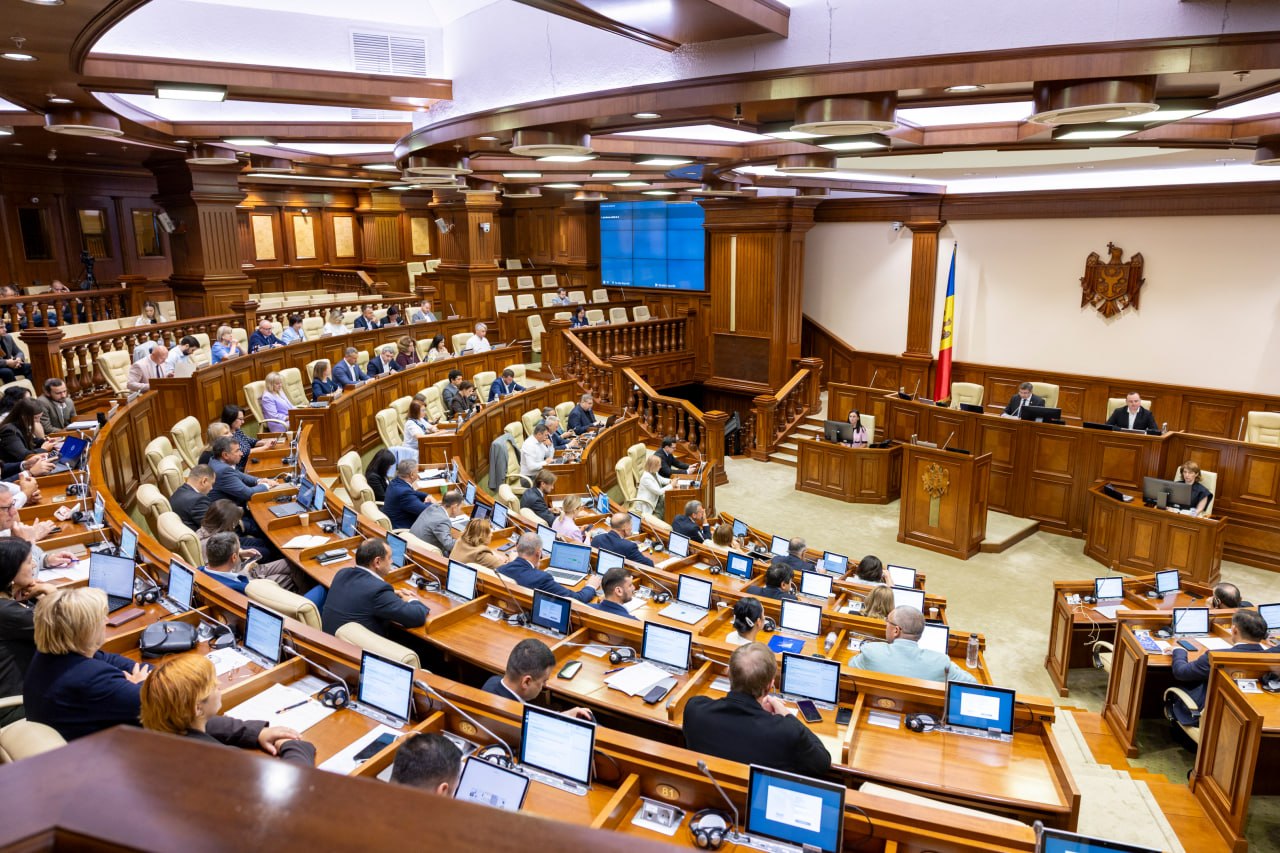
Voted in final reading: Moldova's Electoral Code supplemented with provisions on postal voting, organization of elections in Gagauz autonomy
The Electoral Code has been supplemented with new regulations on postal voting and the organization of elections in the Autonomous Territorial Unit of Gagauzia (UTA Gagauzia), aimed at strengthening the transparency, fairness and efficiency of the electoral process. The provisions are included in the draft law amending the Electoral Code, approved by the parliament in the third reading today, with the votes of 53 MPs.

A new chapter is dedicated to alternative voting ways, in particular postal voting. The draft introduces definitions for postal voting, remote identification of voters through digital means and the electoral roll for postal voting. At the same time, a separate electoral council is established for the organization of postal voting. In addition, voters residing abroad will be able to opt for postal voting based on a preliminary registration and eligibility verification procedure.

Another amendment concerns the way of electing deputies to the People’s Assembly of Gagauzia. The draft provides for a switch from the single-member system to a proportional system, similar to the one used for electing local councils. In order to ensure the stability of the electoral framework and a gradual transition, the elections of deputies to the People’s Assembly of Gagauzia, scheduled for 15 November 2026, will be held, for the last time, under the majority system.

The report on the draft law was presented by the deputy head of the legal commission for appointments and immunities, Vasile Gradinaru. He emphasized that the document aims to improve the legal framework.

“The initiative provides for the modernization of voting mechanisms and the strengthening of electoral administration, as well as the implementation of Constitutional Court Decision No. 8 from July 9, 2026. I note that, in the third reading, no substantive changes were made, only wording adjustments,” said Vasile Gradinaru.

The draft strengthens the status of the Central Electoral Council of the UTA Gagauzia, by clarifying its responsibilities and integrating it into the unified system of electoral administration. The institution will consist of at least seven and at most eleven members. The nominated people will have to meet the same eligibility requirements and undergo the same verification procedures provided by law for holders of and candidates for public offices.

The document also contains measures to prevent the use of administrative resources on electoral purposes. Central and local public authorities will be required to adopt administrative acts that transparently establish the conditions for making available premises meant for meetings with voters. They will have to ensure a minimum number of rooms that can be used by electoral contenders on equal terms. At the same time, meetings with voters will have to be organized outside the working hours of public institutions, in order to prevent the abusive use of administrative resources in electoral campaigns.

Adjustments are also provided regarding the exercise of the right to vote. Registration at domicile or at a temporary residence will have to be carried out at least three months before election day for the voter to be able to vote on the basis of this data.

The draft also amends the rules on managing accounts used in electoral campaigns and by initiative groups. The deadlines and procedures for opening, operating, suspending and closing the accounts marked “Electoral fund” and “Meant for the initiative group” are adjusted, taking into account the working hours of banking institutions and the experience gained at recent elections. At the same time, electoral contenders will be able to use, in addition to bank accounts, payment accounts provided by service providers authorized by the National Bank of Moldova.

The document also includes amendments regarding the registration of candidates, drafted following the recommendations of the OSCE/ODIHR Election Observation Mission, as set out in the Final Report on the parliamentary elections of September 28, 2025. Thus, if the exclusion of candidates declared ineligible affects compliance with the minimum quota of representation for both sexes, electoral contenders will be granted a deadline to adjust their lists and bring them in line with legal requirements.

When drafting the legislative initiative, the authors – a group of Action and Solidarity Party (PAS) MPs – took into account the proposals formulated by the Central Electoral Commission following the post-electoral assessments of the 2024 elections and the 2025 parliamentary elections. The initiative also transposes the normative solutions necessary for the implementation of Constitutional Court Decision No. 8 of July 9, 2026.
 Facebook
 Instagram
 X/Twitter
 Telegram
DOC // SIS and AIM report debunks myths about real amount of ammunition in Cobasna
President condemns Russian attacks on Ukraine: Much greater pressure must be brought to bear on Russia to put end to these actions
Parliament convenes in extraordinary session: standing bureau approves agenda of meetings
Deputy Prime Minister meets with U.S. Congress delegation
Parliament convenes in extraordinary session. MPs to meet on 24 - 25 August
VIDEO // Moldova’s Ambassador to Kazakhstan presents letters of credence
Republic of Moldova at 35 Years of Independence
Parliament strengthens dialogue with civil society: Over 20 draft laws subjected to public consultations
President about cooperation with US: We have very good relations, important projects, including in energy sector
President about Russia’s “second target”: Kremlin wants to control Moldova in order to use it against Ukraine
Foreign Ministry condemns violation of airspace of the Republic of Moldova: Such incidents unacceptable
President about measures to stop Russian drones and aggression: Support Ukraine
VIDEO // Deputy Prime Minister: Moldova turning page on CIS and moving decisively toward peaceful, promising and prosperous future within great European family
Position of Bashkan of Gagauzia declared vacant
PHOTO // Environment Ministry of Moldova warns water reserves in Novodnistrovsk lake dropping alarmingly
Moldova to be able to exchange DNA data with other states for investigation of serious crimes
Voted in final reading: Moldova's Electoral Code supplemented with provisions on postal voting, organization of elections in Gagauz autonomy
PHOTO // Exhibition dedicated to country's foreign path inaugurated at National Museum of History of Moldova
Currency liberalization: 250,000-euros ceiling without authorization of National Bank of Moldova, foreign currency payments in certain commercial units
Romanian-language TV programmes, domestic content to have a greater share in audiovisual space of Moldova; legislative initiative supported by parliament
Eugeniu Osmochescu accepts position of Minister of Agriculture and Food Industry
 National Bank of Moldova
Head of the Reintegration Policy Bureau has meeting with Ambassador of Belgium to Moldova
Lack of own premises remains main obstacle to development of Romanian-language educational institutions in Transnistrian region
Deputy Prime Minister for Reintegration and Ambassador of Ukraine to Moldova approach current issues on Transnistrian case
Presidents of Romania and Ukraine invited to celebrate 35 years of Moldova’s independence
Moldovan president advocates in Kyiv for strengthening Ukraine’s air defense

Deputy Prime Minister for Reintegration and Ambassador of Ukraine to Moldova approach current issues on Transnistrian case
Former Romanian Economy Minister joins Chişinău Government
VIDEO // President invites citizens to events dedicated to Independence Day
Changes in Moldovan Government: Eugeniu Osmochescu proposed for Agriculture and Claudiu Năsui for Economy
New subscription round via the eVMS.md platform in Moldova; citizens can invest online in government bonds with interest rates up to 7.85 per cent
National Wine Day returns to Chișinău with anniversary edition on October 3–4
Speaker invites citizens to events on 35 years of independence
European gas prices remain high as TTF benchmark reaches 68.19 EUR/MWh
PHOTO // Over 20 medals for Moldova at U-15 and U-17 European Weightlifting Championships in Pristina
UPDATE // Mirnoe-Tabachi border customs post resumes operations
Presidents of Romania and Ukraine invited to celebrate 35 years of Moldova’s independence
Moldovan president advocates in Kyiv for strengthening Ukraine’s air defense
PHOTO GALLERY // Fourth edition of National Teachers' Forum organized in Chisinau
Candidates for position of judge or prosecutor to be allowed to retake exam in Moldova
Moldovan president in Kyiv says more air defense for Ukraine means safer sky for Moldova as well
Moldova to have new law on mass media's activity, aligned with European standards
Receive the latest news directly to your email

Receive the latest news directly to your email