
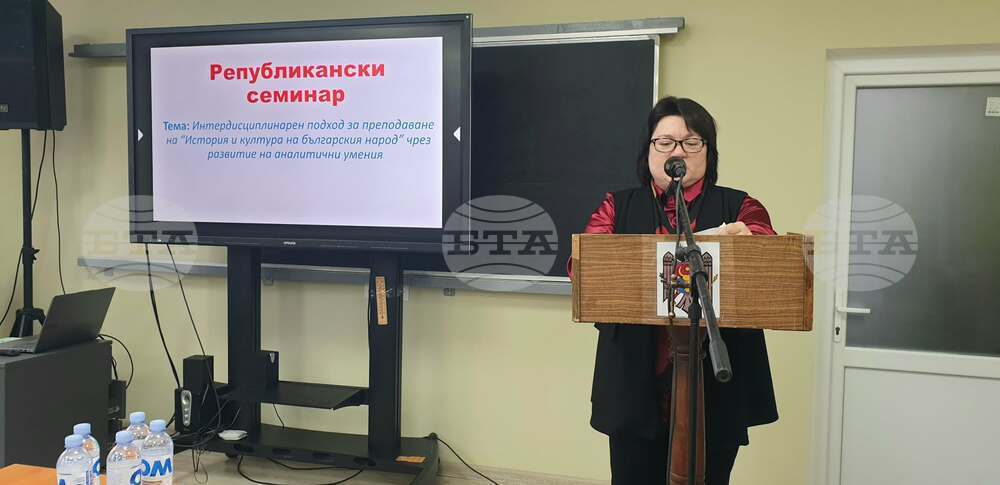
BTA: Workshop in Taraclia Brings Together Teachers and Experts on Bulgarian History and Culture
A national workshop for teachers of Bulgarian history and culture was held in Taraclia at the Olympii Panov Theoretical Lyceum on January 30. The workshop gathered teachers, school administrators, representatives of the Ministry of Education and Research of Moldova, local authorities, and officials from the Bulgarian Embassy to discuss current issues related to teaching, exchanging best practices, and preserving the national identity of the Bulgarian community in Moldova.

Before the official opening, Lilia Sarsaman, head of the Taraclia District Department of Education, spoke to BTA about the workshop activities, goals, and objectives.

The workshop is being held for the second year in this format, with the support of the Bulgarian Ministry of Education and Science under Bulgaria’s national programme for native language and culture abroad. According to Sarsaman, the project makes it possible to organize this important educational event. This year, the target group includes teachers of Bulgarian history and culture, as well as members of the academic community working on key issues related to preserving national identity.

“The workshop is not only an opportunity for knowledge exchange but also a confirmation that Bulgarian history, language, culture, and traditions remain a living value for the Bulgarian community in Moldova. Preserving national identity is a daily responsibility and a deeply personal conviction,” Sarsaman said.

She added that traditions are preserved where they are actively practiced and passed on to young people. In this context, the subject plays an important role in strengthening national identity and transmitting family, folk, and ethnic values to the next generation.

During the workshop, three open lessons will be presented for grades 4, 7, and 10, demonstrating new methods and pedagogical approaches. A master class for children is also planned. Workshop guests will review results from surveys conducted among teachers and students on teaching the subject, followed by a panel discussion addressing key challenges in teaching Bulgarian history and culture.

Participants include teachers, school managers, representatives from education departments, ministries, local authorities, and the Bulgarian diplomatic mission. According to Sarsaman, this dialogue provides important feedback to inform administrative decisions aimed at improving the quality of teaching, enhancing the curriculum, and strengthening the methodological base.

Among the honorary guests was Ivan Duminica, Head of the Interethnic Relations Service at the Ministry of Education and Research of Moldova and Doctor of Historical Sciences. Sarsaman noted that his participation draws attention to the topic and demonstrates the central authorities’ commitment to the issues of national minorities and the study of Bulgarian history and culture.

Earlier, Sarsaman told BTA that Bulgarian is taught in 10 schools and 10 kindergartens in the Taraclia District. History and culture of the Bulgarian people is included as a subject in schools, and the total number of students studying Bulgarian language is nearly 3,000, around 80% of all students in the district.
 Facebook
 Instagram
 X/Twitter
 Telegram
As of 1 April drivers may drive without using low beam headlights during day
Higher pensions and social benefits: 6.84 percent indexation applied as of today
Over 1,800 hectares of forest to be planted in 15 districts along Dniester River, under World Bank–supported programme
Over 900,000 unique beneficiaries, representing 38% of population received reimbursed medicines through ePrescription system
Ben Gurion Airport in Tel Aviv remains closed until 16 April
Another Shahed-type drone detected while unauthorizedly flying over national airspace in Transnistrian segment
DOC // Official Journal publishes implementation mechanism for CEEPUS IV
Moldova’s airspace violated again: Shahed drone found in Dubăsari–Orhei area
Nicolae Testemitanu Medical University of Moldova launches new master’s programme, Health Promotion and Protection
Permanent teaching grades and less bureaucracy in schools
Prosecutor’s Office provides new details on investigation into death of Ludmila Vartic
Moldova, Romania to sign Agreement on extending coordinated control at Leuseni–Albita border crossing point
Unique trilingual work on medicinal plants, created in partnership with Nicolae Testemitanu Medical University of Moldova
Driving licenses issued in Moldova to be recognized in Ireland
Moldovan PM participates in awards ceremony recognizing rescuers' achievements
Large wind farms with energy storage systems to be built in Moldova: 16 bids submitted in tender
Environmental protection experts from two banks of Dniester hold new working meeting
Moldovan Central Electoral Commission accredits 14 national observers to monitor new local elections, local referendums
New milestone for green energy: Moldova surpassed 1 Gigawatt of installed renewable energy capacity
President met with U.S. Senator
PAS faction to have new MP
 National Bank of Moldova
Moldovan PM participates in awards ceremony recognizing rescuers' achievements
Environmental protection experts from two banks of Dniester hold new working meeting
Moldovan deputy PM has meeting with Ambassador of Germany
President met with U.S. Senator
Proposals for improving efficiency of ministries discussed at roundtable

Foreign Ministry: We condemn violation of airspace. Such actions endanger citizens’ security
Support for export promotion: 16 business associations to receive 14.6 million lei through Bridge Export Program
Over 20 media projects to get funding from media subsidy fund
Over 20 media projects to get funding from media subsidy fund
Shahed drone illegally flew over airspace of Moldova
Over 25,000 residents from left bank of Dniester commute daily to right bank, Deputy Prime Minister for Reintegration says
BTA: Bulgarian Literature Has Become Increasingly Visible on International Stage - Deputy Culture Minister Stoyanov
Simple motion on public policies implemented by Ministry of Labour and Social Protection failed
Proposals for improving efficiency of ministries discussed at roundtable
PHOTO GALLERY // Premiere at Mihai Eminescu National Theater: “Intrigue and Love,” directed by Alexandru Cozub
Moldova to sign social security agreements with Quebec (Canada), Albania, Croatia and Ireland
Around 622,000 vulnerable families receive energy compensation
Prime Minister visited agricultural business in Unguri village, Ocnița district
Minister of Labor and Social Protection: Deficit of state social insurance budget decreased to 3.6 billion lei in 2026
Prime Minister visited rescuers and firefighters unit in Ocnița
Eastern European plants used in Chinese medicine: book by Wang Yifeng launched in Chișinău
Receive the latest news directly to your email

Receive the latest news directly to your email