
Chisinau, 17 July /MOLDPRES/ - Moldova’s capital, the Chisinau city, marks the 585th anniversary of its first documentary mention today.
According to the National Calendar, Chisinau was mentioned as rural settlement on 17 July 1436 (Chisinau of Acbas). The second documentary mention, in chronologic order, dates back from 1466, in a property document issued by Stephen the Great, through which he confirmed to his uncle Vlaicu Pârcălab about Cetatea Alba (White Fortress) – precincts of a settlement, with the entire estate and a mill. On 25 April 1576, Chisinau’s estate became property of Dragos, then of Hodor, Cretu and Rosca (1608-1616), Chirita Dumitrachi (1640). It was also the estate of the Holy Friday and Galata monasteries from Iasi (1640-1641), etc.
During the reign of Ruler Vasile Lupu, the settlement was known as the main economic centre on the new commercial road Suceava-Iasi-Tighina-Cetatea Alba (1650). The settlement was mentioned as small town in the Lapusna region and its residents as townspeople (2 March 1666). In 1677, the Polish Chronicle by Miron Costin describes Chisinau as one of the towns in the Lower Country of Moldova. The chronicler specified that the towns of Lapusna and Chisinau were situated in the Lapusna region.
The first mention as town dates back from 1677. The settlement is mentioned also by Dimitrie Cantemir in Descriptio Moldaviae (1714-1716). Chisinau was devastated by Turks and Tartars more times. Following the Russian-Turkish war from 1812, when the region between the Prut and Dniester rivers was annexed by the Russian Empire, the centre of the Bessarabia region was established in Chisinau. Gradually, Chisinau extended territorially to the current Stefan cel Mare Boulevard.
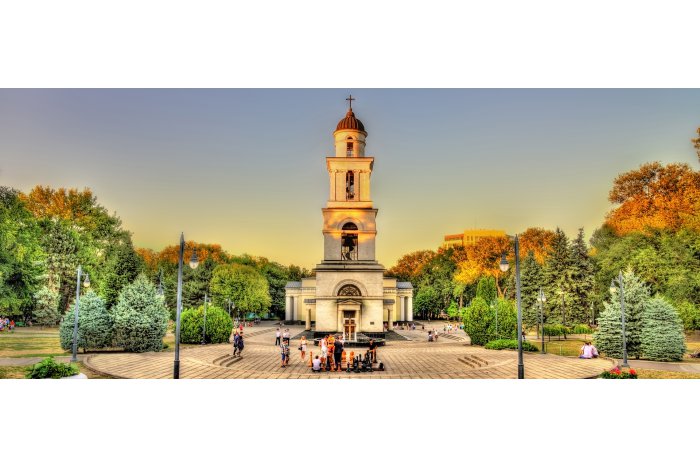
In 1830-1836, the Birth of God Cathedral was erected, with the monumental Belfry nearby and the foundations of a public garden were laid. In 1856, Alexandru Bernardazzi was confirmed principal architect of the city, due to which Chisinau turned into an urban centre of European type. The settlement became centre of the national movement from Bessarabia (1917). The Sfatul Ţării  (Country Council) was set up here, which proclaimed the Union of Bessarabia with Romania on 27 March 1918. The city regained its Romanian look after the Union’s proclamation. More schools, printing houses, libraries, theatres were opened, as well as more enterprises were created.
Also, following 1918, Chisinau became a notable cultural centre.
Placed in the central part of the country, the city is crossed by the Bic river. From the administrative viewpoint, the city is divided into five districts: Botanica, Buiucani, Centru, Ciocana, Rascani; cix town: Codru, Cricova, Durlesti, Sangera, Vadul lui Voda, Vatra and 28 rural settlements. In the times of the Soviet Union, Chisinau’s population grew a lot, especially at the expense of the immigration from Russia and Ukraine.
On 1 January 2018, Chisinau’s population was over 678,000 residents, along with the suburbs.
Chisinau is connected through railways and roads with all cities, town and district centres and more villages of Moldova, as well as with urban centres from Romania, Ukraine, Bulgaria, Turkey, Russia and other states. Following the proclamation of the Independence, the Moldovan capital was the centre of the economic and political life. The districts of Chisinau were renamed and then the names of streets were changed into a more local specific character.
Chisinau hosts the embassies of more states, representations of international institutions and organizations. Meetings, world scientific conferences, exhibitions and fairs are inaugurated. The local state power body is the city hall of Chisinau (Municipal Council).
photo: etalontravel.ro
 Facebook
 Instagram
 X/Twitter
 Telegram
DOC // Government decision on army conscription published in Official Journal
DOC // SIS updates list of persons involved in terrorist activities
Emergency Service 112 strengthens teams for Easter period
VIDEO // EcoContact public association of Moldova launches environmental conflict mediation guide after series of practical sessions in Chisinau, Cahul
Moldovan parliament tightens anti-drug legislation: criminal penalties for online promotion too
Parliament adopts comprehensive reform of environmental institutions
New rules for equipping Ministry of Internal Affairs structures adopted by MPs
PHOTO // President meets Moldovans in Ireland
Moment of silence in Parliament in memory of Mircea Lucescu
Speaker’s Easter greetings to Moldovans everywhere: Easter unites us, wherever we may be
Moldovan driving licenses to be recognized in Ireland
Moldovan-Greek partnership through the LIFE Renata EU programme provides practical solutions for conserving threatened species
Alina Cebotariov nominated for position of president of Moldova's Competition Council
Famine of 1946-1947: rare photos, documents exhibited in Moldovan capital
DOR government programme of Moldova: children, young people from Diaspora can submit participation files till April 22
Local companies can participate in Moldova Presents exhibition, organized in Vaslui, Romania
VIDEO // EU Ambassador to Moldova says people on Eastern holidays return to things that matter most: family, traditions
Moldovan PM conveys message on Easter
VIDEO // Moldovan parliament speaker says may Light of Resurrection brings us peace, courage, new hope
Moldovan president congratulates citizens on Resurrection of the Lord
Orthodox Christians celebrate Holy Easter; Orthodox priest says peace should be sought in hearts, Light of Resurrection should be shared with everyone”
 National Bank of Moldova
Moldovan president participates in launch of exhibition dedicated to 1903 Pogrom
Moldovan parliament votes: voluntary amalgamation becomes simpler, better funded for development
Deputy Prime Minister meets UNFPA Country Representative and UNDP Resident Representative to Moldova
Moldovan president, on visit to Dublin, says Ireland’s transformation after EU accession model for Moldova’s European future
President Maia Sandu’s speech at the joint press conference with the Prime Minister of Ireland, Micheál Martin

PHOTO GALLERY // Old Orhei on Easter Eve
Direct train from Kyiv to Chisinau Airport launched in test mode
VIDEO // Moldovan government's secretary general says Easter fills villages, all Moldova with life, warmth
Ungheni municipality, 18 other settlements unite in voluntary amalgamation; Ungheni mayor says largest cluster in Moldova takes shape
Bomb threat reported at Chisinau Airport proves to be hoax; terminal resumes operations
Moldovan health specialists recommend rational consumption of food products during Easter holidays
Moldovan president participates in launch of exhibition dedicated to 1903 Pogrom
Bomb threat at Chisinau Airport; passengers, airport staff evacuated
Moldova's National Alternative Movement Party withdraws from Alternative Bloc, remains in parliamentary faction
Japan reconfirms status of strategic partner for development of Moldova's agricultural sector
Another nine cultural figures of Moldova to receive merit allowances
National Crisis Management Center presented integrated report on actions taken during state of emergency
VIDEO // Strășeni–Gutinaș power line project moving forward: construction could start in 2027
Significant diesel price cut: cost drops by 1.17 lei
Eugen Doga Chisinau International Airport ensures stable flights on easter, despite heavy passenger traffic
Ministry of Culture considers holding of three events with foreign artists inopportune
Receive the latest news directly to your email

Receive the latest news directly to your email