
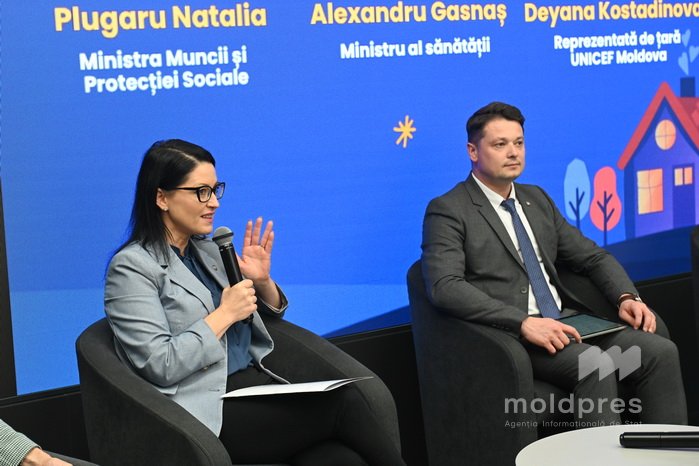
The Republic of Moldova aims to strengthen measures to prevent children from being separated from their families by approving the European Child Guarantee, developing parenting education programs, and investing in specialists in the social protection sector. Minister of Labour and Social Protection Natalia Plugaru spoke about these measures during the public dialogue on reforming the child protection and care system.

One of the priorities of the Ministry of Labour and Social Protection is the implementation of the European Child Guarantee, which is expected to be approved by the end of this year. According to Natalia Plugaru, the program will bring together measures from several areas, including education, healthcare, justice and social protection.


“Through this guarantee, we essentially have a framework or a set of actions that brings together the education sector, the healthcare sector, the justice sector, and social protection. In each sector, there is a set of guaranteed measures—measures that are not subject to negotiation or renegotiation,” Natalia Plugaru said.


The minister emphasized that the authorities do not want to wait for the Republic of Moldova to join the European Union before applying these measures, as children need support now.


“It is, in fact, a framework introduced by the European Council with UNICEF support, intended for countries that are members of the European Union. As an ambitious country, we said that we would not wait until we become full members, but that we want to give children in Moldova the opportunity to benefit from this guarantee. They need it today,” the minister said.


Another area focuses on developing institutionalized parenting education programs, especially for families in which there is a risk of children being separated from their parents. Natalia Plugaru believes that support for parents should become part of the system rather than depend solely on projects funded by organizations.

The minister noted that the programs must be adapted to the circumstances of families and focus primarily on cases where there is a real risk of separation.


“We work with families where there is a risk of separation, because there are generic parenting programs, as well as highly focused parenting programs for families where alcohol abuse is present. There are also parenting programs for parents who have children with disabilities or special needs. Therefore, we also want to introduce targeted, focused programs to prevent separation where such a risk genuinely exists,” the minister said.


A third announced measure is investment in the training of specialists working in the field of child protection. According to the minister, there is a need to strengthen the capacity of social workers, as well as education and police specialists.


“An important aspect is to continue investing in the training and capacity of specialists. We are pleased to have this pool of child protection specialists, and we want to invest in them so that such resources are available whenever it comes to protecting a child,” Natalia Plugaru said.


The minister also mentioned the amendments approved to the social assistance law, which introduce qualification levels for employees in the field. According to her, the measure aims to attract more people to the system and encourage continuous professional development.

Natalia Plugaru pointed out that the main challenge in implementing the reforms remains funding.


“There is political will, there is a legal framework, and there are partners. We know what we want to do and what needs to be done. We no longer need to convince one another. Funding and money are the problem, and they will not come from somewhere else. We will have to identify areas for optimization. We will need to make some cuts and allocate resources to prevention, because the subsequent costs related to health, risks, and vulnerability are extremely high,” Natalia Plugaru noted.


The reform of the child protection and care system aims to prevent children from being separated from their families and to develop support services for children and parents. During the public dialogue, participants discussed the need for early interventions, the strengthening of social services, and increasing the capacity of specialists working with families facing difficulties.

The European Child Guarantee is a European Union instrument aimed at combating poverty and social exclusion among children in vulnerable situations. Through this mechanism, states are encouraged to ensure children’s effective and free access to early childhood education and care, education, healthcare services, at least one healthy meal on every school day, as well as adequate nutrition and suitable housing.
 Facebook
 Instagram
 X/Twitter
 Telegram
Drone entered Moldova. Airspace temporarily closed
UPDATE // Activity at border crossing points in northern part of country resumed
PHOTO // Moldova promotes gastronomy and traditions in Paris
Border control at three Moldovan-Ukrainian crossing points to be temporarily organized solely on territory of Moldova
Moldova stands in solidarity with United States; victims of September 11, 2001 terrorist attacks commemorated in Chisinau
Cyberattack takes place on government resources of Moldova; authorities working to restore access
PHOTO // European Commissioner visited Moldova’s Urban Search and Rescue Team: practical demonstration using EU-provided equipment
Social worker from Chișinău involved in influence-peddling case
New measures for child-friendly justice
Romania’s Ambassador visits Giurgiulesti International Free Port: Important component of Moldova’s European integration
U.S. Embassy in Chișinău commemorates 11 September 2001 terrorist attacks' victims
Government Secretary-General provides details on second stage of administrative reform
Gender equality and women’s rights discussed at Ministry of Foreign Affairs with UN Women Representative
Moldovan troops participate in Strong Griffin 2026 exercise in Lithuania
Moldova condemned repeated violations of airspace to OSCE
Moldova prepares to implement European Child Guarantee
Moldovan parliament speaker in Budapest: ''This is a good time to open a new chapter in the relations between our parliaments and countries''
PM attends anniversary event at National Bank of Moldova
 National Bank of Moldova
Moldovan parliament speaker in Budapest: ''This is a good time to open a new chapter in the relations between our parliaments and countries''
PM attends anniversary event at National Bank of Moldova
Agenda of Moldovan parliament's plenary meeting supplemented
Topics examined at meetings of Moldovan parliament's standing commissions on September 15–16, 2026
Investments in energy efficiency of public buildings exceeded €348 million in 2019–2025

Moldovan parliament speaker in Budapest says Moldova, Hungary can open new chapter in relations between parliaments of two countries
Environment minister says Moldova to reduce Dniester’s flow, to conserve water reserves
Moldova's National Anticorruption Center, Italy’s Financial Guard to exchange information to combat economic, financial crime
Natural gas prices on European exchange continue to rise; energy minister says international energy crises directly affect Moldova
Investments in energy efficiency of public buildings exceeded €348 million in 2019–2025
EU Ambassador: EU remains firmly committed to supporting justice reform in Moldova
President at Forum on justice reform and fighting corruption: Building rule of law most complicated commitment in EU accession program
Agreement between Moldova and Romania to continue construction of Ungheni–Ungheni bridge and modernize road infrastructure
Government approves ratification of agreement on construction of bridge over Prut River and first highway section in Moldova
Republic of Moldova to receive €4.3 million grant to strengthen capabilities of National Army
Energy communities – new legal form of organization for everyone who produces, consumes, stores energy together
President at Justice Reform and Combating Corruption Forum: Judicial independence requires integrity and accountability
Republic of Moldova among countries in EU enlargement perspective
Moldova to launch e-Consulate system, to modernize delivery of consular services for Diaspora citizens
Special access measures at Chișinău Airport remain in effect by 17 September
VIDEO // Justice reform and fight against corruption - focus of discussions at international forum in Chișinău
Receive the latest news directly to your email

Receive the latest news directly to your email