
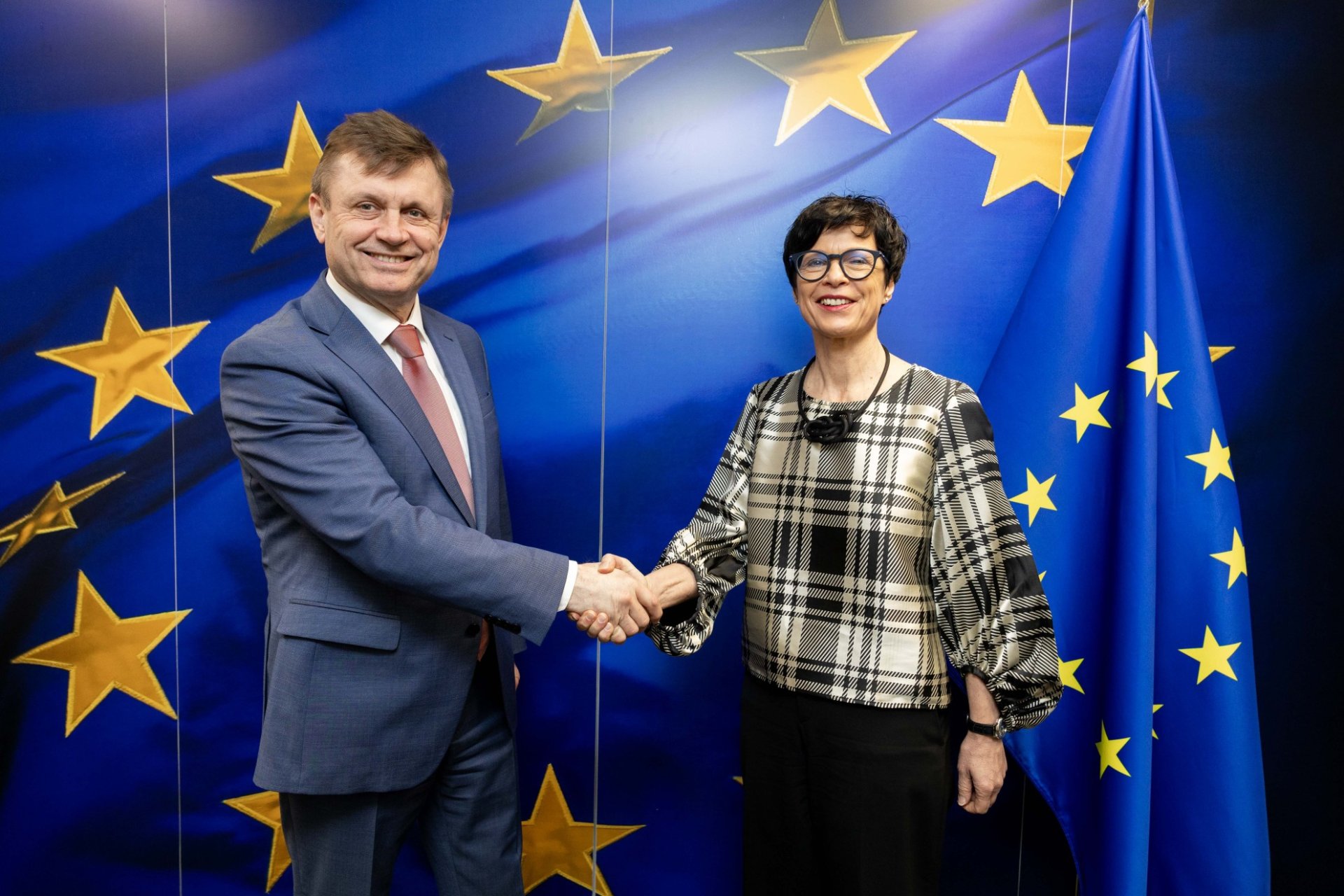
Valeriu Chiveri: Transnistrian settlement and European integration must be treated as two distinct processes
The Republic of Moldova does not want a “fragmented” European integration, but it also does not accept that the Transnistrian settlement should become a precondition for accession to the European Union, says Valeriu Chiveri, Deputy Prime Minister for Reintegration, in a discussion with 2EU.brussels.

Asked how the relationship between the European integration process and the Transnistrian issue could be resolved, Chiveri said that Chișinău authorities do not want a “piecemeal” accession. “Ideally, the Republic of Moldova, in its territorial integrity, should become part of the European Union,” he said.

The Deputy Prime Minister added that the two processes follow different logics. According to him, European integration depends primarily on the reforms and actions of the Government of the Republic of Moldova, while the Transnistrian settlement depends on the political will in Tiraspol, Russia’s influence, the illegal Russian military presence in the region and the evolution of the war in Ukraine.

“We are realistic and understand that we are talking about two distinct processes, with different timelines and different speeds,” Chiveri said.

He pointed out that from Chișinău’s perspective, the European Union support is important precisely because it keeps the settlement process open without automatically linking it to the European integration process. In his view, the two processes can reinforce each other, since Moldova’s rapprochement with the EU can make the state more attractive for citizens on the left bank of the Dniester.

Chiveri said that this process is already visible. According to him, tens of thousands of citizens from the left bank of the Dniester cross to the right bank for jobs, medical treatment or education. He pointed out that salary and pension levels in the territory under the constitutional control of the Republic of Moldova are two to three times higher than in the Transnistrian region, which is prompting more and more citizens to use Moldova’s social and economic systems.

“Citizens can see this. For this reason, more and more of them turn to our social system, to the health insurance system and look for jobs in the area under the constitutional control of the Republic of Moldova,” the Deputy Prime Minister said.

Chiveri explained that the Government is relying on gradual integration, primarily economic. One of the instruments envisaged is a convergence fund that is to be created under the new legislation. The fund would be financed from taxes, including VAT and excise duties, and directed toward raising the standard of living and narrowing the gap between living conditions on the two banks of the Dniester.

“It is, first and foremost, about the citizen, about increasing the standard of living, about making living conditions more uniform on the left and right banks,” he said.

Asked whether the Transnistrian case could become an instrument to block accession, Chiveri replied that this is a risk that Chișinău is trying to avoid. He stated that Russia’s influence over the Transnistrian region and the Russian military presence are real risks, but that reintegration should not be seen as a precondition for EU accession.

“We do not see reintegration as a precondition for European integration,” Chiveri said. He added that this has been explained to Moldova’s partners and that many of them understand that directly linking the two processes would give a “veto right” to Tiraspol or Moscow over the European path of the Republic of Moldova.

The Deputy Prime Minister said that the authorities in Chișinău continue to promote the idea of two distinct processes that interact, but in which the Transnistrian file should not fundamentally affect the process of European integration.

The discussion also mentioned the possibility of temporarily suspending the application of the EU acquis on the left bank of the Dniester until a comprehensive settlement solution is found. Chiveri described this idea as part of a possible creative formula that should be devised at the appropriate time, when the Republic of Moldova becomes a member of the European Union.

Chiveri also rejected the idea that the Transnistrian region could survive in the long term as an economic “island” between Ukraine and the Republic of Moldova. In his view, it is increasingly understood in Tiraspol that there is no real alternative to reintegration.

“In a not too distant perspective, the reintegration process must accelerate, because there is no alternative,” he said.

The Deputy Prime Minister criticized the idea of a distinct Transnistrian identity. He said that the region is inhabited by several ethnic groups and that promoting a so-called “Transnistrian people” is a political construct. According to him, the Russian language dominates the public space, signage, school curricula and the official narrative in the region, and the legislation is copied from the Russian model. Chiveri argued that one cannot speak of a unique Transnistrian cultural or linguistic entity, especially given that in rural localities on the left bank of the Dniester there is a Romanian-speaking population, whose language is referred to in the region as Moldovan.

Regarding the position of European institutions, Chiveri said that at the level of the European Commission he found “a very good understanding” of Moldova’s position. He admitted, however, that at a later stage difficulties could arise in one of the member states’ capitals, where the Transnistrian case could be invoked politically.

The Republic of Moldova has obtained candidate status for the European Union, and its European path is unfolding in parallel with the unresolved existence of the Transnistrian region, which lies outside the constitutional control of Chișinău. The Transnistrian case includes political, economic, security and identity dimensions, as well as the Russian military presence in the region, considered illegal by the authorities of the Republic of Moldova.

For Chișinău, one of the central questions of the European process is how EU accession can advance without the Transnistrian issue becoming a structural obstacle or a tool of political blockage. At the same time, Moldovan authorities insist that the final objective remains the reintegration of the state in its territorial integrity.

The position expressed by Valeriu Chiveri indicates a two-track approach: European integration must continue on the basis of reforms implemented by the constitutional authorities of the Republic of Moldova, while Transnistrian reintegration must be pursued gradually, especially through economic, social and convergence instruments.
 Facebook
 Instagram
 X/Twitter
 Telegram
Free movement, road conditions, illegally imposed fees – on agenda of working groups for development of road transport, roads' infrastructure
€60 million financing for modernizing irrigation infrastructure in Moldova
Increased road safety – vehicles not meeting technical requirements to have registration automatically suspended
Particip.gov.md – single platform for public consultations modernized by Government so that citizens can submit proposals more easily and quickly
Summer camps for children and teenagers preparing for 2026 season
Government allocates 50 million lei for farmers affected by 2025 drought
Speaker participated in Black Sea and Balkans Security Forum held in Bucharest
Moldovan parliament speaker in Bucharest says Moldova, Romania connected by special relationship, strong partnership
Head of state to pay a working visit to central Moldova district
Moldovan president chairs meeting of National Commission for European Integration
Moldovan president meets heads of diplomatic missions of European Union member states
Consultations on organizing elections to People’s Assembly of Gagauzia held at Moldova's Presidency
Moldovan president receives International Monetary Fund mission visiting Chisinau
President of Cyprus in Chisinau says Presidency of Council of European Union standing with Moldova on Europe Day
Moldova relies on Germany’s support to speed up European integration
President begins visit to Strasbourg
Moldovan deputy PM says more investment agreements to be announced at Moldova–EU investment conference
Promo-LEX organization of Moldova reports serious violations in case of a young detainee on left bank of Dniester
 National Bank of Moldova
Germany reconfirms support for European path of Moldova
Speaker at meeting with Germany’s Minister of State for Europe: Your support is very important for our EU accession process
President pays visits to European Parliament, Netherlands
President on working visit to Tallinn: Estonia - reliable friend and supporter of Moldova’s European path, from which we have much to learn
Moldovan president to pay working visit to Estonia

Vlad Turcanu resigns as head of Teleradio-Moldova Company amid Eurovision 2026 scandal: “The vote cast is my responsibility”
International Museum Day marked in Moldova with special cultural programmes
MOLDPRES INTERVIEW // Director Lucia Țurcan: Center of Excellence in Construction aligns with European standards – ERASMUS+ projects, modern technologies and more practical training for students
Germany reconfirms support for European path of Moldova
Speaker at meeting with Germany’s Minister of State for Europe: Your support is very important for our EU accession process
PHOTO REPORT: China through eyes of MOLDPRES // One world, one family: How Chinese celebrate family, women, social cohesion in modern era
Deputy Prime Minister pays visit to Germany
Around 19 thousand tons of gasoline and diesel imported last week into Moldova
Russia’s accredited ambassador summoned to Foreign Ministry
Parliament of Moldova holds annual forum with civil society and external partners
President pays visits to European Parliament, Netherlands
Preliminary results of 17 May local elections // First-round victories in six localities and tight race in Orhei municipality
BTA: Bulgaria's Dara Wins Eurovision 2026
General Police Inspectorate recorded 12 incidents and alleged violations during new local elections
Polling stations have closed. Over 24,600 citizens took part in new local elections and local referendums
New local elections: Around 30% of voters turned out by 6:00 p.m.
Receive the latest news directly to your email

Receive the latest news directly to your email