
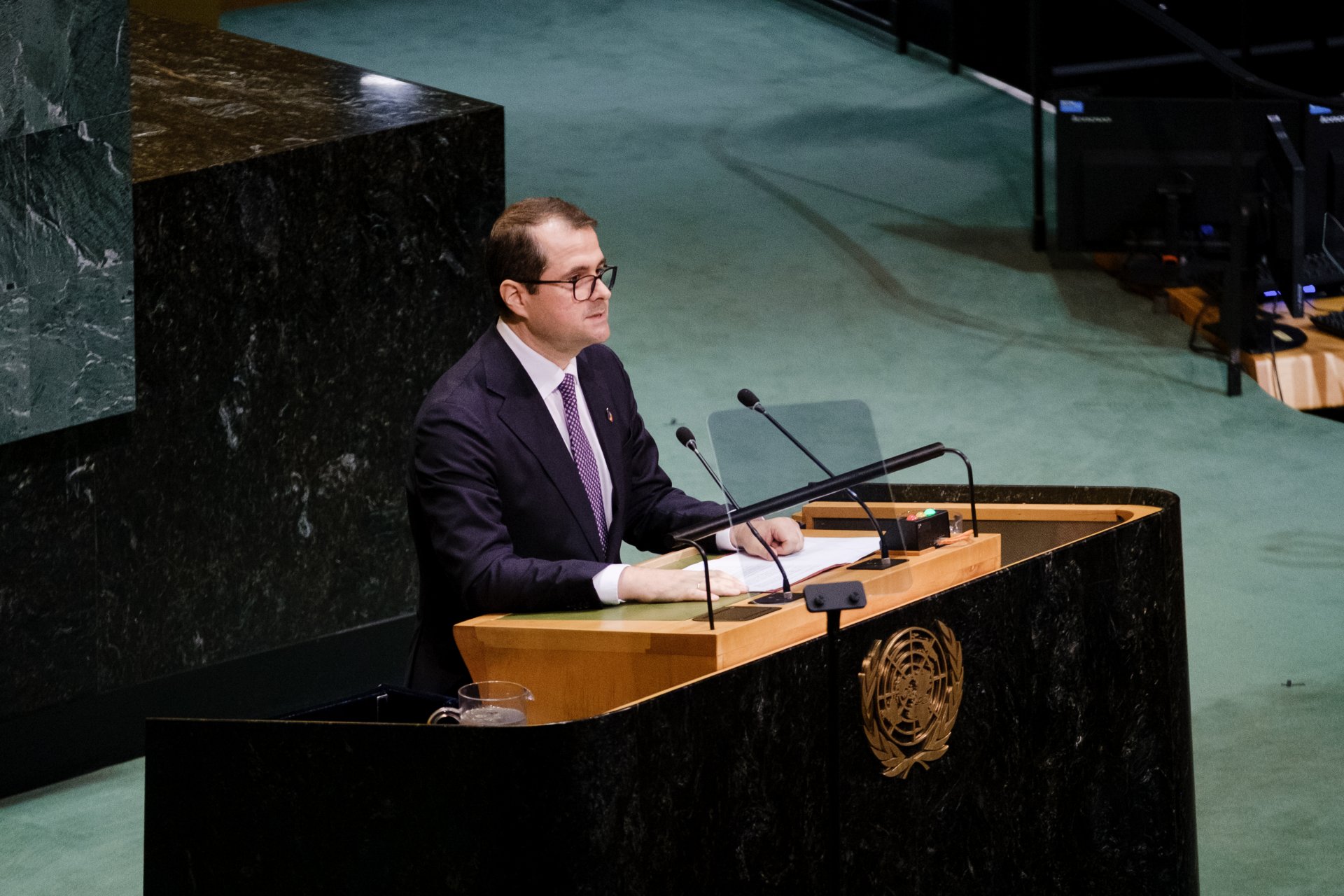
Speech by Prime Minister at 81st Session of United Nations General Assembly
This summer, the Republic of Moldova turned thirty-five. For most of that period, the world described us as a country caught between East and West — a place where others made the decisions. Today I stand before you as the new prime minister of a country that has made its own choice.

Small countries do not choose either their geographical position or their size. But being small does not mean being powerless. Nations, like people, are shaped by the choices they make: whom they trust, whom they choose to lead them, whom they consider their friends, and how they respond when circumstances turn against them.

For a long time, many of these choices were made for us by others. The Soviet authorities deported our families to Siberia, imposed a different alphabet on our Romanian language, and told us that it had another name. After independence, Moscow used natural gas and trade embargoes as instruments of pressure against our country.

Step by step, we began to choose for ourselves. Romanian is once again written in the Latin alphabet and spoken freely. Governments change peacefully, through elections. And when our democracy was threatened, Moldovans defended it through elections and civic engagement.

We have also reduced Russia’s ability to exert economic pressure on us. We diversified our sources of gas procurement. In just five years, the share of energy from renewable sources increased from almost zero to around 30%. Our electricity system is becoming increasingly integrated with that of Romania and with the European grid, while our companies sell their products in some of the most demanding markets in Europe and around the world.

But Kremlin has continued its attempts. Moldova has faced illicit financing, disinformation, cyberattacks, and vote-buying. Russia spent the equivalent of approximately two percent of our GDP in an attempt to influence last year’s elections.

Moldovans responded that their country is not for sale.

Each of these choices came at a price. But each taught us the same lesson: we cannot control everything that happens around us, but what we do matters.

That is where our optimism comes from. Our future remains in our own hands. And today, this choice is visible nowhere more clearly than in our European path.

European integration has become our national project. The Republic of Moldova has been a candidate country for membership since 2022, accession negotiations are under way, and we are advancing rapidly. Our ambition is clear: to firmly anchor Moldova in the European family.

For us, joining the European Union does not mean replacing one sphere of influence with another. It means precisely the opposite. It means that our citizens are exercising their right to choose. To choose democracy. To choose prosperity. To choose peace.

This European choice goes hand in hand with a strong transatlantic partnership. For Moldova, these are not mutually exclusive directions. The United States is an important partner in strengthening our security, energy independence, and resilience. We want the next chapter of this relationship to focus increasingly on trade, investment, technology, and projects that we can build together.

But accession is not only about what Europe can offer Moldova. It is also about what Moldova can bring: a democracy that has learned to withstand interference, an emerging economy, a country that contributes to the stability of Europe’s eastern border, and a small state willing to test new ideas, carry out reforms, and move quickly.

Small size imposes constraints. But it can also be an advantage.

Moldova does not have a huge domestic market. We cannot match the financial resources of the largest economies. Therefore, we must be competitive in other ways: permits issued in days, not months; clear regulations; digital public services; and rules that we change when they no longer serve a purpose.

Almost everywhere, technology is advancing faster than regulation, and artificial intelligence is deepening this gap. Here, small countries can have a natural advantage.

We want Moldova to become a place where emerging technologies can be tested responsibly, in regulatory testing spaces — so-called “sandboxes” — where regulators learn alongside companies, rules are adjusted on the basis of evidence, and good ideas do not wait for years to reach the real economy.

When an entrepreneur comes forward with a technology that legislation has not yet caught up with, the answer should not simply be: “There is no regulation for this.” It should be: “Let us find a safe way to test it.”

We may never have the largest pools of capital or the biggest clusters of graphics processors. But we can build better rules and be more agile. Small size need not mean weakness. Sometimes, it means adapting faster and achieving results where larger countries cannot.

And here I turn to a broader idea about small nations.

Power has never been distributed equally. And it never will be. But inequality of power must never become inequality of sovereignty. Countries are not buffer zones. Nations are not bargaining chips.

Nowhere is this principle being tested more brutally than in our neighboring country.

Security is not an abstract notion for me. Kyiv was my home for nearly fifteen years, including on February 24, 2022. That morning, as parents, we found it difficult to explain to our three boys — who were then one, ten, and twelve years old — what war actually meant.

Perhaps nothing better illustrates how this war has come to be perceived as normal than the arithmetic the children have learned.

Imagine an ordinary night. A jet-powered Shahed drone heading toward Kyiv is detected. A twelve-year-old checks the map, knows approximately how fast it is flying, and calculates in his head: forty minutes left. Another forty minutes of sleep before the approaching drone sends him to the air-raid shelter.

Children have become frighteningly skilled at this nighttime arithmetic of war.

In Moldova, we cannot compare our suffering with that of Ukraine. And yet Russian drones repeatedly violate our airspace and crash on our territory. The danger is that what is unacceptable may begin to seem normal to us.

For us, too, this is about the safety of our families. We must not become accustomed to it. The fact that a violation is repeated does not make it acceptable.

And because these are not abstract matters for Moldovans watching us from home, allow me to address them directly for a few moments.

Dear Moldovans,

I know that many of you are anxiously following the news about the war next door, about the Russian drones that have become more frequent, and are already thinking about the coming winter. Yes, a difficult winter lies ahead. It is our duty, as the Government, to prepare and to help those who have the least above all. That is what we are working on and what we are discussing with our partners here.

But I want to ask one important thing of you: let us stick together. In difficult moments, this has helped us every time — not leaving one another alone, helping our neighbors, our parents, and those who are struggling the most. We may have different opinions and vote differently. That is natural in a country where people think freely. But concern for those around us must unite us. We are a small country. That is precisely why it is even more important to know that we are not alone and that we can support one another.

This solidarity at home must go hand in hand with a clear understanding of the danger around us.

This is not a tragedy without an author. Russia launched a war of aggression against a sovereign neighboring state. It occupied territories and continued to attack Ukrainian cities. Ukraine did not choose this war. Russia chose it.

We often speak about “war fatigue.” The expression is understandable. Governments have other crises to manage as well. Families have their own concerns. Attention turns to other subjects.

But being tired of a war that you can disconnect from by turning off the television is one thing, while being tired because an air-raid alarm wakes your children again tonight is another. And the exhaustion of Ukrainian soldiers who spend yet another cold night in the mud is something else entirely.

Moldova could not choose whether this war would break out next to us. But we could choose how to respond.

We welcomed those fleeing the war. We kept transport routes open. We reduced the cost of rail transit for shipments of Ukrainian grain.

These decisions were not always cost-free or politically easy at home. We made them because the way this war ends matters far beyond our region.

If aggression is rewarded, it becomes a precedent — for the aggressor and for everyone watching. Peace must protect sovereignty and create the conditions for lasting security.

The same principle applies within our own borders.

The Russian army continues to be illegally stationed, without our consent, in the Transnistrian region of the Republic of Moldova. We will continue to insist on their unconditional withdrawal. We want the peaceful reintegration of our country, with full respect for the sovereignty and territorial integrity of the Republic of Moldova. We want people on both banks of the Dniester to live together in a peaceful, democratic, and prosperous Moldova.

And because we believe that small states must help shape the international system, rather than merely depend on it, the Republic of Moldova has the honor of presenting its candidacy for the presidency of the 82nd session of the United Nations General Assembly. We want to contribute to a more effective, inclusive, and results-oriented organization.

Excellencies,

We live in a world that gives us plenty of reasons for pessimism. But Moldova chooses something else.

Not naïve optimism. Not the belief that problems disappear if we refuse to see them. But the optimism that comes from the certainty that our future is still in our own hands.

For too long, Moldovans were told that our country was too small, too exposed, and too divided to choose its future for itself. We believed this for long enough. We know our problems. But we must also know our strength.

We are a free country. Our people are modest, hardworking, and put family first. Our diaspora is spread around the world, but our people remain close to one another and care deeply about what happens at home. Perhaps only when it comes to vineyards do we find it a little harder to be modest: we have serious reasons to believe that our wines may actually be the best in the world.

We have friends throughout Europe, across the Atlantic, and far beyond these borders. And at last, we have a realistic path toward building a country from which our children will not have to leave in search of new opportunities.

Moldova may never become a great power, but it can certainly become a great country.
 Facebook
 Instagram
 X/Twitter
 Telegram
Process for getting permits to produce energy from renewable sources to be simplified in Moldova
PM, former U.S secretary of state discuss regional security, investment opportunities of Moldova
National mechanism for protection, legal assistance, financial compensation of crime victims to be strengthened in Moldova
The first meeting of Growth Plan's Monitoring Committee: Moldova maintains high pace of reforms' implementation
Moldovan president's speech at ceremony marking 80th anniversary of founding of State University of Moldova, centenary of Romanian university education in Bessarabia
Moldovan parliament approves new rules for tobacco products' packaging
Parliament votes, in first reading, on legislative measures to strengthen independence of National Bank of Moldova in line with European standards
Moldovan parliament adopts amendments to Law on Constitutional Court
Moldovan parliament adopts legislative amendments to make procedure for selecting, appointing candidates for position of Constitutional Court judge more transparent
Medical, pharmaceutical qualifications got in EU to be able to be recognized in Moldova; parliament adopts draft law
Caps for foreign exchange operations without National Bank's authorization to increase gradually; Moldovan parliament passes draft in second reading
Enhanced protection for persons targeted by abusive lawsuits: Moldovan parliament votes on anti-SLAPP legislative package in second reading
Moldovan, Norwegian Prime Ministers approach bilateral partnership
Judicial reform, rule of law in focus of discussions between Moldovan president, new Head of Council of Europe Office
VIDEO // Message in Romanian delivered by Prime Minister from UN rostrum
PHOTO // U.S. Ambassador-designate to Moldova arrives in Chisinau
Moldovan Prime Minister holds talks with Croatian and Slovenian counterparts
VIDEO // Prime Minister for Fox News Podcasts: Moldova can be export and trade hub for entire region
 National Bank of Moldova
Prime Minister at UN: Moldova may never become great power, but it can certainly become great country
Prime Minister discusses European integration and strengthening economic cooperation with Croatian and Slovenian counterparts in New York
“A Night Written in Red” - documentary performance about courage, resistance and freedom staged in Parliament square
Strengthening Moldova’s cooperation with UNDP, UNOPS discussed in New York
Moldova's National Crisis Management Commission approves new measures to ensure energy security, protect water resources

Strengthening Moldova’s cooperation with UNDP, UNOPS discussed in New York
PHOTO // PM in New York tells Diaspora government willing to turn experience of Moldovans from United States into projects for country
Moldovan foreign affairs minister at UN says Moldova strengthening capacity to respond to health threats
Moldova under emergency state in energy, hydrological sectors as of September 26; what measures take effect
Moldova's National Crisis Management Commission approves new measures to ensure energy security, protect water resources
PHOTO // PM promotes Moldova's investment opportunities in New York
Balti Clinical Hospital to receive ultrasound machine through grant provided by government of Japan
Moldovan PM, U.S. investors, companies discuss potential projects in Moldova
Japan supports modernization of Balti Clinical Hospital with grant worth over 95,000 dollars
Moldovan parliament speaker urges students not to be afraid to express their ideas, wishes
Moldova's Border Police receive six special vehicles on behalf of FRONTEX
Head of state says Moldovans must build economy where well-educated people can find opportunities at home
Moldovan president attends events dedicated to 35th anniversary of foundation of Academy of Economic Studies
New charges brought against former Moldovan president Igor Dodon in “Kuliok” case; prosecutors seek harsher sentence
Moldova represented at Interparliamentary Conference on Stability, Economic Coordination and Governance in European Union
ARMENPRESS: EU Commissioner Kos promotes Armenian products after trade measures adopted
Receive the latest news directly to your email

Receive the latest news directly to your email