
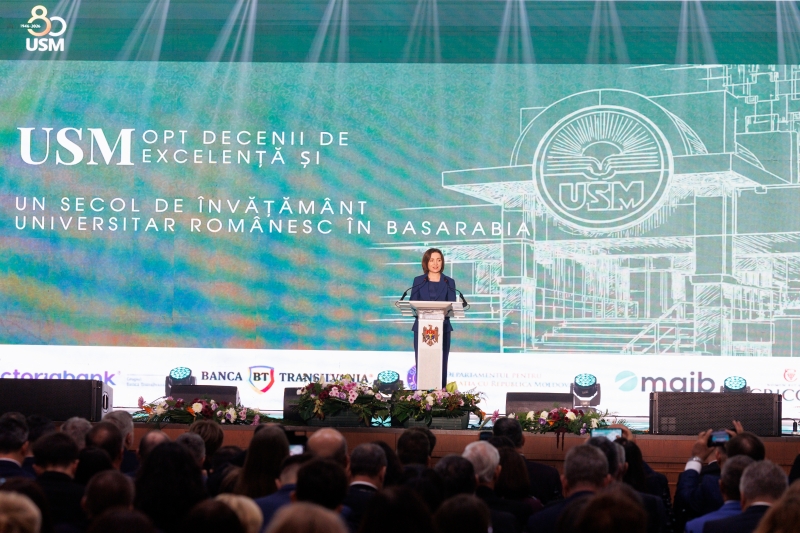
Moldovan president's speech at ceremony marking 80th anniversary of founding of State University of Moldova, centenary of Romanian university education in Bessarabia
Distinguished guests,

Distinguished professors,

Dear students,

Ladies and gentlemen,


On my way to this event, I was wondering what 80 years actually means in the life of an institution. The independent Republic of Moldova is 35 years old. The State University of Moldova is 80. And Romanian university education here, in our country, began 100 years ago.

Over these 100 years, regimes and borders have changed. There have been wars, famine, deportations and repression. Our language and identity have been put to the test. We lost our freedom and regained it.

And throughout all this time, people continued to learn, teach, conduct research and pass knowledge on.

In 1926, the university education in the Romanian language began in Chisinau with the opening of the Faculty of Theology of the University of Iasi. A few years later, in 1933, it was joined by the Faculty of Agricultural Sciences, also of the University of Iasi, strengthening Chisinau’s role as a university center.

However, this path was to be brutally interrupted.

After the war, in 1946, the State University started its activity. It was the first higher education institution with university status, with several hundred students and a very small number of teaching staff. There was not even enough furniture, while teaching materials were made by professors and sometimes even by students.

But material shortages were not the greatest hardship.

Much more burdensome was the totalitarian context in which the new University began its existence. Its early years coincided with forced collectivization, political repression and mass deportations.

The educational process was heavily ideologized. Academic freedom was limited. Important pages of our own history and identity were silenced or even falsified.

And yet, the University grew.

It is important to say this clearly: it was not the Soviet regime that built what we celebrate today, but the people of the University—professors, researchers and students who managed to create and pass on knowledge even within a restrictive system.

And perhaps the best measure of a university is the people who have passed through its halls.

Vladimir Beșleagă, Alexandru Moșanu, Nicolae Dabija, Ion Hadârcă, Mihai Cimpoi, Vasile Romanciuc, Constantin Cheianu, and many others studied here.

Their example reminds us of what a university can do.

A university does not merely provide a diploma. A university can open a path. It can discover a talent.

And through the people it educates, a university can change a society.

In the decades that followed, faculties and laboratories were established at USM, new fields of study were developed and many generations of specialists were trained.

And toward the end of the 1980s, voices emerged from this university community that began openly challenging the oppressive system.

Students created literary circles and new forms of organization, began distancing themselves from the regime’s official structures and took part in demonstrations of the National Liberation Movement. On this way, the University reclaimed its rightful place at the heart of a society that was increasingly determined to assert its language, identity and freedom.

Professors and students were regaining something essential for any university: the right to ask questions and seek answers without constraints, to speak the truth without fear.

After independence was proclaimed, the University embarked on an extensive process of reconfiguration and modernization, as well as integration into the European education and research community.

Today, this European vocation takes on an even deeper meaning. Moldova is in the process of joining the European Union and for our universities this process opens up new opportunities for research, collaboration, and academic exchanges.

But the European path also means greater competition.

Today, our young people can choose among universities from all over the world, and it is natural for them to do so.

Our responsibility is to ensure that they also have good, modern universities at home, where they can receive a quality education.

We want the universities of Moldova to be able to compete on an equal footing with European universities.

We want our young people to choose to study at home. And we want young people from other countries to choose the universities of Moldova.

In recent years, important steps have been taken in this direction through university reform and the integration of research institutes into universities.

But we still have much to do.

The world for which we are preparing today’s students is changing very quickly.

We are facing major challenges at the global level. Artificial intelligence is already changing the way we learn and work.

We need good teachers, researchers, lawyers and specialists in science and technology.

But above all, we need people who think independently and use their knowledge for the good of society.


Ladies and gentlemen,

Looking back at this century, we can see how profoundly the world has changed.

There have been periods of development and periods of restrictions.

Above all, we must learn from this history to value freedom.

The freedom to learn and conduct research. The freedom to ask questions. To seek and speak the truth. The freedom to think.

Universities have a duty to defend this freedom.

And USM—a institution with so much history behind it—knows what is worth preserving. It also has a responsibility to prepare for what lies ahead.

Moldova needs universities where young people want to learn.

Universities that educate free and well-prepared people who have the ability and courage to face the challenges of this century.

For 80 years, the State University of Moldova has educated such people.

And today’s generation has the responsibility to carry this history forward.

Happy anniversary to the professors, students, graduates and everyone who has contributed to building the State University of Moldova!
 Facebook
 Instagram
 X/Twitter
 Telegram
Moldovan PM says government must have necessary tools before crises materialize
Moldovan parliament declares nationwide state of emergency in energy, hydrological sectors for 60 days
Moldovan PM, European Commission official discuss accelerating growth plan projects
Moldovan PM's speech at parliament's plenary meeting on establishment of emergency state
Moldovan president, delegation of Czech senators discuss Moldova’s European path, bilateral cooperation
Government improves financing mechanism for regional and local development projects
National railway infrastructure program for 2026–2030 approved by Government: Railway to be modernized and passenger transport expanded
Crime victims to gain easier access to support and compensation
Chisinau's Triumphal Arch to be restored
Government begins reorganization of central public administration to reduce expenditures
Government proposes declaring state of emergency in energy and hydrological sectors for 60 days
Moldovan National Security Council approves string of measures to ensure continuous energy supply, prepare country for cold season
Moldovan president's message following meeting of National Security Council
Moldovan PM meets Irish Ambassador
MOLDPRES INTERVIEW // Slovak Ambassador: Moldova deserves to be part of EU in near future. It can complete accession process by 2030
VIDEO // Russia tried to destabilize our country and spent hundreds of millions of dollars for this purpose. Moldova resisted, Prime Minister says
More than 50 UN member states called on Russia for complete, immediate and unconditional ceasefire in Ukraine
VIDEO // Prime Minister - interview with CNN: We welcome United States involved in energy support projects for Moldova
Moldovan parliament speaker says Russia triggers tensions, seeks to sow fear by unauthorized overflights of airspace
Moldova discusses strengthening airspace protection capabilities with Romania and Ukraine, Speaker says
Republic of Moldova reaffirms commitment to refugee protection at UN meeting dedicated to 1951 Convention
 National Bank of Moldova
Parliament votes, in first reading, on legislative measures to strengthen independence of National Bank of Moldova in line with European standards
Moldovan parliament adopts legislative amendments to make procedure for selecting, appointing candidates for position of Constitutional Court judge more transparent
Medical, pharmaceutical qualifications got in EU to be able to be recognized in Moldova; parliament adopts draft law
Caps for foreign exchange operations without National Bank's authorization to increase gradually; Moldovan parliament passes draft in second reading
Enhanced protection for persons targeted by abusive lawsuits: Moldovan parliament votes on anti-SLAPP legislative package in second reading

Parliament votes, in first reading, on legislative measures to strengthen independence of National Bank of Moldova in line with European standards
Moldovan parliament adopts legislative amendments to make procedure for selecting, appointing candidates for position of Constitutional Court judge more transparent
Medical, pharmaceutical qualifications got in EU to be able to be recognized in Moldova; parliament adopts draft law
Caps for foreign exchange operations without National Bank's authorization to increase gradually; Moldovan parliament passes draft in second reading
Enhanced protection for persons targeted by abusive lawsuits: Moldovan parliament votes on anti-SLAPP legislative package in second reading
Drone found in Florești had onboard camera, features specific to Gerbera type
Emotional moment in Parliament: six children opened plenary session with special sign language performance
Republic of Moldova and UNESCO to strengthen cooperation in education, culture and combating information manipulation
Foreign Ministry deems violation of airspace by Russian drones inadmissible
Draft decisions with environmental impact compiled in new section on EcoContact
Speaker condemns drone incidents recorded this morning
President condemns violation of Moldova’s airspace by Russian drones: Russia’s war puts all of Europe at risk
Deputy Prime Minister at Crimea Platform Summit: Russia’s aggression affects security and stability of all Europe
Moldovan, Norwegian Prime Ministers approach bilateral partnership
Corneliu Dudnic, Alexandr Stoianoglo file documents to run for office of Gagauzia's bashkan
Judicial reform, rule of law in focus of discussions between Moldovan president, new Head of Council of Europe Office
Receive the latest news directly to your email

Receive the latest news directly to your email