
Government presents proposal for new administrative-territorial map
Government is proposing a new administrative-territorial configuration for the Republic of Moldova: 273 city halls and 3 regions – North, Centre and South. Chișinău and Bălți will retain their municipality status, Taraclia will become a second-tier municipality, while the Autonomous Territorial Unit of Gagauzia will retain its special status.

The proposal for the new administrative-territorial map was presented today by Government Secretary General Alexei Buzu.  The new configuration is the result of the amalgamation process and consultations held with local authorities and citizens. The reform aims to strengthen city halls so that they have more resources and can better respond to the needs of their communities. Following the completion of the reform, city halls will have larger populations, the necessary specialists and increased resources to provide quality services, financial incentives from the Government to modernize infrastructure, and support from the new regional administrations to implement major regional projects.

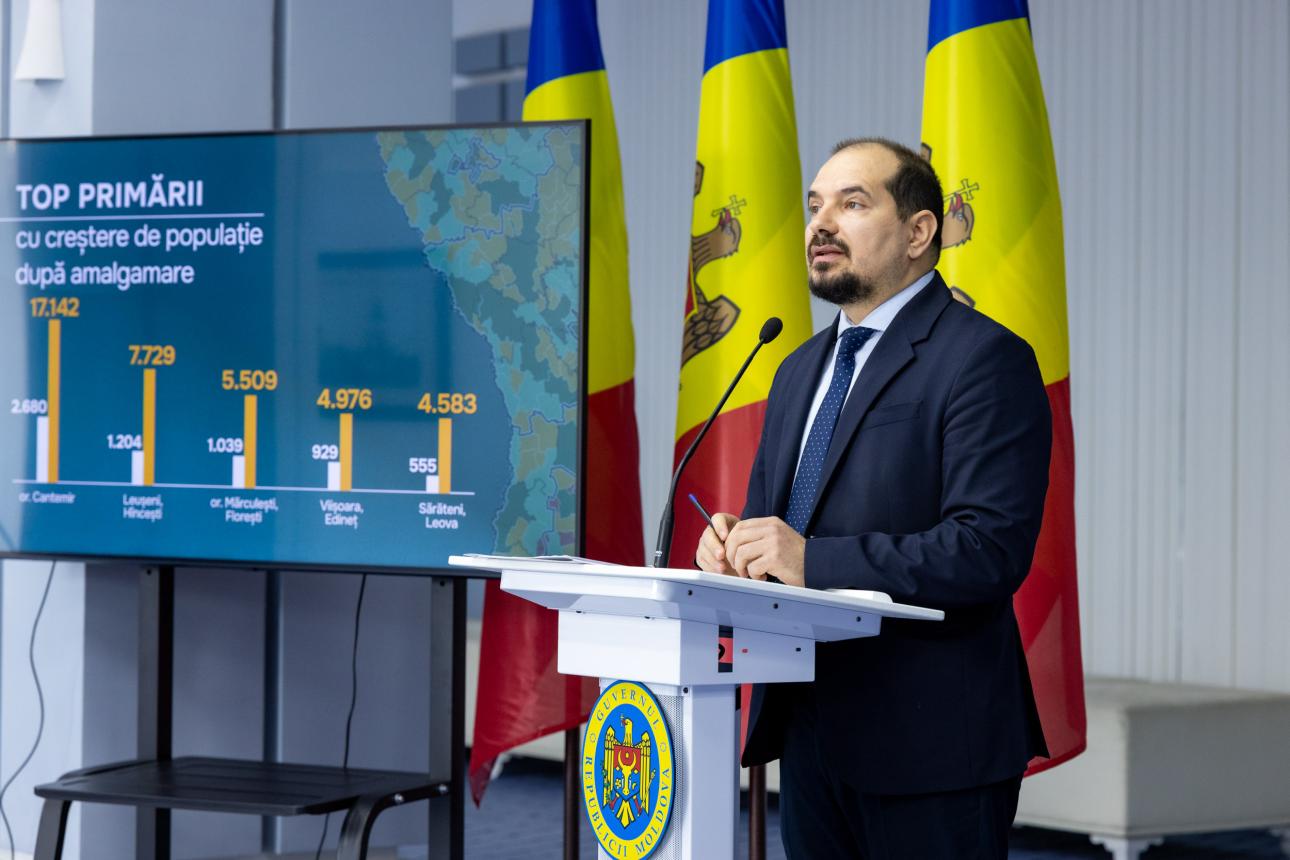
Under the proposed reorganization, the average population of a city hall (excluding Chișinău, Bălți and the Autonomous Territorial Unit of Gagauzia) will increase from 1,916 to 6,758 inhabitants. In some localities, the change will be even more significant. For example, the population of the new Cantemir city hall will increase from 2,680 to more than 17,000 inhabitants, while that of Leușeni city hall will grow from approximately 1,200 to more than 7,700 inhabitants.

Larger city halls will have more opportunities to attract investment and funding and to prepare and implement projects for the development of their communities. Through the development incentive granted as part of the amalgamation process, Ungheni will receive approximately 150 million lei, Călărași – 110 million lei, Orhei – 79 million lei, Rezina – 78 million lei, and Rîșcani – 66 million lei. The projects to be supported through the amalgamation incentives have a total value of more than 4.2 billion lei.

“It is important to provide these teams with the necessary capacities, to build strong city halls with more resources, to digitalize processes and to ensure that the necessary professionals are available. It is important to prepare for European funds and to develop the capacity to implement major projects that provide citizens with essential services: roads, street lighting, water supply, sewage systems and waste sorting,” he said.

The new organization will also change the size of some urban and rural centres. According to the data presented, Ungheni will have more than 42,000 inhabitants, Orhei more than 28,000, while Călărași and Nisporeni will each have approximately 27,000. At the same time, several rural mayoralties will have more than 10,000 inhabitants. A larger scale will allow for more efficient use of resources and the development of projects benefiting more citizens.

To make the new configuration easier to view and understand, an interactive map of the new mayoralties and regions has been launched. Citizens can search for each locality to see which mayoralty and region it will be part of and how many inhabitants it will have. The map, available at primariiputernice.gov.md/harta, allows users to view different administrative levels and download data for further analysis.

The new configuration follows an extensive consultation process. Approximately 115,000 people were consulted as part of the local public administration reform, during more than 1,200 meetings with citizens. Going forward, the Government will submit the first package of laws required to implement the new structure for consultation. Subsequently, the legislative package will be examined by the Government and submitted to Parliament for debate. In parallel, the transition from districts to regions will be prepared so that services remain available in every locality, and the operating procedures for the new city halls will be established.

“I would like to thank the local elected officials for their courage and for taking responsibility. We will work side by side to ensure that, with the 2027 local elections, we successfully carry out this transition and, more importantly, that the new city halls function much better and are able to develop and implement projects much more quickly and efficiently for the benefit of our localities, villages and towns,” he said.
 Facebook
 Instagram
 X/Twitter
 Telegram
Priorities of Moldova-Germany development cooperation discussed at Moldova's government
On Professional Day of Education Workers, 70 lyceum pupils of Moldova simulate parliament meeting, discuss school network's reform
Moldova to receive new 157 million-euros installment from Growth Plan
Speech by Prime Minister following EU–Moldova Association Council
Students of Mihai Bătrânu School of Arts in Dondușeni exhibit works at Parliament
Moldovan PM, on National Wine Day, says winemakers country's ambassadors in the world, calling card
Moldovan PM attends ceremony dedicated to Professional Day of Education Workers
Moldovan PM to pay working visit to Brussels
Measurement of performance, monitoring of government's priorities discussed at Moldova's government
Preparing of Moldovan authorities to access EU funds: Poland’s experience presented in Chisinau
PM attends annual meeting of Moldova's honorary consuls
Parliament's foreign policy commission hears Foreign Affairs Ministry's report on economic diplomacy's goals of Moldova
Moldovan president proposes Moldova–Finland dialogue on resilience in Helsinki
Summary of Moldovan parliament's plenary meeting held on October 2, 2026
Moldova Security Forum // Defense Minister: War in Ukraine changed Europe’s security environment
Parliament to review structure and personnel strength of National Army in closed session
VIDEO // President at Moldova Security Forum 2026: Russia is trying to test our limits, but every time we have managed to cope. In European family, we will be even stronger
Foreign Minister at Security Forum: Moldova is stronger and more resilient than a few years ago
VIDEO // Government proposes reorganizing local administration into 273 city halls and three regions
Moldova Security Forum 2026 // Head of NATO Liaison Office in Chișinău: Moldova on front line of protecting democracy and sovereignty
Irina Florea wins bronze for Moldova at World Sambo Championships
 National Bank of Moldova
President’s address at Moldova Security Forum
Moldovan parliament's standing bureau approves agenda for plenary meeting of October 8
Strengthening cooperation, exchange of best practices between parliamentary secretariats of Moldova, Romania in support of country’s EU accession process
Moldovan Presidency publishes register of gifts received in July–September 2026, which remain in institution’s assets or may be repurchased
Parliament speaker, U.S. Ambassador discuss strengthening Moldovan-American partnership


LIVE // Moldova Security Forum 2026 taking place in Chișinău
Civil society invited to discussions on European integration of Moldova
“Black Swans in the Black Sea” launched in Chișinău
Perception of human rights' observance improve in Moldova - study
Moldovan parliament's standing bureau approves agenda for plenary meeting of October 8
PHOTO // Experience of Green Justice project could underpin new environmental justice initiative in Moldova
Medical technologies, artificial intelligence at center of new partnerships proposed by Moldova's State University of Medicine and Pharmacy
Strengthening cooperation, exchange of best practices between parliamentary secretariats of Moldova, Romania in support of country’s EU accession process
Moldovan Presidency publishes register of gifts received in July–September 2026, which remain in institution’s assets or may be repurchased
Moldovan authorities to strengthen security measures at border crossing points following incident at Palanca
PHOTOS // Austria’s experience in protected areas' management, habitats' restoration studied by specialists of Moldova
Moldova, Turkey strengthen economic cooperation; trade reaches 638.7 million dollars
Parliament speaker, U.S. Ambassador discuss strengthening Moldovan-American partnership
United States, Moldova strengthen cooperation on cybersecurity
VIDEO // Deputy PM for reintegration says Moldova's advancement along European integration path to create sustainable, much more attractive framework for country's reintegration
ARMENPRESS: UN Human Rights Council unanimously adopts Armenia-initiated resolution
Receive the latest news directly to your email

Receive the latest news directly to your email