
VIDEO // Government proposes reorganizing local administration into 273 city halls and three regions
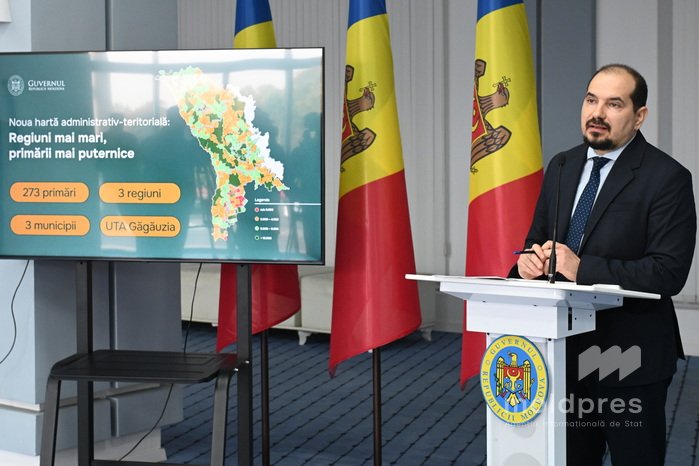
Government Secretary General Alexei Buzu today presented the proposal for the new administrative-territorial map of the Republic of Moldova, which provides for the consolidation of local public administration into 273 city halls and three regions. According to the official, the reform aims to create local administrations with greater capacity to manage resources, attract investment and provide public services.


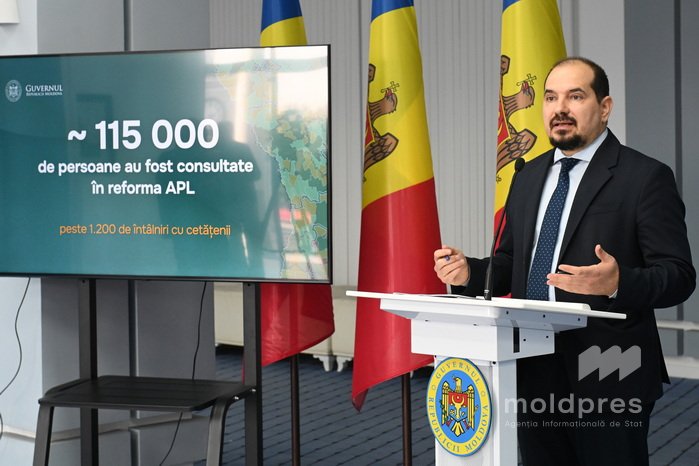
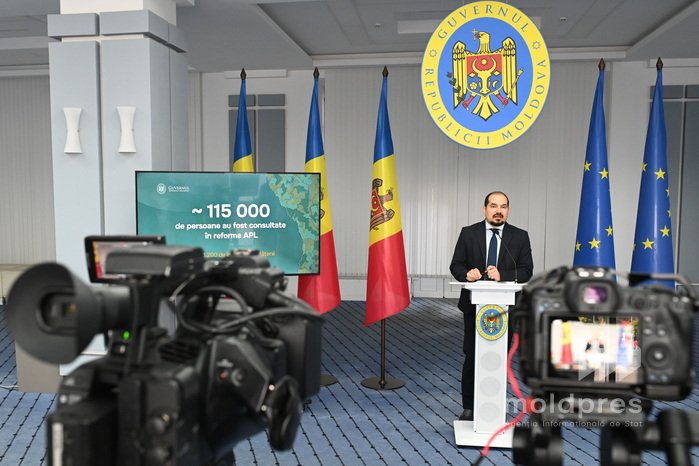
The proposal follows an extensive consultation process initiated in January, during which more than 2,000 meetings and discussions were held with local elected officials, civil servants and citizens. According to data presented by Alexei Buzu, more than 115,000 citizens took part in the consultations, while 788 city halls adopted 1,226 decisions regarding the initiation of the amalgamation process.


„During this period, I was once again convinced of the very high quality of the mayors, local and regional councils, and civil servants in the city halls and councils. They are committed, patriotic, professional people, dedicated to the citizens, localities and towns where they work,” Alexei Buzu said.


He nevertheless emphasized that, although local administrations have well-trained people, in many cases they have teams and resources that are too small to meet all the needs of their communities.


„In the Republic of Moldova, we have strong mayors, but these mayors work in weak mayoralties. We have excessive fragmentation at the local level,” the official stated.


According to the data presented, 87% of the country’s mayoralties have a population of fewer than 3,000 inhabitants. Between 2014 and 2024, localities with fewer than 3,000 inhabitants lost an average of 33% of their population. At the same time, in localities with more than 10,000 inhabitants, the population increased by 36%.


„Not all citizens who leave small mayoralties go abroad. They move to larger mayoralties, where there is capacity, more resources and better services,” Buzu said.


In his view, administrative fragmentation also has a direct impact on access to infrastructure.


„Of every 10 families in our country that lack water and sewerage, eight live in mayoralties where the number of citizens is below 3,000,” he said.


Alexei Buzu also presented data on the costs of maintaining local administrations. In 2025, maintaining the city halls cost an average of 1,138 lei per inhabitant. In localities with fewer than 500 inhabitants, the average cost reached 3,147 lei per inhabitant, while in mayoralties with more than 3,000 inhabitants it was 763 lei.


„Year after year, the administration of the mayoralties costs us more, but year after year, because we have limited capacities and a restricted tax base, the capacity of mayoralties with these teams, compared with stronger city halls, decreases,” Buzu explained.


He said that, through amalgamation, the Government proposes merging the budgets and teams of several city halls, which would free up resources for specialized positions.


„If, among five, six, seven or ten mayoralties, each has an accountant, a tax specialist, a secretary and an administrative specialist, we can merge these positions in order to create roles in project development, public procurement or territorial planning. These are the positions currently lacking in most mayoralties across our country,” he explained.


According to Buzu, the objective of the reform is „to build strong city halls” with larger and specialized teams, digitized processes and the capacity to develop and implement complex projects.


„A strong city hall means more resources, digitized processes, a larger team, a specialized team capable of developing and implementing projects, carrying out complex procurement, specializing in territorial planning and, most importantly, managing water and sewerage services, solid waste, street lighting and the maintenance of public spaces,” Buzu said.


He assured that the administrative reform would not involve the removal of services from the localities that will be merged.


„At the level of service delivery, things will remain unchanged. In the locality where the mayoralty existed, there will be a representative of the mayor who will administer the unified service delivery center,” he explained.


Thus, citizens who need certificates, consultations or meetings with officials will still be able to address the relevant authorities in their locality.


„At the service level, these services will not be withdrawn. Social workers will remain in the community, while the kindergarten, school, assistance center, cultural center, sports field and other services will remain in place,” Buzu said.


In the official’s view, what is to be consolidated is administrative capacity, not the proximity of services to citizens.


„What we are bringing together is power and administrative capacity,” he said.


Buzu believes that consolidated mayoralties could also be more attractive to investors, as they would have larger budgets and higher local revenues and could present investors with a more substantial offer.


„Instead of an investor negotiating with 10 mayoralties or six mayoralties, they will negotiate with a single city hall which will be able to offer land, assets or greater workforce potential,” he explained.


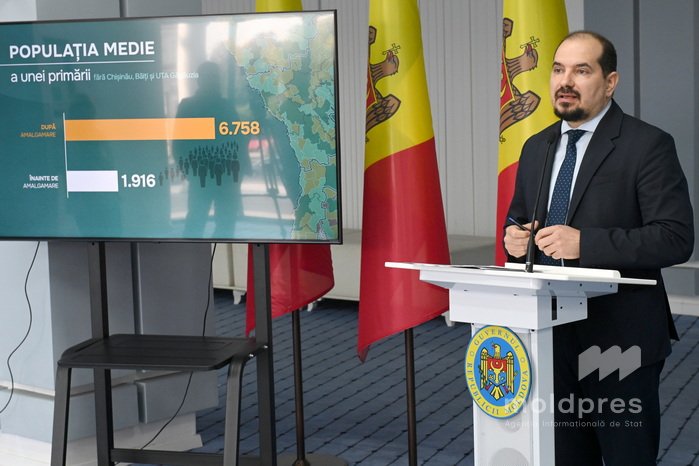
The new configuration would significantly reduce the fragmentation of local administration. According to the data presented, the average population of a city hall would increase from 1,916 to 6,758 inhabitants.

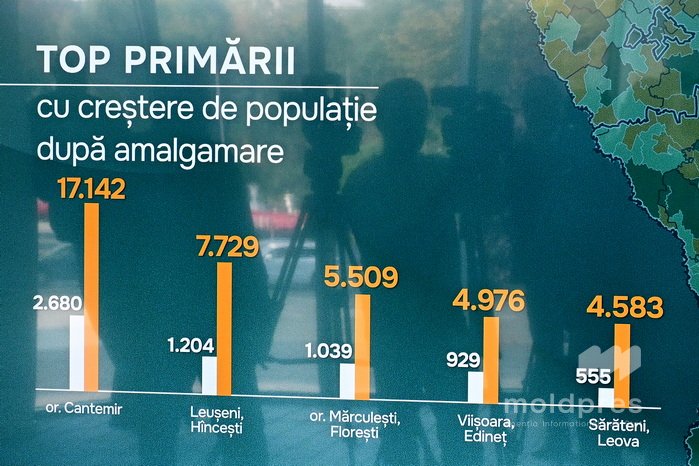
Buzu also offered several examples. In Cantemir municipality, the population served by the local administration would increase, according to the new configuration, from 2,680 to 17,142 inhabitants. In Leușeni, it would increase from 1,204 to 7,729 inhabitants; in Mereni/Mărculești, from 1,039 to 5,509; in Viișoara, from 929 to 4,976; and in Sărăteni, from 555 to 4,583.


„This is an average that exceeds the European average, but it is a reasonable average. In this discussion about the reform, there has been a great deal of talk about local democracy and the fact that the reform would reduce local democracy. This figure shows that, although the change is substantial, it is not so radical,” Buzu stated.


He said that the Government had also analyzed participation in local elections to determine whether there were differences between small and large localities.


„We examined the turnout in the 2023 and 2019 local elections and tried to determine whether participation rates differed between small and large localities. There is no such link. Participation is quite good both in larger localities and in smaller ones,” the official said.


According to the proposal presented, at the second level of administration, the 32 districts are to be reorganized into three regions. The new configuration also includes the municipalities of Chișinău and Bălți, as well as the special status of the Autonomous Territorial Unit of Gagauzia. During the presentation, Buzu also mentioned Taraclia municipality in the new administrative configuration.

The reform follows the voluntary amalgamation stage. According to Buzu, 85% of the country’s city halls initiated the voluntary amalgamation process, while 63% successfully completed it.


„The fact that 85% of the city halls in our country initiated the voluntary amalgamation process and that 63% of them successfully completed it shows that, for the most part, local mayors understand how important this issue is and have made difficult decisions on behalf of the localities, citizens and towns they manage,” the Secretary General stated.


He called this „a clear sign of maturity” and said he hoped the example set by local elected officials would also be followed at the national level.

To encourage amalgamation, the Government is offering consolidated localities support equivalent to 3,000 lei for each inhabitant. Buzu announced that the infrastructure projects financed under the second incentive are expected to exceed 4.2 billion lei and be approved by the end of the year, with implementation scheduled to begin in 2027.

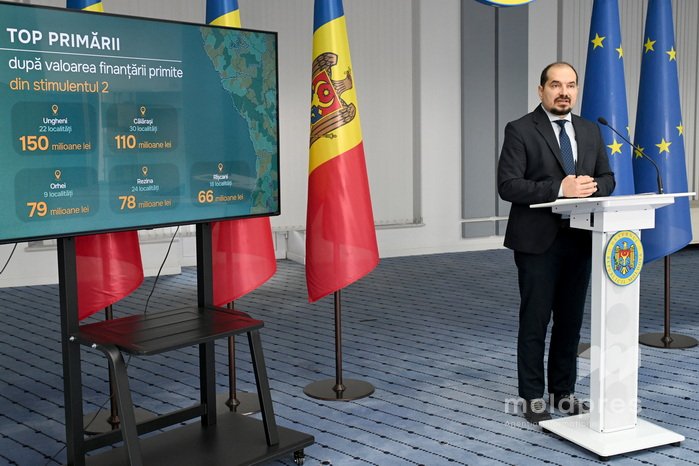
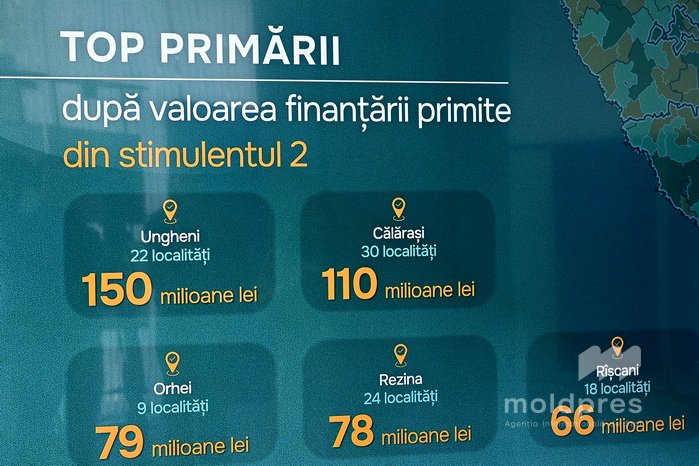
The largest investments mentioned during the presentation are 150 million lei for Ungheni, 110 million lei for Călărași, 79 million lei for Orhei, 78 million lei for Rezina and 66 million lei for Rîșcani.

According to Buzu, some of the new city halls will bring together a significant number of localities. In Călărași, for example, 18 city halls have merged into the new mayoralty; in Ialoveni, 15; in Rezina, 14; and in Cantemir, 13. The official’s presentation also mentions an example involving 12 city halls in the consolidation process in Călărași.

Buzu announced that, in the coming days, the Government will submit for consultation the first package of normative acts required to implement the new administrative structure.


„We will hold broad consultations. We will go to Parliament and invite each parliamentary faction for discussions, as well as extra-parliamentary parties. We will hold a round of consultations in each region,” he said.


The Secretary General emphasized the national character of the reform.


„We want to make sure that this is a national effort. It goes beyond certain political or organizational interests,” Buzu said.


Following the consultations and the finalization of the legislative framework, the legislative package will be submitted to Parliament. Its adoption will allow the transition process to the new administrative structure to begin.


„We want to make sure that we prepare the transition, that all services are in place, that we build a new way of working in the new city halls and that we work on the project portfolio,” the official stated.


According to the proposal presented, the new provisions are to enter into force with the 2027 local elections. Until then, the Government intends to prepare the administrative transition and project portfolios for the new local authorities.


„As the Republic of Moldova advances along the European path, we will have more financial opportunities, and it is important to prepare, have a portfolio of projects, be competitive and be able to implement these projects on time,” Alexei Buzu added.


He emphasized that the reform must enable local authorities to provide citizens with basic services and better infrastructure.


„It is important to give city halls extraordinary capacities, provide them with more resources, digitize processes and ensure that there are more professionals, so that we can provide citizens with basic services, good roads, street lighting, water, sewerage, and waste collection and sorting,” Buzu said.


At the end of the presentation, the Secretary General of the Government thanked local elected officials for their involvement in the reform process and assured them that the government team would work together with them to carry out the transition after the 2027 local elections.


„I assure you that I and the Government team will work side by side with them and make sure that, with the 2027 local elections, we successfully carry out this transition and, more importantly, that the new city halls function much better and can develop and implement projects much more quickly and efficiently for the benefit of localities, villages and towns,” Alexei Buzu concluded.
 Facebook
 Instagram
 X/Twitter
 Telegram
Projectile fell in area of Palanca-Maiaki-Udobnoe border crossing
National Wine Day, 25th edition, brings together around 100,000 people and over 110 producers in PMAN
Teachers celebrate professional day on October 5
VIDEO // President on Teacher's Day: Thank you for work you do every day for every child
PHOTOS // Head of state, at National Wine Day, says Moldovan wine getting better, reaching farther around the world
Severe weather warning in Spain; Embassy of Moldova issues recommendations for citizens
PHOTO // Moldova sets Guinness world record with world's largest human grapevine
Drones entering Moldova’s airspace left craters, debris across extensive areas
Bomb threat at Chisinau-based Eugen Doga Airport unconfirmed; passengers' access to terminal resumed
Bomb threat alert at Eugen Doga International Airport – Chisinau: passengers, staff evacuated
National Army detects six unauthorized flights in Moldova’s airspace on October 3
VIDEO // Drone fragments detected in more settlements of Moldova; police investigate explosions reported
More drones fly over airspace of Moldova
Bomb alert at Eugen Doga International Airport – Chisinau proves to be hoax; Airport operations resumed
Moldova Security Forum // Defense Minister: War in Ukraine changed Europe’s security environment
Parliament to review structure and personnel strength of National Army in closed session
VIDEO // President at Moldova Security Forum 2026: Russia is trying to test our limits, but every time we have managed to cope. In European family, we will be even stronger
Foreign Minister at Security Forum: Moldova is stronger and more resilient than a few years ago
VIDEO // Government proposes reorganizing local administration into 273 city halls and three regions
Moldova Security Forum 2026 // Head of NATO Liaison Office in Chișinău: Moldova on front line of protecting democracy and sovereignty
Irina Florea wins bronze for Moldova at World Sambo Championships
 National Bank of Moldova
Government presents proposal for new administrative-territorial map
President’s address at Moldova Security Forum
Moldovan parliament's standing bureau approves agenda for plenary meeting of October 8
Strengthening cooperation, exchange of best practices between parliamentary secretariats of Moldova, Romania in support of country’s EU accession process
Moldovan Presidency publishes register of gifts received in July–September 2026, which remain in institution’s assets or may be repurchased

LIVE // Moldova Security Forum 2026 taking place in Chișinău
Civil society invited to discussions on European integration of Moldova
“Black Swans in the Black Sea” launched in Chișinău
Perception of human rights' observance improve in Moldova - study
Moldovan parliament's standing bureau approves agenda for plenary meeting of October 8
PHOTO // Experience of Green Justice project could underpin new environmental justice initiative in Moldova
Medical technologies, artificial intelligence at center of new partnerships proposed by Moldova's State University of Medicine and Pharmacy
Strengthening cooperation, exchange of best practices between parliamentary secretariats of Moldova, Romania in support of country’s EU accession process
Moldovan Presidency publishes register of gifts received in July–September 2026, which remain in institution’s assets or may be repurchased
Moldovan authorities to strengthen security measures at border crossing points following incident at Palanca
PHOTOS // Austria’s experience in protected areas' management, habitats' restoration studied by specialists of Moldova
Moldova, Turkey strengthen economic cooperation; trade reaches 638.7 million dollars
Parliament speaker, U.S. Ambassador discuss strengthening Moldovan-American partnership
United States, Moldova strengthen cooperation on cybersecurity
VIDEO // Deputy PM for reintegration says Moldova's advancement along European integration path to create sustainable, much more attractive framework for country's reintegration
ARMENPRESS: UN Human Rights Council unanimously adopts Armenia-initiated resolution
Receive the latest news directly to your email

Receive the latest news directly to your email