
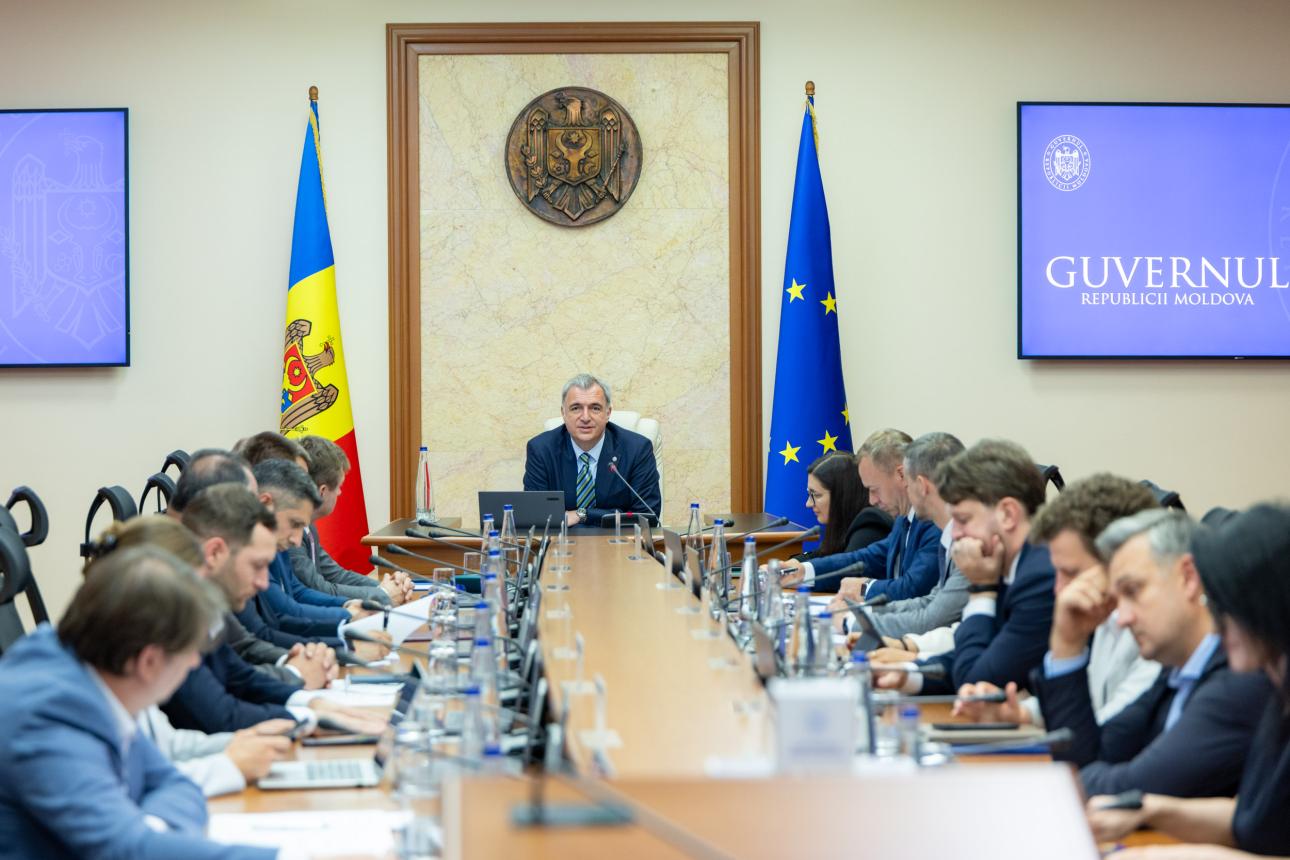
Over 9,000 state-funded places for future students approved by Government
As part of this year’s admission session, public universities will offer 9,013 state-funded places. The state order for the 2026–2027 academic year has been approved by the Government. It covers first-cycle higher education (Bachelor’s), integrated higher education, Master’s programmes, residency and clinical secondary training, as well as doctoral studies.

“Education sciences remain the priority field of the state order this year as well. The education system needs well-trained teachers. By maintaining the largest share of state-funded places for this field, we are investing in the most important resource of the school – teaching staff. Teacher training is a strategic investment in the quality of education and in the future of the Republic of Moldova,” said Dan Perciun, Minister of Education and Research.

For Bachelor’s and integrated higher education studies, 5,380 state-funded places are planned. Of these, approximately 20.5% are allocated to the field of Education Sciences. At the same time, the number of state-funded places has been increased in fields where there is a high demand for specialists, such as Biological, Chemical and Physical Sciences, Engineering, Architecture and Construction, Forestry and Veterinary Medicine.

For the 2026–2027 academic year, the number of state-funded places for dual higher education has been increased in fields such as Journalism and Information, Economic Sciences, and Engineering and Engineering Activities. Also, for the first time, state-funded places have been allocated to the fields of Forestry and Public Services.

The measure aims to align university training with labour market needs and to increase graduates’ employment prospects. Following the piloting of distance learning in the 2025–2026 academic year, this year’s admission session introduces, for the first time, state-funded places for distance study programmes intended for persons with severe or pronounced disabilities who cannot attend full-time studies. The state order continues to include separate places for young people from the diaspora, to facilitate their access to higher education in the Republic of Moldova. In addition, state-funded places are reserved for young people of Roma ethnicity, to support their access to higher education.

At the same time, this year the number of state-funded places with special destination for graduates of educational institutions from the administrative-territorial units on the left bank of the Nistru River and from the municipality of Bender has been increased from 262 to 280.

For Master’s studies, 2,771 state-funded places are proposed. For the first time, only candidates with a general admission average of at least 7.00 will be able to participate in the competition for state-funded places in the second cycle. For residency and clinical secondary training, 504 state-funded places are planned: 489 for residency and 15 for clinical secondary training.

The number of places has been increased by 69, considering the growing number of graduates of integrated higher education in the Health field and the need to ensure compulsory professional training for doctors and pharmacists.

For foreign citizens, 133 state-funded places are reserved, based on obligations assumed by the Republic of Moldova under bilateral agreements in the field of education.

For doctoral studies, 225 state-funded places are available, to be allocated across fundamental fields of science, culture and technology, with an emphasis on national priorities in research and innovation.

Admission to higher education institutions in the Republic of Moldova will begin on 27 July and will take place, as in recent years, entirely online via the national platform eAdmitere.gov.md, using an electronic signature or, in its absence, with the support of representatives of higher education institutions.

During the main session, files may be submitted between 27 July and 1 August. Interim results will be published on 8 August, and admitted candidates will confirm their place by submitting original documents between 8–12 August. Final results will be published on 14 August. For remaining available places, an additional session will be organised from 15–24 August.

Through the platform www.eAdmitere.gov.md, each candidate may simultaneously participate in the competition at up to three universities and may select up to three study programmes for each institution, according to their preferences.
 Facebook
 Instagram
 X/Twitter
 Telegram
Government’s State Secretary for Reintegration meets with Ambassador of Croatia
Participation of Deputy Prime Minister for Reintegration in roundtable on Transnistrian conflict settlement process, held in Vilnius
Republic of Moldova implemented over 90% of reform measures planned for first half of 2026
President met with Head of Council of Europe Office in Chișinău
Dynamics of vehicle registration with national and neutral license plates in Transnistrian region
Working visit of State Secretary of Government for Reintegration to localities of Copanca and Grădinița, Căușeni district
Bilateral meetings with Lithuanian officials during working visit of Deputy Prime Minister for Reintegration to Vilnius
Discussions with representatives of Norwegian Refugee Council on activities carried out in Moldova
Almost 360 thousand residents of Transnistrian region hold citizenship of the Republic of Moldova
President launches consultations on nominating candidate for Prime Minister
Government State Secretary for Reintegration in dialogue with local public authorities on community development and citizens’ access to public services
Moldovan Deputy Prime Minister for Reintegration meets Speaker of Lithuania
Speaker at Conference of Speakers of EU candidate states
European Union remains main destination for goods exports by economic agents from Transnistrian region
Acting Prime Minister expects new Government to be sworn in next week, while ministers avoid saying whether they will remain in office
Acting Minister of Defense about drone crashed near Copanca: Detection by radars depends on distance, altitude and terrain features
Acting Prime Minister after opening negotiations on Cluster 6: We have shown perseverance and quality. We must continue implementing reforms
Construction works on national road R7 “R14 - Drochia - Costești - border with Romania” could be declared of public utility and national interest
Government accepts resignation of APP head
Deputy Prime Minister presented in European Parliament the Republic of Moldova’s priorities in security and defence
Recruitment into National Army under scrutiny by Ombudsman following multiple complaints
 National Bank of Moldova
Construction of bypass road around city of Drochia progresses: Government approves new phase of project
President on Ukraine Statehood Day: Thank you for reminding us what it means to fight for freedom
Deputy Prime Minister for Reintegration meets Ambassador of United Kingdom of Great Britain and Northern Ireland
VIDEO // President attends in Kyiv events dedicated to Ukraine’s Statehood Day and Ukraine – South-East Europe Summit
Acting Prime Minister at meeting with European Commissioner: We continue working to prove through concrete results that Moldova belongs in European family

Deputy Prime Minister for Reintegration meets Ambassador of United Kingdom of Great Britain and Northern Ireland
PHOTO // Vasile Tofan held talks with small entrepreneurs
Tourism turns Orheiul Vechi into driver of local economy: accommodation revenues increased sixfold in recent years
VIDEO // President attends in Kyiv events dedicated to Ukraine’s Statehood Day and Ukraine – South-East Europe Summit
Message of Prime Minister-designate Vasile Tofan after opening of negotiations on Cluster 6
Irish Minister for European Affairs and Defence: Moldova made significant progress and demonstrated strategic alignment with EU values
Moldova maintains EU accession timeline
Acting Prime Minister at meeting with European Commissioner: We continue working to prove through concrete results that Moldova belongs in European family
Speaker: Opening of negotiations for External Relations Cluster confirms that reforms are delivering results
PHOTO // Vasile Tofan held first consultations with business representatives
EU Commissioner after opening negotiations on Cluster 6: Moldova - best performing student in my class
Accession talks advance: Republic of Moldova opens second cluster with EU
Moldova opens EU accession negotiations for Cluster 6 External Relations
VIDEO // Moldova opens negotiations on EU accession Cluster 6: Historic day for EU enlargement
European agenda and implementation of Growth Plan discussed at meeting between Acting Prime Minister and European Commissioner
PHOTO // Vasile Tofan, after consultations with interim ministers: I want Government focused on few clear priorities, disciplined in use of public money and evaluated based on results
Receive the latest news directly to your email

Receive the latest news directly to your email