
Moldovan government, Council of Europe discuss administrative reform: voluntary amalgamation of settlements seen as key to better public services
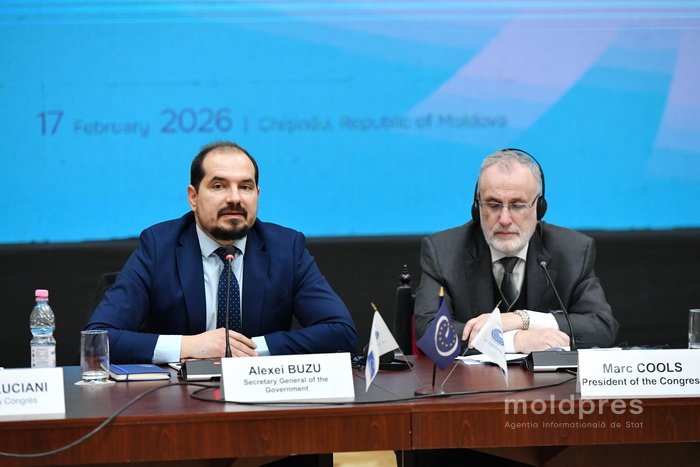
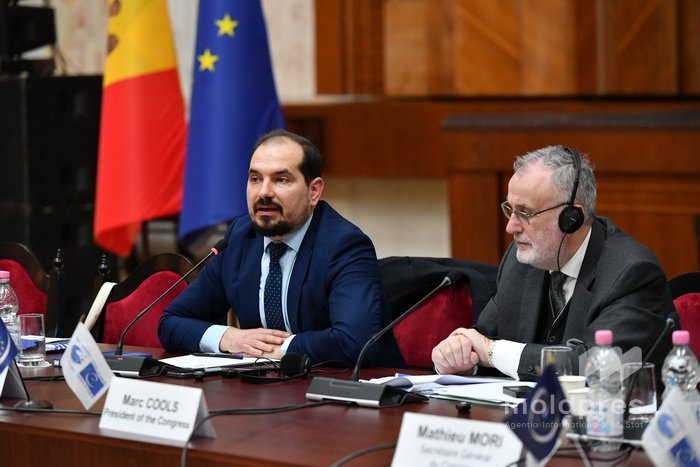
The strengthening of local autonomy and the improvement of public services’ quality were the main topics addressed at a press conference held in Chisinau today by Secretary General of the Government Alexei Buzu jointly with President of the Congress of Local and Regional Authorities of the Council of Europe Marc Cools.

The event took place in the context of a visit by the European delegation to Moldova and the preparation of the administrative and territorial reform, which provides, in a first stage, for the voluntary amalgamation of settlements and the strengthening of the capacities of mayoralties.


Government: reform must be carried out together with mayors and citizens

The Secretary General of the Government emphasized that the objective of the reform was to create stronger mayoralties capable of providing faster and more efficient public services. According to Alexei Buzu, the process will not be imposed from the center, but built through direct consultations with local authorities and community residents.

“We informed the audience about the government’s intentions to strengthen local public administration, in order to have better-developed localities and better services for people. Direct dialogue is essential for us. That is why, we have already visited seven districts and we are continuing discussions in the regions, and the next step will be to speak directly with citizens in the communities where the amalgamation process has begun,” said Alexei Buzu.

The official said that there is already interest on behalf of local administrations.

“We are encouraged by the positive signals. Every day, local public authorities contact us, asking for support and clarifications. We clearly see that the number of mayoralties that are analyzing or initiating the amalgamation process is increasing,” said the secretary general of the government.

Buzu insisted that the reform will be based on incentives, not constraints.

“We are not talking about an imposed reform. We will come forward with legislative clarity and with concrete financial incentives, both in the short and long term, so that mayoralties have more resources and can meet citizens’ expectations,” he said.

Council of Europe: administrative fragmentation limits development

President of the Congress of Local and Regional Authorities of the Council of Europe Marc Cools welcomed the progress made by Moldova in the field of local democracy, but stressed that administrative reform was still necessary, in order to increase the efficiency of institutions.

“Administrative reform of local public authorities is a necessity in Moldova, in order to enhance efficiency, the quality of services and the financial capacity of communities. The experience of other states shows that excessive fragmentation makes it difficult to ensure development and the provision of modern public services,” the European official said.

He also highlighted the complexity of the process.

“It is not easy to carry out an administrative reform. It must be prepared through a broad process of consultation and dialogue. We hope there will be broad consensus in society, because such a reform is a long-term one and must ensure efficient administration in the long run. The amalgamation process is not specific only to  Moldova; it is taking place in many European states. In Ukraine, about ten years ago, the same discussions that we see here today were taking place. There were many very small municipalities, with 100, 200, or 300 inhabitants, which could not effectively manage local affairs. The government then offered them a clear incentive: if they united, they would receive broader competences and greater financial resources, because stronger administrative units can better cope with public responsibilities,” Marc Cools noted.

According to him, the European Charter of Local Self-Government does not impose mandatory amalgamation — this remains the decision of each state. If a country can choose the path of voluntary amalgamation, it is a very good solution. What matters, however, is that this process be accompanied by extensive consultations with local authorities and citizens, as also provided by the Charter.

Flexible timeline and possible normative stage after 2027

The Moldovan government specifies that there is no fixed deadline for completing the voluntary amalgamation this year. The priority is to start the process and provide the necessary conditions for localities to make informed decisions.

After a period of implementation and evaluation of the results, the authorities may consider a stage of normative amalgamation applicable after 2027, especially for localities that will not be able to ensure minimum standards of public services.

The reform is to be supported through:

legislative clarifications,

financial incentives for localities that merge,

increasing the financial capacity of mayoralties,

reducing disparities between communities.

European support for local administration

Representatives of the Council of Europe reiterated their support for the modernization of local public administration of Moldova, underlining the essential role of mayoralties in maintaining direct relations with citizens.

European officials stressed that local authorities were the institutions closest to the people and play a decisive role in involving citizens in decision-making processes and in strengthening democracy at community level.

The administrative and territorial reform is considered by the authorities to be one of the most important structural changes planned in the coming years, aimed at ensuring more accessible public services, greater local investment and more balanced development of communities of Moldova.

The Congress of Local and Regional Authorities is an institution of the Council of Europe responsible for monitoring local and regional democracy in the 46 member states. Through its work, the Congress contributes to strengthening local self-government, promotes political consultation between different levels of government and supports administrative reforms in line with the principles of the European Charter of Local Self-Government.
 Facebook
 Instagram
 X/Twitter
 Telegram
EU Commissioner for Enlargement says Moldova on first position in its preparations for European Union membership
Moldovan president says all EU member states reconfirm Moldova ready to open accession negotiations
VIDEO // Moldova and Ukraine reaffirm: Our future in EU
VIDEO // News from Brussels on starting preparations for Cluster I in accession negotiations of Moldova to European Union applauded in Parliament
Strong support for Ukraine reaffirmed in Chisinau Parliament
Prime Minister at Moldova–EU Investment Conference: Moldova ready for accession and becoming part of European economy
European Commissioner in Chișinău: Moldova will be increasingly integrated into European economy, not only at time of accession, but long before it
President at Moldova–European Union Investment Conference: More and more friends from EU want to contribute to our country’s economic success
Siegfried Mureșan: Historic moment for European future of the Republic of Moldova: preparations start for opening cluster negotiations
European Commissioner for Enlargement expected in Chisinau, to advance EU accession reforms, boost investments; visit's agenda
European Parliament Vice-President calls for launch of political negotiations, opening of all clusters with Moldova
CEC launches web platform for district electoral councils
Government approves national reintegration activity program: 25 million lei for 30 projects to be implemented this year
Moldova completed clearing land for construction of new US Embassy
Number of electric cars might double in Moldova by 2030; authorities prepare solutions to expand charging stations
PHOTO // Moldova learns from France’s experience in urban mobility, public transport's modernization; deputy PM’s visit to Paris
Over 300 tons of used appliances collected for recycling through EcoVoucher Programme in Moldova
Moldovan-Hungarian cooperation in focus for foreign ministers of Chisinau and Budapest
European Commission President: EU to open first negotiation cluster with Moldova on days to come
Moldova, Romania coordinate efforts to advance EU accession negotiations
Over 250 rescuers from Europe to take part in MD–EU MODEX 2026 exercise organized in Moldova
 National Bank of Moldova
Moldovan deputy PM for reintegration has meeting with French senators
Moldovan parliament speaker thanks UNICEF representative in Moldova for support in social reforms, child protection
Moldovan president attends ceremony on 24th anniversary of foundation of National Anticorruption Centre
Prime Minister at Moldova Digital Summit 2026: Our ambition is not only to join EU, but to help build Europe’s digital future
Over 1 billion euros in new investment partnerships, financing announced for Moldova

VIDEO // Over 5 million lei seized following searches in fraud file in Moldova; five people detained
Record on electricity exchange in Moldova: largest volume of traded power since its launch
Deputy Prime Minister: EU Growth Plan for Moldova creates conditions for modernizing economy at unprecedented pace
Sergiu Caraman remains head of Superior Council of Magistracy
Moldovagaz to supply natural gas to Transnistrian region by late 2026
VIDEO // Alexei Buzu: Government allocates 145 million lei for development of amalgamated localities in Călărași
Deputy parliament speaker says Moldova must strengthen defense capabilities
Works at Chisinau Electrical Substation progressing; Romanian Ambassador says Romania stays reliable partner of Moldova in strengthening energy security
EUROPEAN VILLAGE // Over 27 million lei invested in modernizing infrastructure in central Moldova settlement
Moldovan Foreign Affairs Ministry issues travel alert for Qatar, Kuwait: “Security situation stays volatile”
Economic, investment opportunities of Moldova promoted at Annual Meeting of Board of Governors of European Bank for Reconstruction and Development
Environmental NGOs' representatives trained in alternative methods for resolving environmental conflicts in Moldova
PHOTO // Moldovan deputy parliament speaker says Grand Duchy of Luxembourg, as EU founding member, firmly supports Moldova's European path
ARMENPRESS: IRI observers: Armenia’s June 7 elections conducted calmly and fairly
Discover Moldova with #MOLDPRES // Sweet business in Prut Meadow
MOLDPRES REPORT // Smart technology for old apartment blocks: Chinese solutions that might fix parking, waste problems in Moldova’s cities
Receive the latest news directly to your email

Receive the latest news directly to your email