

New oil slicks on Dniester River; Moldovan authorities order reinforcement, expansion of anti-pollution barriers
The authorities have ordered the reinforcement and expansion of anti-pollution barriers on the Dniester River, including the installation of new retention points. Working teams will also boost the replacement of absorbent materials. The measures were introduced after the detection of a new wave of oil product slicks on the Dniester River.

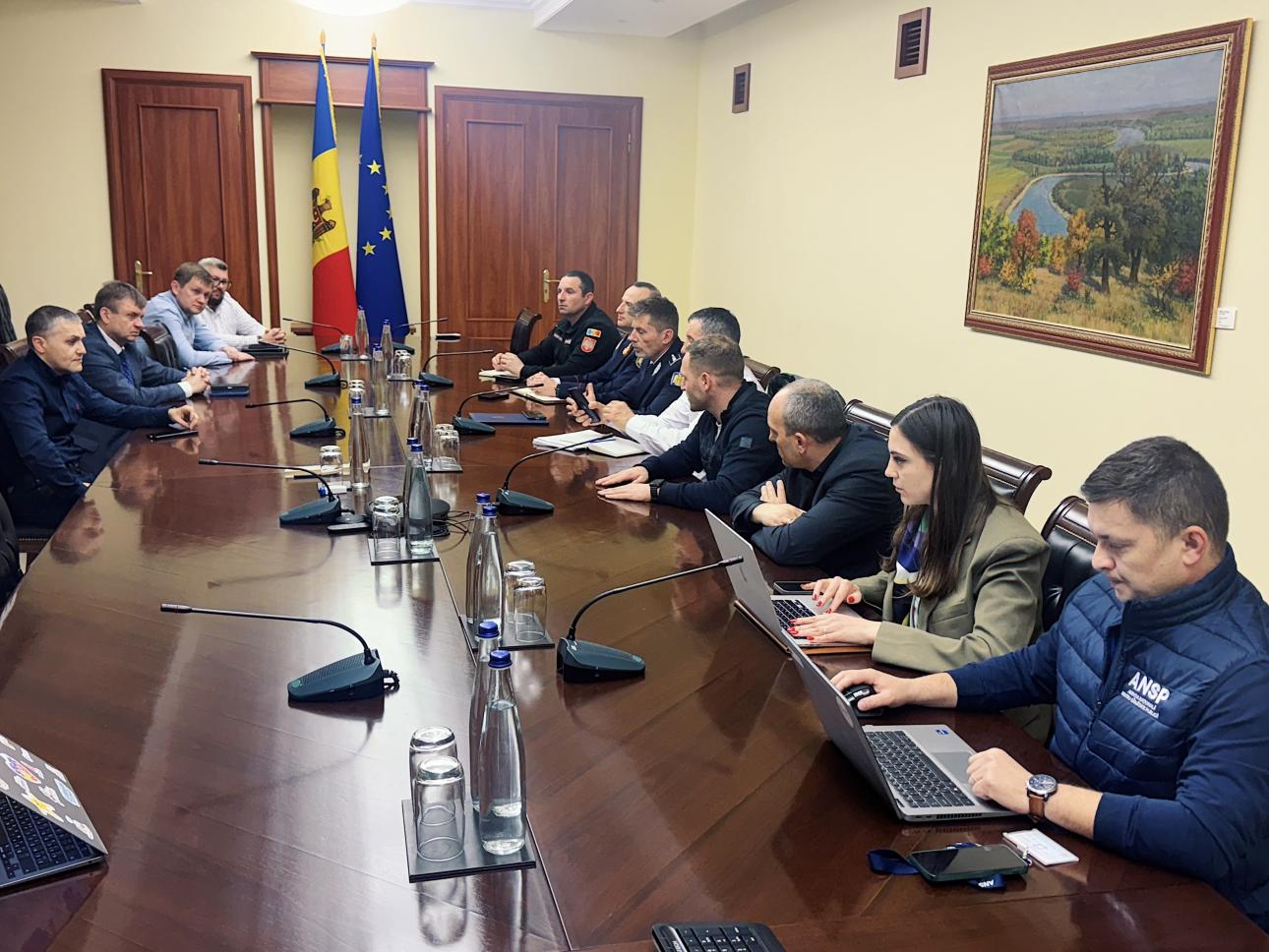
Following information received from Ukraine, at an instruction by Prime Minister Alexandru Munteanu, an emergency meeting was convened on the platform of the National Crisis Management Center (CNMC), with the participation of all competent institutions.

According to data presented at the meeting, the rising water level, caused by precipitation and controlled discharges from storage reservoirs, may carry downstream previously accumulated oil residues from shoreline and reed areas on the Ukrainian side.

“The Ukrainian authorities have already initiated interventions on their segment, while institutions of Moldova are operating in a state of maximum mobilization for the next 24–72 hours. At this stage, the authorities confirm that the film of oil products has not passed beyond the installed barriers, and in the Otaci area there is currently no evidence of pollution patches. The situation remains under constant monitoring,” the CNMC said.

In the context, the authorities have ordered additional field teams to be deployed and continuous monitoring of the situation, including the use of drones in the border area.

“Samples will also be taken twice a day, including downstream of the barriers, to assess the effectiveness of the interventions and any possible leaks. A new set of analyses will be carried out tomorrow morning in Naslavcea and Cosauti, in order to confirm the evolution of water quality indicators. At this stage, there are no grounds for declaring a state of alert or imposing restrictions on water use; however, the situation is being continuously monitored, and any decision will be taken based on laboratory tests’ results. The authorities stay on high alert and are acting quickly on the ground,” the CNMC specified.

Moldova also continues to benefit from support provided by the EU through the EU Civil Protection Mechanism and bilateral agreements. In this regard, a new batch of assistance from Slovakia was received today, which will help improve field intervention capacity.

The state of alert on the Dniester was introduced on March 16, 2026, for a period of 15 days, after the Dniester River had been affected by contamination with an oil substance following an attack on a hydropower plant in Ukraine by Russian forces on March 7. The pollutant was discharged into the watercourse and started moving into the territory of Moldova, which led to the suspension of water supply in more localities in the northern region.

Presently, 22 functional absorbent filters are installed on the Dniester River, and the intake stations are additionally protected with four absorbent filters each.
 Facebook
 Instagram
 X/Twitter
 Telegram
Adopted in final reading: From 1 June, day laborers to be registered electronically
VIDEO // CSP approved three interim appointments to leadership positions within Prosecutor’s Office
Prime Minister on World Day for Cultural Diversity: Only through unity, dialogue and mutual understanding can we build European, modern and united Moldova
DOC // Condominiums to face new administration and voting rules
Orthodox Christians celebrate Ascension of the Lord
Two bomb alerts in single night at Chișinău Airport
Tourism integrated into state’s economic policies in Moldova; sector moves to Economic Development and Digitalization Ministry
Yellow Code for atmospheric instability: rain, thunderstorms, hail, strong winds forecast nationwide in Moldova
Education week launched in Moldova; Parliament speaker says Moldova’s future depends on quality education
Nicolae Testemitanu State University of Medicine and Pharmacy of Moldova to host international endourology conference
CNA and Anticorruption Prosecutor’s Office to have new powers
Children with disabilities to receive annual support of 3,000 Lei
Moldovan citizens who worked in Slovakia to be eligible for social benefits
President’s visit to Kingdom of the Netherlands
PHOTO // Moldovan PM visits areas hit by torrential rains
VIDEO // Moldovan authorities step up operations amid torrential rains: over three thousand emergencies registered by 112 Service
Moldovan president calls for continuous efforts to address aftermath of heavy rains: authorities to assess damage, provide support where needed
European Night of Museums marked in Moldova: all museum institutions open doors with free entrance
Superior Council of Prosecutors comments on procedure of external evaluation of Moldova's Prosecutor General: decision adopted based on verified materials
Azerbaijan, Moldova deepen partnership: messages of cooperation, mutual trust conveyed at reception in Chisinau
Rail traffic resumes after torrential rains in Moldova; trains continue moving to Chisinau
 National Bank of Moldova
Moldovan PM visits settlements hit by heavy rains, flash floods from central district
Moldovan president has phone conversations with European leaders, to advance EU accession negotiations
Voluntary amalgamation of mayoralties in Moldova: 608 decisions approved by local councils
Moldovan deputy PM for reintegration has dialogue with permanent representatives at OSCE
President participated in GLOBSEC Forum in Prague

Energy Ministry announces emergency disconnections of 400 kV power lines; consumers stay supplied with electricity in Moldova
PHOTO // New opportunities for agricultural cooperation in Italy; Moldovan agriculture minister visits Agri-Food Center in Rome, company in region
Ambassador of Moldova to Norway presents letters of credence to His Majesty King Harald V
Three prosecutors fail external evaluation in Moldova; reports sent to Superior Council of Prosecutors
PHOTO // Moldovan energy minister participates in Istanbul Natural Resources Summit
PHOTO // Moldovan foreign affairs minister meets group of Chinese students learning Romanian
VIDEO // Emotional moment in Beijing: Chinese students recite in Romanian poems in front of Moldovan foreign affairs minister
Moldovan PM says Satoshi at Eurovision managed to convey to Europe an honest image of Moldova
New Q fever cases detected in Chisinau, three districts of Moldova; health authorities step up surveillance
Attention, travelers! Enhanced traffic at Palanca border crossing point of Moldova
Moldovan president has phone conversations with European leaders, to advance EU accession negotiations
Moldova, China boost dialogue between business communities; two sides' officials discuss economic partnerships in Beijing
European Parliament President calls for speeding up accession of Moldova, Ukraine to EU
Four historical monuments on both banks of Dniester River to be restored with EU's support
Voluntary amalgamation of mayoralties in Moldova: 608 decisions approved by local councils
ARMENPRESS: Armenian police set up cyber lab with U.S. support to fight cybercrime
Receive the latest news directly to your email

Receive the latest news directly to your email