
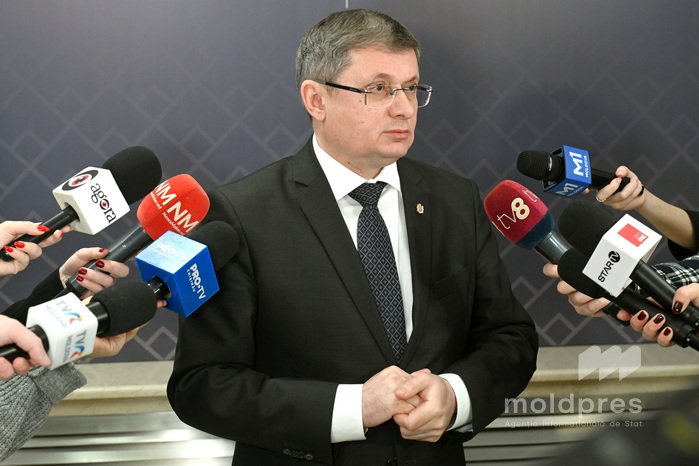
Speaker about protests in Transnistrian region: Reintegration process irreversible
Protests in the Transnistrian region, organized amid dissatisfaction with Chișinău’s new fiscal measures, do not change the direction of the reintegration process, Speaker Igor Grosu says. According to him, the demonstrations should also be viewed in the context of political events in the Russian Federation. The statement was made before the Parliament’s plenary session.


“I sincerely link the series of protests in Transnistria to the context of the so-called elections in the Russian Federation, which begin tomorrow,” Igor Grosu said.


He also commented on the reaction of the so-called authorities in Tiraspol to the fiscal measures introduced by Chișinău. Grosu believes they are trying to demonstrate that they are active and that they are responding to the decisions of the constitutional authorities.


“They probably need to show a bit of bravado, to be active, to show that they are not indifferent, and so on,” the Parliament Speaker said.


The statements come after several protests organized in Bender, where participants spoke out against changing the tax regime for businesses in the Transnistrian region. The demonstrations took place over several consecutive days.

Starting September 1, 2026, VAT and excise duties will apply to a range of products brought in from the Transnistrian region. The first stage covers, among other things, tobacco, alcohol, caviar, furs, and precious metals.

The measures will be gradually expanded. Starting January 1, 2027, petroleum products, base metals, ores, and other categories of goods will be included. From April 1, 2027, the list will also include natural gas and electricity, with the exceptions established by the authorities.

Despite the protests, Igor Grosu says that the measures adopted by Chișinău do not affect the direction of the reintegration process.


“Otherwise, the reintegration process is moving forward, it is irreversible, and the decisions were correct,” the official said.


The gradual application of VAT and excise duties is part of the policy to harmonize the tax regime for businesses on both banks of the Dniester. The authorities in Chișinău say the measures are aimed at eliminating certain tax exemptions and bringing the region closer to the economic and legal framework of the Republic of Moldova.
 Facebook
 Instagram
 X/Twitter
 Telegram
Chisinau maintains position on withdrawal of Russian troops and demilitarization of Transnistrian region
5+2 format no longer works
PHOTO // Moldovan PM commemorates victims of September 11, 2001 terrorist attacks in Chisinau
European Commissioner reconfirms EU support for advancing reforms in European integration process
European Commissioner holds talks with Prime Minister
MOLDPRES INTERVIEW // Moldovan deputy PM for reintegration: “Reintegration cannot happen through a single decision. Citizens must feel that moving closer to the right bank brings them benefits”
Moldovan President, European Commissioner for Equality approach progress in implementing reforms
European Commissioner on first visit to Chișinău: Moldova - important partner in strengthening Europe’s resilience
Adrian Băluțel appointed co-chair of Moldova–EU Parliamentary Association Committee
How future Constitutional Court judges will be selected. Parliament changes rules
Speaker: Elections in Gagauzia must be fair
Moldovan lawmakers held minute of silence in memory of victims of 11 September 2001 attacks
Moldovan Speaker to visit Budapest to persuade Hungarian authorities to support opening of EU negotiation clusters
Speaker on Local Public Administration Reform: Moldova’s new administrative map to have fewer than 10 regions
DOC // New rules for recognition of professional qualifications obtained abroad
Joseph Mark Burkhalter sworn in as U.S. Ambassador to Moldova
Speaker about protests in Transnistrian region: Reintegration process irreversible
Palanca border crossing point temporarily suspended due to communication network failure
 National Bank of Moldova
New edition of program „Sub cușma lui Guguță” launched at Parliament
Reforming recruitment in civil service: from legal framework to implementation
Summary of Moldovan parliament's plenary meeting held on September 17, 2026
Roman Rosca takes over as chair of special parliamentary commission for monitoring and oversight of Moldova’s reintegration policy
Working of small farms in built-up areas of localities to be regulated by law in Moldova

Summary of Moldovan parliament's plenary meeting held on September 17, 2026
Moldovan parliament speaker, after meetings in Budapest, says Hungary supports Moldova in its efforts
Roman Rosca takes over as chair of special parliamentary commission for monitoring and oversight of Moldova’s reintegration policy
Working of small farms in built-up areas of localities to be regulated by law in Moldova
Moldova accedes to convention in marine environmental protection sector
Moldovan parliament speaker explains need to create Moldova Project: “We must concentrate expertise in a single entity”
Moldovan deputy PM for reintegration has meeting with Sweden’s Ambassador
Moldovan PM meets Director of European Bank for Reconstruction and Development for Ukraine and Moldova
Voted in first reading: Railway of Moldova state enterprise to be reorganized by late 2026
Mircea Esanu leaves Public Services Agency to lead Moldova Project
Clear requirements for classification, labelling of chemical products in Moldova
Regulatory framework for extractive waste management harmonized with EU standards in Moldova
Moldovan parliament denounces agreement with Commonwealth of Independent States on interlibrary lending
Moldovan government creates single structure for implementing strategic infrastructure projects
Defence Staff institutionalized by law in Moldova
Moldovan parliament adopts measures to prevent phone scams, electronic communications fraud
Receive the latest news directly to your email

Receive the latest news directly to your email