
Moldova to include analysis of gender gaps in access to agricultural resources in report to United Nations for the first time
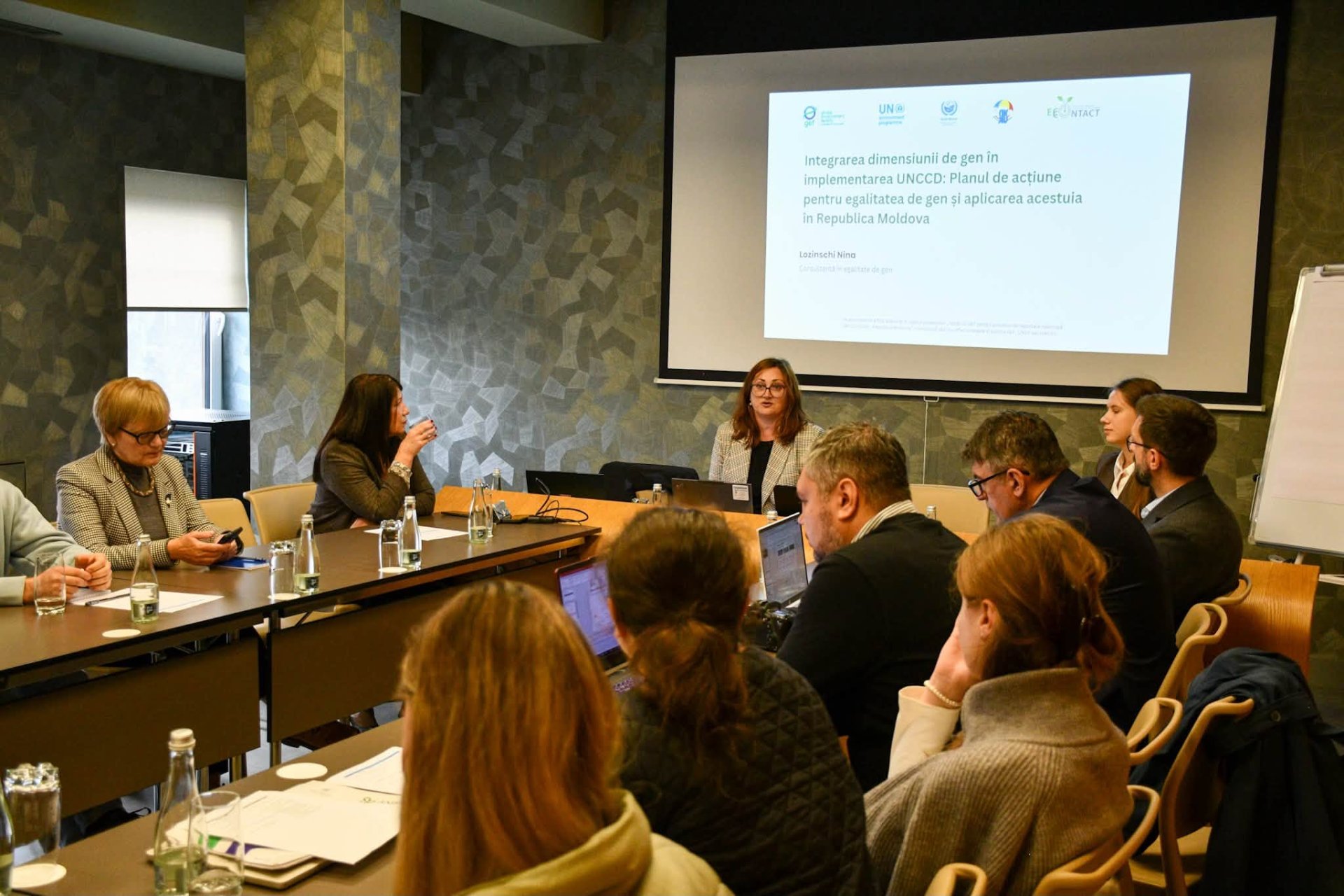
Differences between women and men in access to land, water, financing and drought adaptation measures will be analyzed in the National Report of the Republic of Moldova to the United Nations Convention to Combat Desertification (UNCCD) for the first time. The gender analysis, prepared as part of the reporting process, today was presented and discussed in Chisinau, during a workshop organized by the EcoContact NGO, in partnership with the Authority for Meteorology and Environmental Monitoring (AMM).

The assessment shows that small and fragmented agricultural holdings, limited access to irrigation, machinery and financial support reduce the ability of women farmers to prevent soil degradation and cope with drought. These difficulties are compounded by household responsibilities, which may limit the time available to them for training and economic activities.

According to an analysis presented by Eugenia Ganea, a consultant on gender equality and social inclusion, water shortages may increase the time needed to secure supplies, care for livestock and provide food for the family, affecting women’s ability to participate in professional and economic development activities.

Including this data in the national report will complement information on the condition of land and help identify those who need support, as well as the obstacles preventing them from applying sustainable agricultural practices, such as soil cover, crop rotation and efficient water use.

During the workshop, Nina Lozinschi, a gender equality consultant, presented the UNCCD Gender Action Plan and ways to implement it in Moldova.

Among the recommendations discussed, there were adapting eligibility and co-financing criteria to the circumstances of small farms, providing support in preparing funding applications and organizing training sessions in local communities at times that take agricultural activities and care responsibilities into account.

In addition, institutions providing agricultural support are encouraged to collect and analyze data on the number of women and men who apply for and receive assistance, the amount of funding provided and the types of benefits granted. This information would make it possible to assess how support is distributed and adjust programmes, when certain categories of farmers are unable to access the available resources.

For local authorities, the recommendations focus on consulting women and men who use land, including women farmers and smallholder households, as well as ensuring women’s representation on land committees, in cooperatives and in water-user associations. The proposals made during consultations and the way they are reflected in the measures adopted should also be documented.

The workshop also included a session on the use of satellite data in the reporting process, presented by Tudor Castravet, Vice-Rector for Research at the Ion Creanga State Pedagogical University, and Vitalie Mardari, a representative of AMM. Aliona Isac, Deputy UNCCD Focal Point, presented the project’s progress, while Mihail Ojog, a representative of Food and Agriculture Organization (FAO) Moldova, addressed the conclusions regarding LDN TSP2 and the next steps.

The event was organized within the project, GEF Support for the 2026 UNCCD National Reporting Process – Moldova, implemented by the EcoContact NGO with financial support from the Global Environment Facility (GEF), through the United Nations Environment Programme (UNEP), in support of AMM in its capacity as the UNCCD National Focal Point.
 Facebook
 Instagram
 X/Twitter
 Telegram
PHOTO // Old Chisinau: lesser-known stories, traditions of Moldova's capital
Moldovan parliament speaker calls for strengthening local administrations
PM, on capital's City Day, says almost five billion lei allocated to Chisinau in 2026
Moldovan president conveys message on Chisinau’s City Day
PHOTO // General Carabineer Inspectorate provided with 16 vehicles and modern equipment with EU support
STISC warns of spear-phishing campaign targeting Government institutions
PHOTO // First monument commemorating Roma victims of Holocaust to be erected in Cosăuți, Soroca
Seven hospitals to receive new equipment for storing blood products
One in four pupils involved in bullying or physical aggression situations; Moldovan authorities develop action plan to prevent, manage violence cases in schools
Moldovan parliament speaker says young people must study in modern conditions, be able to build future at home
Investments in training specialists; PM says well-learned trades bring better salaries in Moldova
Eighty million euros invested in vocational schools of Moldova: 47 buildings to be renovated
Government launches Moldova Prepared Program to train citizens to cope with crisis situations
Director of Center for Contemporary Art dies in accident in Vaslui county
Moldovan PM visits Chisinau Electrical Substation, in final preparation stage
Moldovan Foreign Affairs Ministry condemns repeated violation of national airspace
Moldovan PM, Ambassador of State of Qatar discuss investments, expanding bilateral economic cooperation
UPDATE // Unmanned aircraft crashes, explodes in field in northern district of Moldova
PHOTO // Third contingent of Moldova's National Army deployed to peacekeeping operation in Bosnia & Herzegovina
PHOTO // Students participating in Moldova Model United Nations project visit Foreign Affairs Ministry
VIDEO // Moldova explores opportunities to import liquefied natural gas from United States
 National Bank of Moldova
Moldovan PM visits Chisinau Electrical Substation, in final preparation stage
Moldovan PM, Ambassador of State of Qatar discuss investments, expanding bilateral economic cooperation
Moldovan parliament speaker in Rome has meetings with counterparts from Norway, Lithuania, Armenia
Moldovan parliament's secretary general participates in meeting of secretaries general of parliaments of Council of Europe member states
Speaker held talks with counterparts from Italy, France and Türkiye

PHOTO // Students participating in Moldova Model United Nations project visit Foreign Affairs Ministry
VIDEO // Moldova explores opportunities to import liquefied natural gas from United States
Moldovan government denies “manipulations” regarding plans to establish drone factory in Chisinau
PHOTO // Railway of Moldova enterprise tests new Chisinau–Revaca–Sangera railway route
Moldovan parliament speaker in Rome has meetings with counterparts from Norway, Lithuania, Armenia
Moldova, Armenia to strengthen parliamentary cooperation
Air Operations Center of National Army: number of airspace violations reaches 100 in Moldova
VIDEO // Shepherds' family of Moldova sets national record with 30.7-kilogram cheese
Moldovan parliament's secretary general participates in meeting of secretaries general of parliaments of Council of Europe member states
PHOTO GALLERY // 30.7-kilogram cheese set national record at Moldexpo
PHOTO // Moldovan Radu Budan finishes second in 5,000-kilometer ultramarathon in New York
Moldovan, Lithuanian Speakers discuss support for country's European integration
Government launches in-depth assessment of Yandex Go’s activities in Moldova
Speaker welcomed Norway’s decision to turn mission in Chișinău into full-fledged embassy
DOC // Official Journal publishes decision on modernization of 25 technical vocational education institutions
Gagauzia enters electoral campaign for 15 November elections
Receive the latest news directly to your email

Receive the latest news directly to your email