
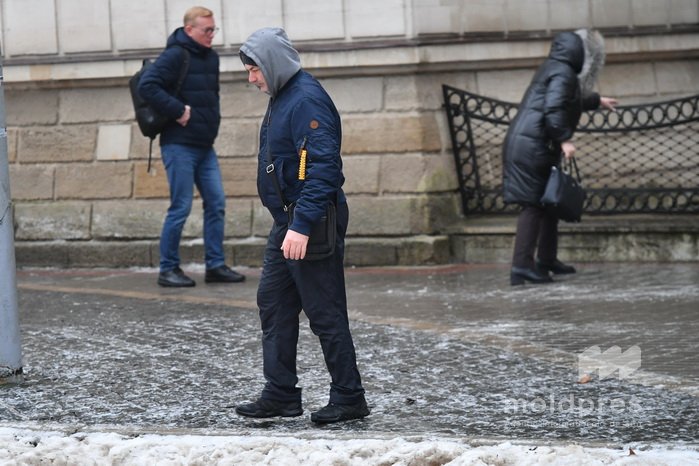
National-level intervention measures amid bad weather conditions: National Crisis Management Center convenes operational meeting
The National Crisis Management Center (NCMC) convened an operational coordination meeting this morning, in the context of bad weather conditions recorded across the territory of the Republic of Moldova. Following an assessment of the operational situation and the information presented by the responsible institutions, several intervention measures were ordered at national level.

The Prime Minister of the Republic of Moldova also took part in the meeting, alongside the leadership of the institutions with responsibilities in crisis management.

Among the measures to be undertaken are:

- The relevant institutions (the Ministry of Infrastructure and Regional Development, the Ministry of Internal Affairs, and the Ministry of Energy) have activated crisis protocols and will intervene as a priority to ease road traffic, maintain circulation on national and regional roads, combat the ice formation, and restore electricity supply in the affected localities.

- The working day and school hours will start at 09:00 throughout this week, a measure adopted to reduce the risks associated with the movement of the population in difficult traffic conditions.

- The General Inspectorate for Emergency Situations and the National Army will provide support to local public authorities, upon request, on the most affected or dangerous segments, including to ensure access to critical infrastructure and to protect the population.

Current operational situation:

Across the entire territory of the Republic of Moldova, there is rain and fog, with temperatures ranging between -2°C and +3°C, conditions that have favored the ice formation on road surfaces. Traffic is difficult on several national routes, including M1, M2, M3, M5, R2, and R3. Continuous interventions are underway on all these sections, with approximately 135 pieces of machinery and 195 workers deployed. In the last 12 hours, around 1,460 tons of anti-skid material have been spread to keep roads passable and reduce risks for road users.

The General Inspectorate for Emergency Situations has intervened in several districts of the country to unblock vehicles, including ambulances, to support medical crews, and to respond to road accidents that occurred under icy conditions. At national level, additional forces and resources are on standby, ready to intervene at the request of local authorities.

Recommendations for citizens

In the context of bad weather conditions and temporary traffic restrictions, the National Crisis Management Center recommends that citizens:

- avoid non-essential travel, especially in the morning and on affected road sections;

- adjust driving speed to road conditions and follow the instructions of the Police and road authorities;

- ensure that vehicles are properly equipped for winter conditions;

- exercise increased caution when walking, especially on sidewalks, stairs, underpasses, and sloped areas;

- pay special attention to vulnerable persons (elderly, children) and provide assistance when needed;

- contribute, as far as possible, to clearing and removing snow and ice from the areas adjacent to businesses, apartment blocks, pedestrian access routes, and heavily used areas, to prevent accidents and facilitate mobility.

For emergencies, call 112 and follow the instructions of the authorities.
 Facebook
 Instagram
 X/Twitter
 Telegram
Higher pensions and social benefits: 6.84 percent indexation applied as of today
Over 1,800 hectares of forest to be planted in 15 districts along Dniester River, under World Bank–supported programme
Over 900,000 unique beneficiaries, representing 38% of population received reimbursed medicines through ePrescription system
Ben Gurion Airport in Tel Aviv remains closed until 16 April
Another Shahed-type drone detected while unauthorizedly flying over national airspace in Transnistrian segment
DOC // Official Journal publishes implementation mechanism for CEEPUS IV
Moldova’s airspace violated again: Shahed drone found in Dubăsari–Orhei area
Nicolae Testemitanu Medical University of Moldova launches new master’s programme, Health Promotion and Protection
Permanent teaching grades and less bureaucracy in schools
Prosecutor’s Office provides new details on investigation into death of Ludmila Vartic
Moldova, Romania to sign Agreement on extending coordinated control at Leuseni–Albita border crossing point
Unique trilingual work on medicinal plants, created in partnership with Nicolae Testemitanu Medical University of Moldova
Driving licenses issued in Moldova to be recognized in Ireland
Increased flow of passengers in Moldova on eve of Easter holidays; Customs Service head announces measures to streamline traffic
CNMC: Eenergy sector remains fragile, ending state of emergency requires caution
Foreign Ministry: We condemn violation of airspace. Such actions endanger citizens’ security
Support for export promotion: 16 business associations to receive 14.6 million lei through Bridge Export Program
Over 20 media projects to get funding from media subsidy fund
 National Bank of Moldova
President met with U.S. Senator
Proposals for improving efficiency of ministries discussed at roundtable
Prime Minister visited agricultural business in Unguri village, Ocnița district
Prime Minister visited rescuers and firefighters unit in Ocnița
Weekly meeting of Joint Control Commission of 2 April 2026

Simple motion on public policies implemented by Ministry of Labour and Social Protection failed
Proposals for improving efficiency of ministries discussed at roundtable
PHOTO GALLERY // Premiere at Mihai Eminescu National Theater: “Intrigue and Love,” directed by Alexandru Cozub
Moldova to sign social security agreements with Quebec (Canada), Albania, Croatia and Ireland
Around 622,000 vulnerable families receive energy compensation
Prime Minister visited agricultural business in Unguri village, Ocnița district
Minister of Labor and Social Protection: Deficit of state social insurance budget decreased to 3.6 billion lei in 2026
Prime Minister visited rescuers and firefighters unit in Ocnița
Eastern European plants used in Chinese medicine: book by Wang Yifeng launched in Chișinău
PHOTO GALLERY // About 160 companies gathered at Moldconstruct and Moldenergy exhibitions: innovation and cutting-edge technologies
Weekly meeting of Joint Control Commission of 2 April 2026
Energy and infrastructure – essential pillars in Ukraine’s reconstruction
Specialized international exhibitions Moldconstruct and Moldenergy open at Moldexpo
Deputy Prime Minister for Reintegration meets Ambassador of Romania to Moldova
Speaker about permanent withdrawal from CIS statutory bodies: Moldova has sovereign and independent right to decide which union to be part of
Moldovan government representatives to present to parliamentary factions actions taken during emergency state, proposals on future developments
Receive the latest news directly to your email

Receive the latest news directly to your email