
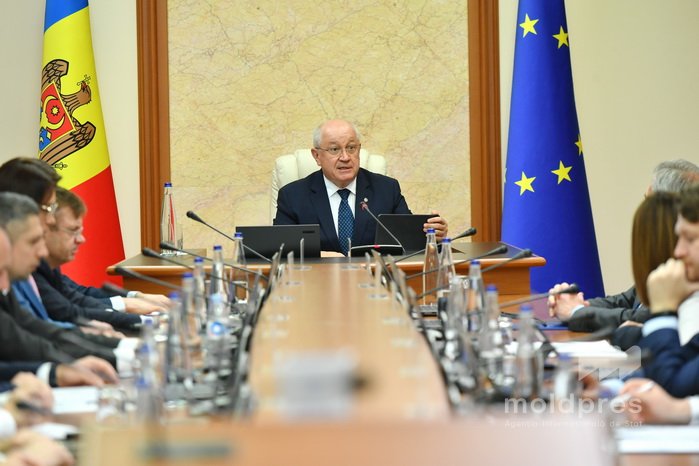
Mechanism of setting prices for fuels to be changed in Moldova during emergency state period
The mechanism of setting prices for fuels will be changed on period of the  emergency state. Thus, when establishing tariffs, the National Energy Regulatory Agency (ANRE) will take into account the average of international quotations for a period of seven days, instead of 14 days, as it is at present. This provision is included in a draft approved at today's extraordinary government meeting, which established new measures for the period of the state of emergency.

At the cabinet meeting, Director of the National Crisis Management Center Serghei Diaconu said that the changes would be applied only for the duration of the state of emergency. According to him, the measure is necessary, in order to provide greater stability for prices at the pump.

“During the emergency state, ANRE will use a calculation methodology based on an average not of 14 days, but of 7 days for international quotations and the exchange rate, which will provide greater stability for prices at the pump. At the same time, this will mean that, when prices on the international exchange start to fall, we will return more quickly to normal prices for citizens,” Serghei Diaconu noted.

At the same time, the approved decision will allow filling stations to sell other types of diesel at the standard diesel price, if the latter is temporarily unavailable at the pump.

“In order not to leave citizens without fuel, we allow filling stations to sell other types of diesel at the standard diesel price, if the latter is temporarily unavailable at the pump. If the station shows that there is no standard-type diesel and tries to sell more expensive diesel, it will have to sell it at the standard diesel price,” said Serghei Diaconu.

At the same time, ANRE will require oil products’ importers to present a realistic five-day procurement plan and will request that economic agents do not import less for April than they imported for March. “This is important, in order to be able to replenish our fuel stocks,” Diaconu noted.

Additionally, the authorities have ruled to allow the use of Lukoil’s existing sources to replenish fuel stocks, especially for diesel.

“For the moment, some of the stations of the Lukoil company, which has the most stations in the country, are closed. We want citizens to have access to the pump where it is most convenient, and for this reason, exclusively for the purchase of oil products on the local market and their sale in the national network of stations, we allow the use of Lukoil’s existing sources only to replenish fuel stocks, especially diesel, at all the stations it owns,” said the CNMC director.

Likewise, a proposed amendment aims to ensure that the service procedures for personnel in the public order and state security sectors are not affected by the state of emergency in the energy sector.

“Normally, in the event of a state of emergency, this personnel is not allowed to submit resignation reports or retirement requests. We do not want to restrict this right, it is not the type of security segment that would require their permanent presence,” said Serghei Diaconu.

The CNMC director said that the measures were proposed, in order to respond in real time to operational challenges, prevent possible bottlenecks and ensure the uninterrupted work of the energy market.

“In a context of dynamic crisis, the initial measures need continuous additions, in order to respond in real time to operational challenges, prevent possible bottlenecks and ensure the uninterrupted work of the energy market, while at the same time offering predictability and confidence both to suppliers and real consumers. (...) The proposed measures do not reflect a worsening of the situation but, on the contrary, represent a responsible and controlled adaptation of state intervention, as we gain a clearer picture of developments and on-the-ground needs. We are de-bureaucratizing processes, acting preventively, in stages and proportionally, in order to maintain the functionality of vital services for citizens and to avoid major risks, including uncontrolled disconnections,” argued the CNMC director.

The parliament of Moldova has established a nationwide state of emergency for a period of 60 days, starting from March 25, 2026, after the main power line supplying Moldova – the Vulcanesti–Isaccea line – had been disconnected following Russia’s attacks on Ukraine’s civilian energy infrastructure.
 Facebook
 Instagram
 X/Twitter
 Telegram
VIDEO // Energy Minister: Moldova supplied with energy through alternative routes, while Isaccea–Vulcănești line remains disconnected
Grants of up to 50,000 euros for farmers: application deadline extended until April 6, 2026
Moldova makes significant progress in aligning transport sector with EU standards, director of Transport Community Permanent Secretariat says
Faults on Isaccea–Vulcănești Line under repair after attacks in Ukraine
Isaccea–Vulcănești Power Line remains disconnected: Authorities activate alternative supply routes, including four 110 kV interconnection lines between Romania and Moldova
Isaccea–Vulcănești Power Line disconnected following attacks on energy infrastructure in Southern Ukraine
Moldovan president warns about impact of rising prices for energy resource
EU Growth Plan for Moldova: €1.9 billion to modernize local communities and raise citizens’ living standards
Deputy Prime Minister calls for full mobilization to maintain national road network
Over 4,000 tons of gasoline and diesel imported into Moldova in recent days
Casa Verde funding call closed
More transparency on shelf: Moldovan parliament adopts law on short agri‑food supply chains
New step in development of digital payments: Open Banking standard entered into force
Over 3,000 tons of gasoline and diesel imported in Moldova on Thursday
Disinformation about reservists' training: Moldovan Defense Ministry provides clarifications
Moldovan environment minister confirms Dniester River's pollution source stopped, authorities ready to intercept potential upstream leaks
VIDEO // Moldovan deputy PM says more than half of regular passenger routes not being operated at present
Equal taxes on both banks of Dniester: Moldovan parliament passes first measures
Mechanism of setting prices for fuels to be changed in Moldova during emergency state period
PHOTO // Agreement signed in Bratislava: Moldovan citizens who worked officially in Slovakia to be able to receive pensions, other social benefits
Moldovan government holds extraordinary meeting to introduce new measures on emergency state period
 National Bank of Moldova
Weekly meeting of Joint Control Commission held in Bender today
President Maia Sandu’s speech at joint press conference with President of the Slovak Republic Peter Pellegrini
Moldovan deputy PM for reintegration has meeting with high official of United Kingdom
Veterinary, phytosanitary experts from both banks of Dniester hold working meeting
Government approved set of measures to protect energy system and reduce consumption during state of emergency

Energocom company says electricity demand fully covered in Moldova for March 26
Slovakian president says Moldova proved it is ready to accelerate process of accession to European Union
President Maia Sandu’s speech at joint press conference with President of the Slovak Republic Peter Pellegrini
Romania’s support for Moldova highlighted in Parliament
Giurgiulești Free Port becomes strategic objective and receives new facilities for investors
Parliament of the Republic of Moldova joins Earth Hour
Applause in Parliament for Nicolae Botgros as he leaves office
Over 2,200 tons of fuel imported in Moldova on Wednesday
PHOTO, VIDEO // President welcomed in Bratislava by Slovak counterpart
PHOTO // Minister of Finance spotted riding a scooter to work
Record tax revenue to state budget in a single day
Vignette payment now available online via EVO government platform
DOC // Published in Official Journal: Higher pensions for seniors from 1 April 2026
DOC // Paliament’s statement condemning Russia for polluting Dniester river published in Official Journal
Moldova to terminate another 60 CIS agreements
Deputy Prime Minister: Moldova to seek compensation from Russia for attack on Isaccea–Vulcănești line
Receive the latest news directly to your email

Receive the latest news directly to your email