
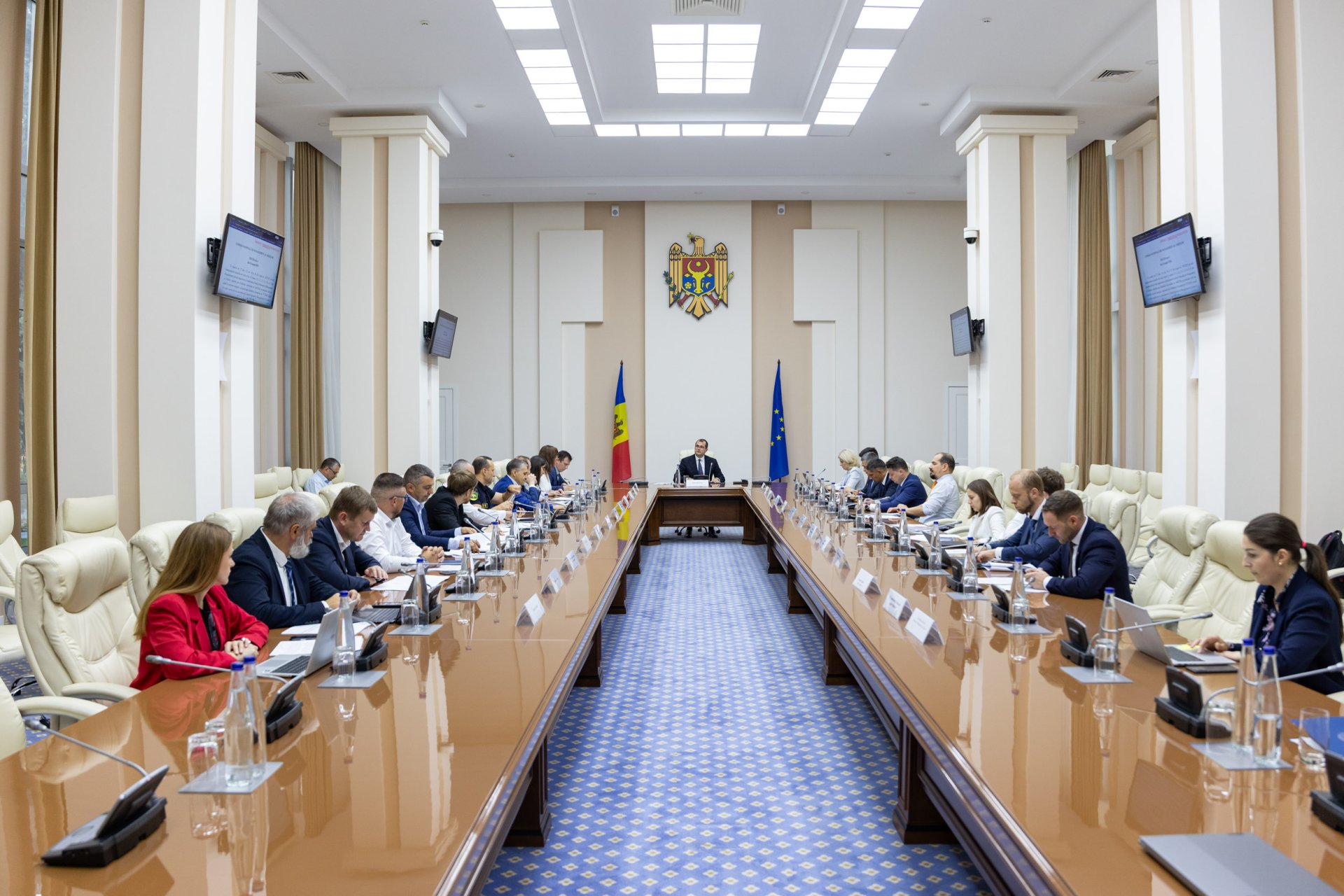
State of alert in energy sector, hydrological domain extended by 30 days in Moldova
The government has extended the state of alert in the energy sector and in the hydrological domain by 30 days. The measure is necessary, in order to continue managing risks in the energy sector and the effects of the hydrological drought. Although at present, the supply of electricity and water is taking place without interruptions, regional developments and the persistence of low river flows require maintaining preventive measures to reduce the risk of supply disruptions for the population and essential services.

During August 3-25, the electricity demand on the right bank of the Dniester River was fully covered on a commercial basis. However, Moldova continues to depend to a significant extent on imports from Romania and Ukraine, and reduced availability of certain generation capacities in the region may limit the energy available on the market and generate price pressures, especially during peak consumption hours.

To strengthen domestic generation and storage capacity, the National Crisis Management Commission has approved measures to accelerate projects that can add new capacities to the system. Thus, requests for prior approval of investments for electricity generation and storage projects will be examined as a priority.

At the same time, for the duration of the state of alert, wind and photovoltaic power plants that include storage facilities on the same site and are to be commissioned before the expiry of the state of alert will be exempted from the authorization procedure, with notification of the Authorization Commission.

For wind, photovoltaic and storage projects whose grid connection permits expired in July or will expire during the state of alert, system operators will be able, upon request, to resume the procedure for extending these permits, including in cases where certain procedural deadlines have been exceeded.

For generation and storage capacities already under construction, grid connection permits may be extended, under conditions set by the Commission, for a maximum of three months. Applications will be examined within five days, and no further extension will be possible. The applicant must submit a written commitment to energize the plant within the granted period.

Another measure targets faster development of storage capacities. For applications submitted up to September 15, 2026, system operators will be able to issue grid connection permits under flexible conditions for storage facilities with a total cumulative capacity of up to 200 MW. The mechanism applies to installations with a power of at least 1 MW and a storage capacity greater than 2 MWh, and the permits will be valid for a maximum of six months, with no possibility of extension. For these installations, withdrawing electricity from the grid for charging will not be allowed between 06:00–09:00 and 18:00–23:00.

In parallel, measures to reduce electricity consumption will continue. Local public authorities will ensure, within technical possibilities, at least a 50-per cent cut in electricity consumption for public lighting.

As for the hydrological situation, drought continues to affect the Dniester basin, the Prut basin and several small rivers. On August 18-25, the level of the Dniester reservoir dropped by 31 cm, and on some small rivers the flow represents 10 per cent or less of the average values typical for August.

At the same time, monitored water intake and supply systems are operating without reported interruptions. The measures maintained for the duration of the state of alert aim to ensure continuity of water supply, if the hydrological deficit persists.

Water supply service operators will monitor on a daily basis the volumes of water abstracted and distributed, identify and repair network losses and maintain the reserves necessary for system operation. Local authorities will inventory wells, deep boreholes and other alternative sources that could be used, if needed.

In localities where there is a risk to the continuity of water supply, continuity plans and alternative supply solutions will be prepared. At the same time, drinking water may not be used for irrigation, and the use of water for irrigation will be managed according to resources’ availability.

The National Crisis Management Center will continue to monitor the developments and the implementation of the approved measures.
 Facebook
 Instagram
 X/Twitter
 Telegram
Working visit by Government State Secretary for Reintegration to educational institutions in Coșnița
Economic working groups held new meeting
World Bank to continue to support modernization of Moldova
Speaker spoke with Turkish Parliament member about development of Gagauzia and strengthening partnership with Turkey
Moldova and Turkey to strengthen economic and investment partnership
Prime Minister held talks with Latvian counterpart
Wage Law: Government announces one-off compensation payments from October and public sector salary increases starting 1 January 2027
President received bipartisan delegation of U.S. House Appropriations Committee
President meets with Turkish MP, Vice President of ruling AK Party
Government approves Implementation Program for Education 2030 Development Strategy
Moldovan driving licences to be recognized in Latvia
Famine caused by Soviet totalitarian regime in 1946–1947 is to be officially recognized as crime against humanity
Clearer rules for storing petroleum products intended for emergency situations
Government increases budget for supporting investments in manufacturing industry to 4 billion lei
Eugeniu Buzatu wins competition for position of general director of Moldova's Energocom company
VIDEO // Moldovan parliament speaker: ''Independence belongs to everyone. Let us enjoy it and protect it”
Signer of Moldova's Declaration of Independence says spirit of national unity, dignity has never fallen
VIDEO // President at solemn Parliament session: Our independence is being tested and must be protected every day
State of alert in energy sector, hydrological domain extended by 30 days in Moldova
Government backs licensing of grain and oilseed imports by 31 October 2026
VIDEO // Prime Minister invited citizens to attend events on Independence Day
 National Bank of Moldova
Fifty nine young people of Moldova complete paid internship programme in public service
Government backs licensing of grain and oilseed imports by 31 October 2026
Government to support social inclusion of people with disabilities under National Program 2026–2030
29 new regional development projects included in 2025-2027 Single Programming Document
Government gradually standardizing tax regime applied to goods imported by economic operators from Transnistrian region

State of alert in energy and hydrological sectors to be extended
PHOTO // NBM puts into circulation two coins dedicated to 35 years of independence
29 new regional development projects included in 2025-2027 Single Programming Document
UPDATE // Heavy traffic in Sculeni eased
Government gradually standardizing tax regime applied to goods imported by economic operators from Transnistrian region
Energy Ministry to have new deputy secretary general
Designated Ministers of Economy and Agriculture to be sworn in on Friday
Restricted access to Eugen Doga International Airport on August 27-31
Ministry of Culture launches call for offers to translate national book abroad
Over 22,000 students admitted to universities in Moldova: up by 5.2 per cent compared to last year
Moldovan PM says appointment of Eugeniu Osmochescu to Agriculture to allow government to bring more economic logic to such an important field
Moldovan PM explains why he chose Claudiu Nasui for economy portfolio: “We need brave people, who do not shy away even from difficult problems”
Voted by parliament: Moldova to be able to automatically exchange police data with EU member states
Evaluation Commission challenges decision of Superior Council of Magistracy on judge at Supreme Court of Justice of Moldova
PHOTO // Environment Ministry of Moldova warns water reserves in Novodnistrovsk lake dropping alarmingly
ARMENPRESS: Armenia grants over 10,500 residence statuses to foreigners in first half of 2026
Receive the latest news directly to your email

Receive the latest news directly to your email