
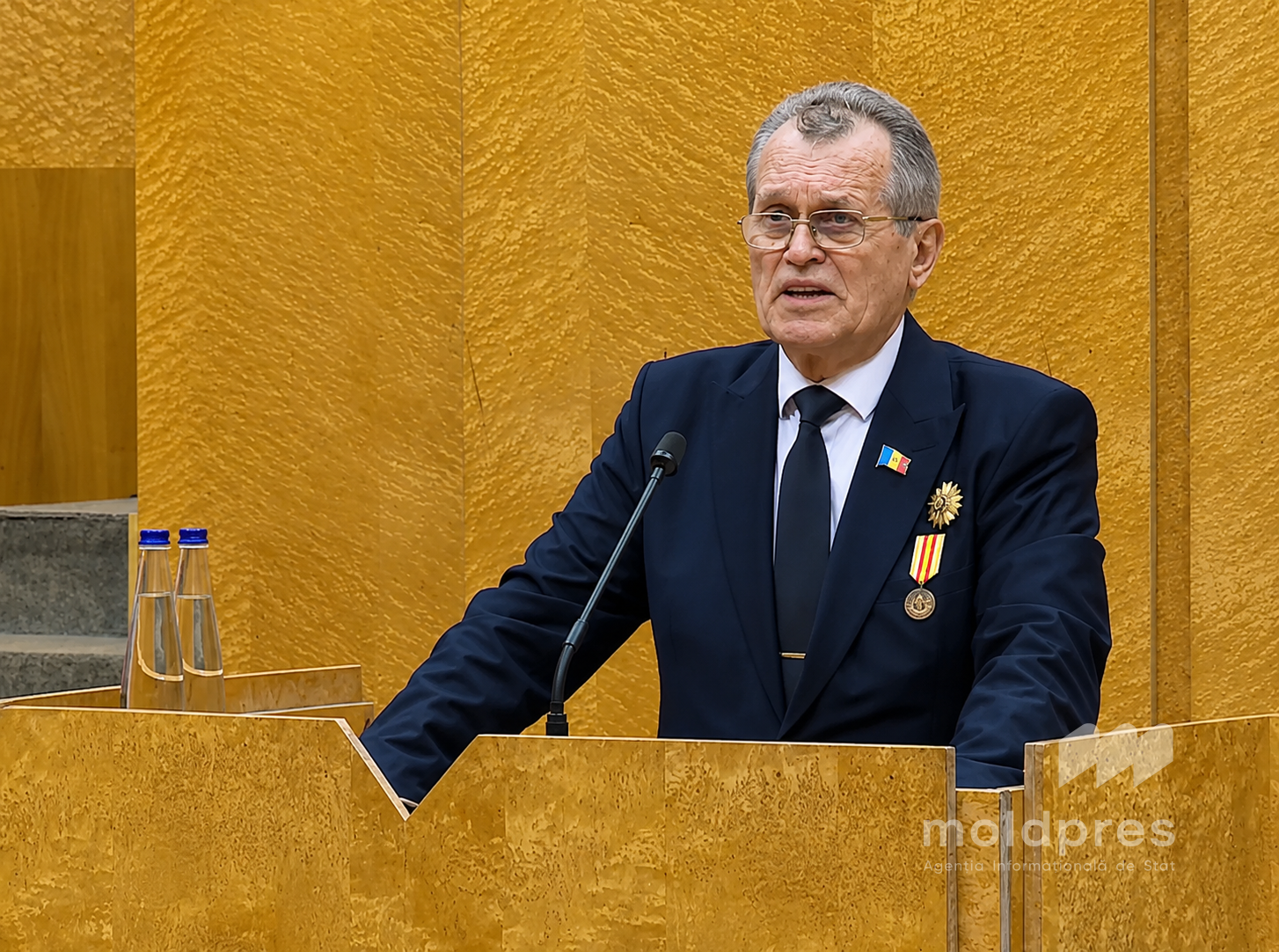
Signer of Moldova's Declaration of Independence says spirit of national unity, dignity has never fallen
An MP of first parliament and one of the signatories of the Declaration of Independence Alexandru Arseni today evoked the moments that had preceded the proclamation of the independence of the Republic of Moldova and spoke about the legal and historical meaning of the act adopted on August 27, 1991. The speech was delivered at a solemn session at the Presidency, dedicated to the 35 years of independence of the Republic of Moldova.

Recalling the context that led to the creation of the sovereign state, Alexandru Arseni explained that, from the point of view of constitutional and international law, independence represents “liberation from the yoke of occupation and a return to the position held before the occupation.”

He referred directly to international resolutions that condemned the harmful consequences of the Ribbentrop-Molotov Pact.

“Accordingly, June 28, 1940 is the day when the knife was thrust into the natural body of the Romanian nation, just as it was thrust into the natural body of the Polish nation and so on, with all consequences of the war. Afterwards, on August 2,1940, through secession, that is, on foreign territory, the Soviet government in Moscow founded the Moldavian Soviet Socialist Republic and established the institutions of the state, through which deportations, famine and all the disaster began,” Alexandru Arseni stressed from the rostrum.

The professor emphasized that the spirit of national unity could never be extinguished by the totalitarian regime.

“However, what cannot be stopped — because it is not in human nature — is that the spirit of national unity and of dignity has never fallen. Movements against the occupiers continued,” noted the signatory of the Declaration of Independence.

Evoking the effervescence of the 1990s, Arseni recalled the fundamental role played by the deputies of the first parliament, intellectuals, as well as the cultural symbols of the era, such as the ‘doina’ and the songs performed by Ion and Doina Aldea-Teodorovici.

One moment mentioned in the speech was the firm response of the deputies’ corps to the attempted coup d’état during the Moscow putsch, at a time when powerful Soviet troops were stationed on the country’s territory, including the 14th Army in Tiraspol.

“Measures were taken, so that these forces would respect the will of the sovereign people. There was no conflict. An extraordinary session of Parliament was convened and, at the same time, the Great National Assembly was called. The government instructed local self-administration bodies to ensure plenipotentiary delegates. For three days, people came on foot to the Great National Assembly,” Arseni said.

He described the moment in great detail, recalling how Anatol Plugaru, the chair of the Commission for Ethics, Appointments and Immunities, called out the name of each elected representative of the people, the response being a determined ‘FOR’ for freedom, followed by the singing of the anthem “Awaken, Romanian!”.

At the end of his speech, Professor Alexandru Arseni drew a parallel between the letter and the spirit of the laws, stressing that the fundamental goal of the Declaration of Independence is the return to the historical and ethnic space of national evolution.

In a symbolic formulation, Arseni told the head of state that, in his opinion, the current context offers her the opportunity to contribute to achieving the ideal of reunification.

“Today, honorable Madam President, by virtue of your evolution, you hold the crown in your hand, which you have every right and blessing to place upon the act of the reunification of the Romanian nation in the Garden of Mother of God,” the former deputy concluded.

Alexandru Arseni was a deputy in the first parliament of Moldova, a signatory of the Declaration of Independence and chair of the Commission for Human Rights. He is a university professor and a specialist in constitutional law.
 Facebook
 Instagram
 X/Twitter
 Telegram
Moldovan parliament speaker conveys message on Independence Day of Ukraine
PHOTO // Moldovan parliament hosts exhibition dedicated to Ukraine’s sacred heritage destroyed by war
Prime Minister on Ukraine’s Independence Day: Moldova is and will remain reliable neighbor and steadfast partner of Ukraine
Parliament to convene in solemn session marking 35th anniversary of proclamation of independence
VIDEO // President visits Kyiv on Ukraine’s Independence Day: Moldova lives in peace thanks to courage of Ukrainian people
Parliament building illuminated in colors of Ukrainian flag on Ukraine’s Independence Day
Moldovan president condemns Russian attack on shopping center in Kryvyi Rih, Ukraine
DOC // SIS and AIM report debunks myths about real amount of ammunition in Cobasna
President condemns Russian attacks on Ukraine: Much greater pressure must be brought to bear on Russia to put end to these actions
Parliament convenes in extraordinary session: standing bureau approves agenda of meetings
Deputy Prime Minister meets with U.S. Congress delegation
Parliament convenes in extraordinary session. MPs to meet on 24 - 25 August
VIDEO // Moldova’s Ambassador to Kazakhstan presents letters of credence
Republic of Moldova at 35 Years of Independence
Eugeniu Buzatu wins competition for position of general director of Moldova's Energocom company
VIDEO // Moldovan parliament speaker: ''Independence belongs to everyone. Let us enjoy it and protect it”
Signer of Moldova's Declaration of Independence says spirit of national unity, dignity has never fallen
VIDEO // President at solemn Parliament session: Our independence is being tested and must be protected every day
State of alert in energy sector, hydrological domain extended by 30 days in Moldova
Government backs licensing of grain and oilseed imports by 31 October 2026
VIDEO // Prime Minister invited citizens to attend events on Independence Day
 National Bank of Moldova
Fifty nine young people of Moldova complete paid internship programme in public service
State of alert in energy sector, hydrological domain extended by 30 days in Moldova
Government backs licensing of grain and oilseed imports by 31 October 2026
Government to support social inclusion of people with disabilities under National Program 2026–2030
29 new regional development projects included in 2025-2027 Single Programming Document

State of alert in energy and hydrological sectors to be extended
PHOTO // NBM puts into circulation two coins dedicated to 35 years of independence
29 new regional development projects included in 2025-2027 Single Programming Document
UPDATE // Heavy traffic in Sculeni eased
Government gradually standardizing tax regime applied to goods imported by economic operators from Transnistrian region
Energy Ministry to have new deputy secretary general
Designated Ministers of Economy and Agriculture to be sworn in on Friday
Restricted access to Eugen Doga International Airport on August 27-31
Ministry of Culture launches call for offers to translate national book abroad
Over 22,000 students admitted to universities in Moldova: up by 5.2 per cent compared to last year
Moldovan PM says appointment of Eugeniu Osmochescu to Agriculture to allow government to bring more economic logic to such an important field
Moldovan PM explains why he chose Claudiu Nasui for economy portfolio: “We need brave people, who do not shy away even from difficult problems”
Voted by parliament: Moldova to be able to automatically exchange police data with EU member states
Evaluation Commission challenges decision of Superior Council of Magistracy on judge at Supreme Court of Justice of Moldova
PHOTO // Environment Ministry of Moldova warns water reserves in Novodnistrovsk lake dropping alarmingly
ARMENPRESS: Armenia grants over 10,500 residence statuses to foreigners in first half of 2026
Receive the latest news directly to your email

Receive the latest news directly to your email