
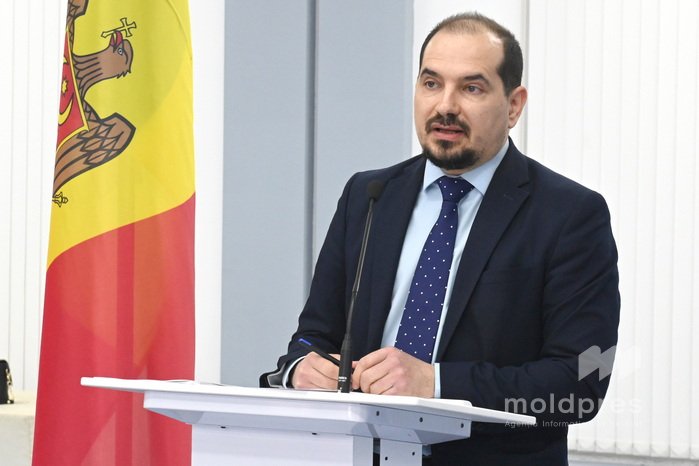
Concept of local public administration reform presented in Moldova's parliament
Secretary General of the Government Alexei Buzu today presented in parliament the draft law on local public administration’s (APL) reform. He said that the current system must be changed, as it is affected by excessive fragmentation, depopulation and limited institutional capacities.

The official noted that the draft was the result of extensive consultations held in recent months.

“In the last three months, we have spoken with more than 4,500 mayors, local elected officials and citizens, and following these discussions the government proposed this reform concept,” Buzu said.

He emphasized that, although there are “strong and dedicated” mayors in Moldova, many small mayoralties are unable to meet the needs of their communities.

“We have many small mayoralties caught in a vicious circle of depopulation, a narrow tax base and limited institutional capacity,” Buzu said.

The data presented at the plenary meeting indicate major imbalances.

“Forty per cent of the population lives in 776 mayoralties, while 42 per cent of citizens live in only 26 mayoralties. If there are inequalities in development, this is the spearhead,” the secretary general said.

According to him, in the last 10 years, the population of Moldova has decreased by about 389,000 people, but in localities with fewer than 3,000 inhabitants, the decline has been even more pronounced.

“In these mayoralties, the population has decreased by approximately half a million, that is, twice as much in percentage terms as the national average,” Buzu specified.

At the same time, the official drew attention to infrastructure-related problems.

“Out of 10 families that do not have sewage, 8 are in mayoralties with fewer than 3,000 inhabitants. And 7 out of 10 families without running water are also there,” he noted.

Financially, the situation is equally difficult.

“In small mayoralties, administrative costs are four and a half times higher than own revenues. For each leu collected, we spend another four lei,” Buzu said, stressing that the own revenues of local administrations had decreased in real terms in recent years.

In the context, the secretary general of the government described the reform as inevitable.

“This reform is not only necessary; it is long overdue. Any delay is an act of profound irresponsibility towards the citizens,” he said.

The draft proposes simplifying the process of voluntary amalgamation of mayoralties, including the removal of certain bureaucratic barriers.

“We removed the 25-kilometer distance criterion, offered flexibility in choosing the administrative center and simplified the consultation and voting procedures,” Buzu said.

Local elected officials will also be able to complete their mandates, even if they initiate the amalgamation process.

“We listened to the mayors and made the process more flexible and less bureaucratic,” the official said.

A central element of the reform is the establishment of a minimum threshold of 3,000 inhabitants for the functioning of a mayoralty.

“After the 2027 local elections, we will no longer have mayoralties with fewer than 3,000 inhabitants. This is the minimum threshold to ensure quality services,” Buzu said.

The government also proposes reducing the number of districts from 32 to 10 and redefining their role.

“Districts must become regional development centers, able to manage large projects and attract European funds,” he also said.

The reform includes measures to modernize local administration, such as the digitalization of services, the introduction of a one-stop shop and the creation of specialized teams in public procurement, audit and project management.

“We do not have enough specialists and one of the biggest problems reported by mayors is related to public procurement. If we do not solve this problem, we risk missing important projects,” Buzu warned.

At the same time, the official said that unified service delivery centers would be created in each amalgamated mayoralty, in order to ensure citizens’ access.

“We will not send people on long journeys. Services will be closer to citizens, not further away,” the secretary general said.

According to him, more than 320 local councils have already initiated amalgamation procedures, which proves the openness of local authorities to the reform.

“We must provide our strong mayors with strong mayoralties. This is what this reform is about,” Alexei Buzu concluded.
 Facebook
 Instagram
 X/Twitter
 Telegram
POLITICO: Moldova, Ukraine might start official EU accession talks in June
Moldovan president, after Russian attack on Ukraine, says more support for Ukraine, stronger pressure on Russia – both needed now
Seven Moldovan MPs to pay study visit to United States
Prime Minister condemns Russia’s recent attack on Ukraine
Strengthening collective defense and support for Ukraine discussed at NATO Parliamentary Assembly Spring Session
Washington announces nomination of Joseph Burkhalter as ambassador to Chisinau
PHOTO // After two weekends of debates, Citizens’ Assembly put forward 15 recommendations to authorities on local administration reform
Bulgaria reconfirms support for European path of Moldova
Moldovan MPs discuss opening EU accession negotiations in Brussels
Moldovan parliament's delegation on visit to Brussels for talks on European integration
Moldovan Central Electoral Commission presents preliminary results of second round of new local elections
Local elections: Over 21% of voters cast ballots by 3:00 p.m.
Moldova continues on path to EU even without formal decision on clusters, says head of state
New local elections: over 2 percent of voters cast ballots by 09:00
Moldovan parliament speaker describes Russia’s intention to move Russian Center of Culture to Tiraspol as political provocation
Stricter rules for taxi platforms: payments to be required to obligatorily go through banks of Moldova
Moldovan parliament speaker says each day of delay of elections in Gagauzia works against autonomy
Voted in parliament: Moldovan citizens who worked legally in Canada to be able to receive social benefits
Moldovans working in Ukraine to be able to receive pensions, other social benefits
Moldova hosts Kettlebell World Championship
Over 1 billion euros in new investment partnerships, financing announced for Moldova
 National Bank of Moldova
Over 1 billion euros in new investment partnerships, financing announced for Moldova
Topical issues addressed at meeting of Joint Control Commission
Moldovan president, European Commissioner for Enlargement discuss reforms, next steps in accession process
Moldova strengthens institutional capacity to counter hybrid threats with support of EU Partnership Mission in Moldova
President’s speech at joint press conference with European Commissioner for Enlargement

VIDEO // ARBOM offers 80 tickets for Moldova - Bulgaria match to supporters from Taraclia
Moldovan head of state says Russia’s interference constant, efforts must be made to counter it
Moldova secures additional funding for connection to European Road Network
ARMENPRESS: EU to provide additional support to Armenia amid Russian import restrictions
Moldova attracts over 1 billion euros in investments through new strategic partnerships announced at first Moldova–EU Investment Conference
Topical issues addressed at meeting of Joint Control Commission
Moldovan president, European Commissioner for Enlargement discuss reforms, next steps in accession process
EU Commissioner for Enlargement says Moldova on first position in its preparations for European Union membership
Moldovan president says all EU member states reconfirm Moldova ready to open accession negotiations
Moldova strengthens institutional capacity to counter hybrid threats with support of EU Partnership Mission in Moldova
Departed well-known composer of Moldova honored in Chisinau: maestro’s music returns to salon bearing his name
VIDEO // Moldova and Ukraine reaffirm: Our future in EU
President’s speech at joint press conference with European Commissioner for Enlargement
VIDEO // News from Brussels on starting preparations for Cluster I in accession negotiations of Moldova to European Union applauded in Parliament
Strong support for Ukraine reaffirmed in Chisinau Parliament
Applause in Parliament in memory of Eugen Doga
Receive the latest news directly to your email

Receive the latest news directly to your email